
Room Heater Turns Off After a Few Minutes? Causes, Safe Fixes and When to Replace It

You switch on your room heater on a cold evening, enjoy the warmth for a few minutes, and then it clicks off. You turn it on again and the same thing happens. It is frustrating, and it can also feel a little worrying. The good news is that in most cases a heater that turns off after a few minutes is not broken. It is doing exactly what it was designed to do: shutting down because something is wrong.
This guide explains why a room heater turns itself off, how to work out which cause applies to your heater, which fixes are safe to try at home, and when it is time to stop using the heater and call a professional or replace it.
Quick answer
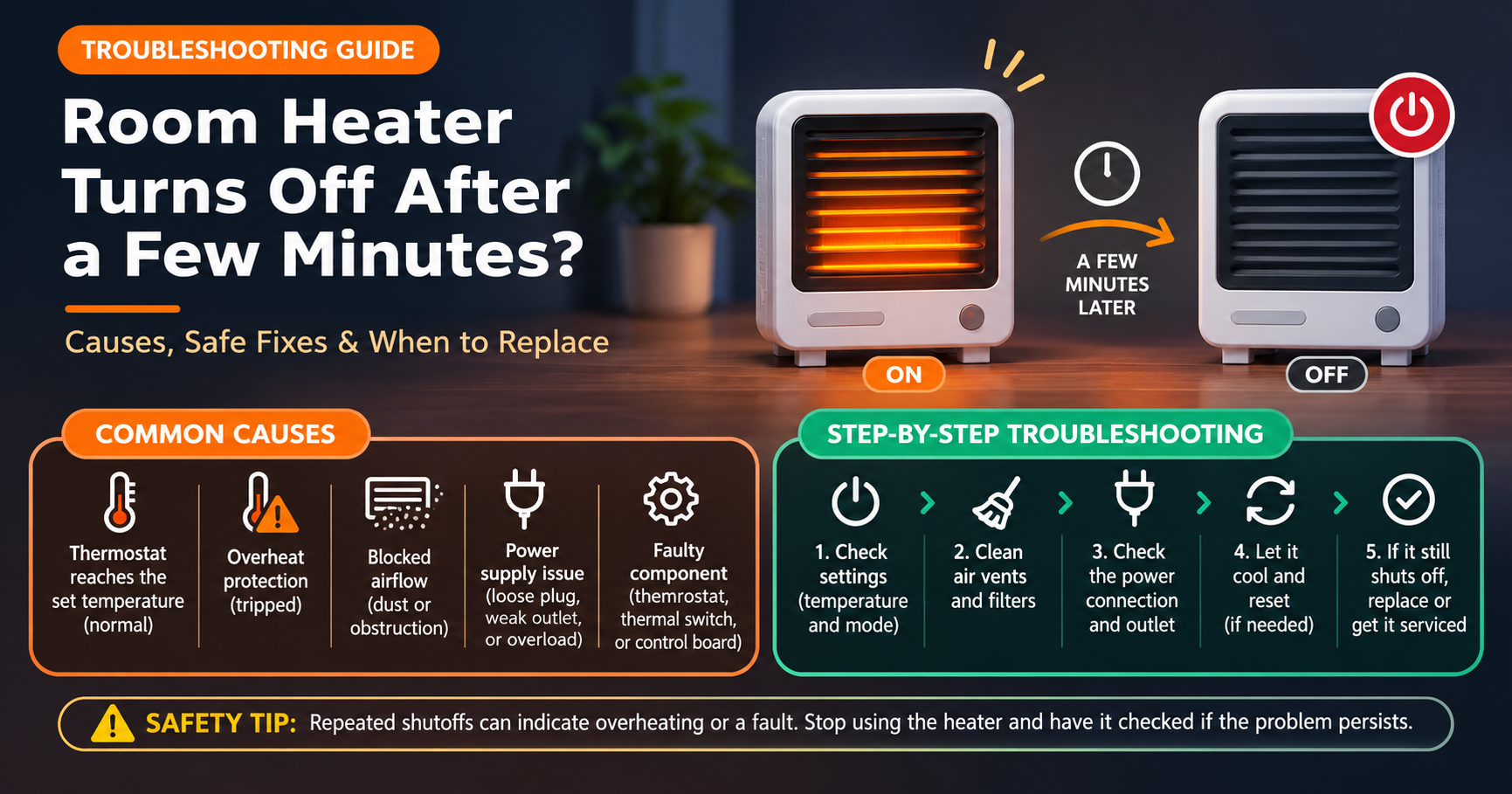
The most common reason is overheating. Dust-clogged vents, blocked airflow or a heater placed too close to furniture make the internal temperature rise, and the overheat protection cuts the power. Other common causes are a tripped tip-over switch, a built-in timer or ECO mode, an overloaded outlet or extension cord, and a faulty thermostat or heating element.
Table of Contents
- How a room heater decides to shut off
- Eight common causes and their fixes
- Quick troubleshooting flowchart
- How to clean your heater safely
- Shut-off behavior by heater type
- Repair or replace?
- Safety rules you should never break
- What to look for in a reliable replacement
- Prevention checklist
- Frequently asked questions
How a Room Heater Decides to Shut Off
Modern heaters are packed with protective components. Their job is to stop the unit before it becomes a fire or burn hazard. Understanding them makes troubleshooting much easier.

- Thermostat: measures room or internal temperature and switches the heating element on and off to hold the temperature you set. Once the room reaches the target, a normal shut-off is expected.
- Overheat protection (thermal cutoff): a sensor or fuse that cuts power if the inside of the heater gets hotter than it should. Some reset automatically after cooling, and some need a manual reset.
- Tip-over switch: a small switch in the base that turns the heater off if it is tilted or knocked over, or if it sits on an uneven surface.
- Timer and ECO functions: programmable features that can end a heating cycle after a set time.
- Power protection: some models shut down when the supply voltage drops or the plug and cord overheat.
Eight Common Causes and Their Fixes

1. Overheat Protection Is Triggered
Why it happens: The heater is running hotter inside than designed, so the thermal cutoff switches it off. This is the number one cause of a heater that runs for a few minutes and stops, then works again after cooling down.
How to fix it: Unplug the heater, let it cool for at least 30 minutes, then check for the causes below: dust, blocked vents, nearby objects, or a fan that is not spinning. Fixing the cause of the overheating is the only real cure.
2. Dust, Lint or Pet Hair in the Filter and Vents
Why it happens: Dust builds up on the air intake, the fan blades and the heating element. It restricts airflow, so heat cannot escape and the internal temperature climbs quickly. Heaters used in homes with pets, carpets or construction dust are especially affected.
How to fix it: Unplug the unit and let it cool. Vacuum the grille and intake with a soft brush attachment, wipe the housing with a dry cloth and clean any removable filter as the manual describes. Repeat every two weeks during heavy use.
3. Blocked Airflow From Poor Placement
Why it happens: Curtains, sofas, bedding or walls close to the heater stop air from flowing in and out. Heat then collects around the unit and the overheat sensor trips.
How to fix it: Keep at least 3 feet (about 1 meter) of clear space around the front and sides, and never place anything on top. Move the heater away from walls and fabric.
4. The Tip-Over Switch Is Activated
Why it happens: If the heater sits on carpet, a slightly slanted floor or a wobbly surface, the base switch may read it as tilted and cut power. Dust or debris under the switch can also make it stick.
How to fix it: Place the heater on a flat, hard, stable surface. Check the base for lint or small objects, and make sure it is not leaning against anything. If it shuts off even on a level floor, the switch may be faulty.
5. Timer, ECO Mode or Low Thermostat Setting
Why it happens: Many heaters have a timer, an auto-off feature or an energy-saving mode that holds the room at a lower temperature. If the room reaches the set temperature quickly, the heater turns off and appears to quit.
How to fix it: Read the display and manual. Cancel the timer, turn off ECO mode and raise the thermostat well above the room temperature to see whether it keeps running.
6. Overloaded Circuit or Extension Cord
Why it happens: Room heaters draw a lot of power, often 1,500 watts. A thin extension cord, a power strip, or a circuit shared with other appliances can overheat or trip, cutting power after a few minutes. A warm plug or cord is a warning sign.
How to fix it: Plug the heater directly into a wall outlet and avoid power strips and cheap extension cords. Turn off other high-power devices on the same circuit. If the breaker keeps tripping, have the outlet and wiring checked.
7. Faulty Thermostat Sensor
Why it happens: If the thermostat reads the wrong temperature, the heater thinks the room is already warm and shuts down early. Sensors can drift or fail with age, dust or heat exposure.
How to fix it: Test the heater in a different room and at the highest setting. If it still shuts down early with a clean unit, the thermostat likely needs professional repair or replacement. Do not bypass it.
8. Worn Heating Element, Thermal Fuse or Fan Failure
Why it happens: Aging components can short-cycle. A failing fan stops moving air, so the unit overheats. A weak thermal fuse can blow at a lower temperature than intended, and a damaged element can create hot spots.
How to fix it: These are internal faults. Unplug the heater and stop using it. Repair by a qualified technician is possible on some models, but for most budget units, replacing the heater costs less than repairing it.
Important
If you notice a burning smell, sparks, visible scorch marks, a melted plug or a crackling sound, unplug the heater immediately and stop using it. These are signs of a serious electrical fault and not something to test or troubleshoot.
Quick Troubleshooting Flowchart
Work through the questions below from top to bottom. Fix one thing at a time and test the heater for 20 to 30 minutes before moving to the next step.

How to Clean Your Heater Safely
Because dust is such a frequent cause, cleaning is the best first step. Follow these steps carefully.
- Unplug the heater and wait until it is completely cool, at least 30 minutes.
- Vacuum the vents and grille with a soft brush attachment, moving gently so you do not bend the fins.
- Wipe the casing with a dry or slightly damp microfiber cloth. Never spray liquid inside the heater.
- Clean or replace the filter if your model has one, following the manufacturer instructions.
- Use compressed air in short bursts to clear dust around the fan and the element opening if you can reach it from outside.
- Dry everything fully before plugging the heater back in, and test it on a flat surface with open space around it.
Do not remove the casing or open the heater unless you are trained to do so. Internal parts can hold heat and carry live wiring.
Shut-Off Behavior by Heater Type
Different heater technologies tend to fail in different ways. This table shows what to expect.
| Heater type | Typical reason it shuts off | What to check first |
|---|---|---|
| Fan heater | Dust on the fan and element, fan failure, overheat cutoff | Clean the intake and listen for the fan running |
| Ceramic heater | Blocked vents, tip-over switch, thermostat cycling | Clear the vents and use a flat surface |
| Oil-filled radiator | Overheat cutoff from covered fins or poor placement, thermostat setting | Keep fins uncovered and raise the thermostat |
| Infrared or radiant heater | Overheat protection from nearby objects, tilt switch | Clear space in front and check the stand |
| Convector heater | Restricted airflow, thermostat setting, overloaded outlet | Clear the top and bottom vents and use a wall outlet |
Repair or Replace?
Many people wonder whether a heater that keeps shutting off is worth fixing. A simple rule of thumb helps.
- Clean the heater and adjust the setup first. This solves most cases at no cost.
- Replace the heater if it is more than eight to ten years old, if a budget model needs an internal part, if the plug or cord is damaged, or if it still shuts off after you have cleaned it and used a proper outlet.
- Repair is reasonable for higher-priced oil-filled or premium models when a qualified technician can replace a specific part such as a thermostat.
Never try to bypass a thermal fuse, thermostat or tip-over switch. These parts exist to prevent fires, and disabling them puts you and your home at risk.
Safety Rules You Should Never Break
- Never leave a heater running while you sleep or when nobody is home unless it is designed for it and has the proper safety features.
- Never dry clothes, towels or shoes on a heater.
- Never use a heater in a bathroom or damp area unless it is specifically rated for it.
- Never use damaged cords, loose plugs or wall outlets that feel hot.
- Keep children, pets and flammable items well away from the unit.
- Test smoke and carbon monoxide alarms regularly, especially when using any fuel-based heating.
What to Look for in a Reliable Replacement
If your heater has reached the end of its life, choose a replacement with the right features so you avoid the same problem again.
| Feature | Why it matters |
|---|---|
| Overheat protection with auto shut-off | Cuts power safely if the unit gets too hot |
| Tip-over protection | Stops heating if the heater falls or tilts |
| Adjustable thermostat | Keeps the room comfortable and avoids constant overheating |
| Correct wattage for the room | A common guideline is about 10 watts per square foot, so a 1,500-watt heater suits roughly 150 square feet |
| Cool-touch housing | Reduces burn risk, especially around children and pets |
| Easy-to-clean filter and vents | Makes regular maintenance simple so dust does not cause shut-offs |
| Recognized safety certification | Shows the unit has passed independent safety testing |
| Clear timer and ECO controls | Lets you see and control automatic shut-off settings |
A heater that is too small for the room runs constantly and can overheat, while one that is too large may cycle on and off. Matching the heater to your room size gives the best balance of comfort, safety and energy use.
Prevention Checklist

Frequently Asked Questions
Why does my room heater turn off by itself after 5 to 10 minutes?
The most likely cause is overheating from dust or blocked airflow. Other common reasons are a tip-over switch, a timer or ECO mode, an overloaded outlet, or a faulty thermostat.
Is it dangerous if my heater keeps shutting off?
The shut-off itself is a safety feature, so it is usually protecting you. The danger comes from ignoring it, bypassing safety parts, or continuing to use a heater that smells of burning or has a damaged cord.
Can I reset an overheat protection switch?
Some heaters reset automatically after cooling. Others have a manual reset button, so check the manual. If the heater trips again quickly after resetting, find and fix the cause before using it.
Why does my heater work for a while and then stop, but works again later?
That pattern is typical of overheat protection. The unit shuts off when hot and restarts when it cools. Cleaning the vents and improving airflow normally solves it.
Can an extension cord make a heater turn off?
Yes. Thin or long cords can overheat and cause voltage drop, which may trigger a shut-off or even a fire. Plug the heater straight into a wall outlet.
How long does a room heater usually last?
Most last around eight to ten years with regular cleaning and normal use. Heavy use, dust and poor placement can shorten this.
Should I fix or replace a cheap heater?
For low-cost models, replacement is usually the safer and more economical choice, because repair costs can be close to the price of a new unit.
Final Thoughts
A room heater that turns off after a few minutes is giving you an important message. In most homes the cause is simple and fixable: a dusty vent, a blocked grille, an uneven floor, an overloaded outlet or a timer setting. Start with cleaning and placement, test the heater on a proper wall outlet, and check its settings. If it still shuts down on a clean, correct setup, stop using it and choose a repair by a qualified technician or a safe replacement. Staying warm is important, but staying safe matters more.
This article is for general information only. If you are unsure about your heater or your home wiring, consult a qualified electrician or the heater manufacturer.