
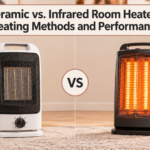




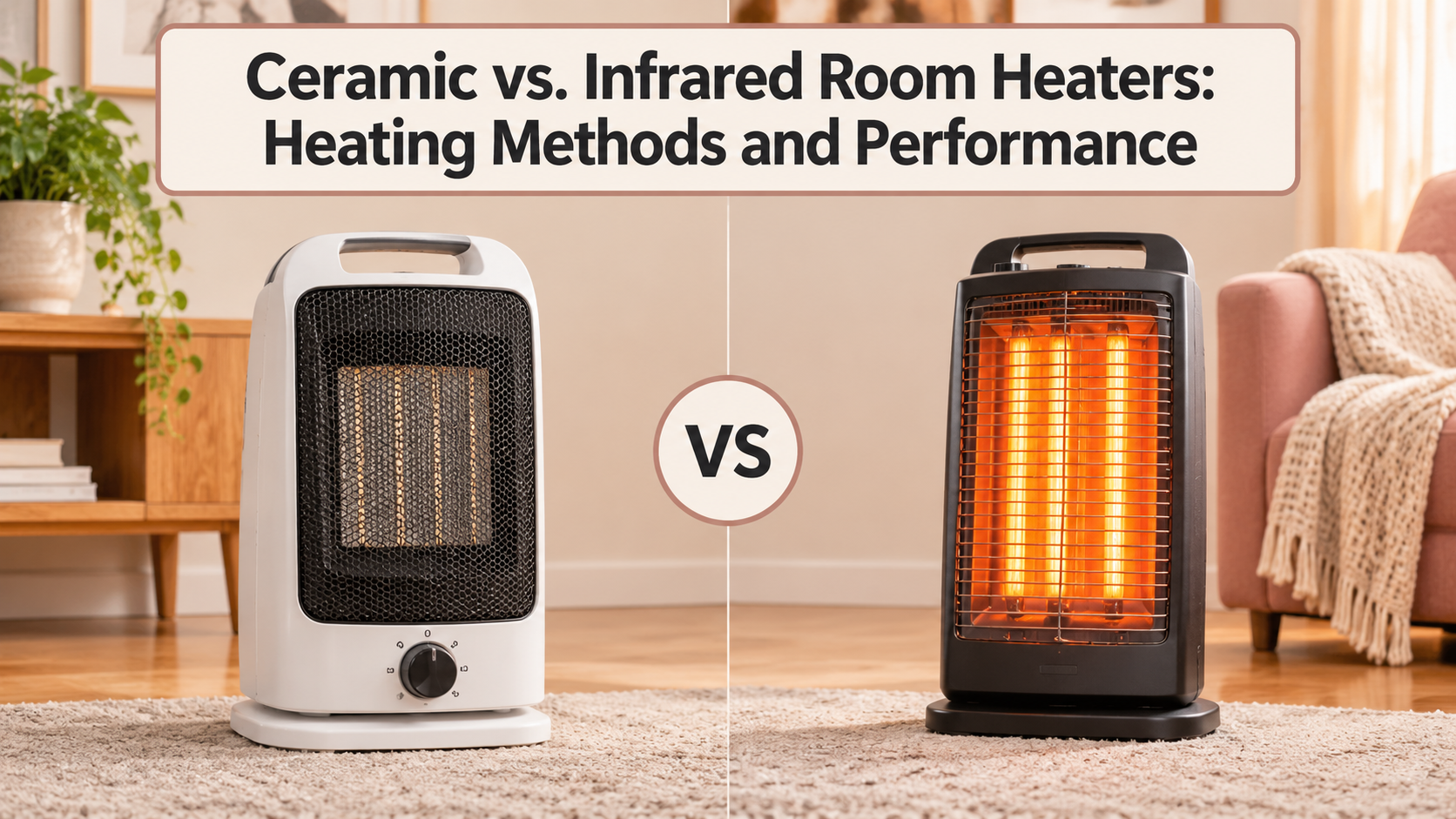
Winter is not the time to guess. Pick the wrong heater and you end up with cold toes, a loud fan, or an electricity bill that makes you wince. The two most popular choices for small spaces are the ceramic heater and the infrared heater, and they look similar enough on a store shelf that many people assume they work the same way. They do not.
This guide explains how each type works, where each one shines, what it really costs to run, and how to match the right heater to your room. By the end you will know exactly which one to buy, and which common marketing claims to ignore.
Quick answer
Choose a ceramic heater if you want to warm the air in a small, closed room such as a bedroom or a home office, and you like having a thermostat, a timer, and a fan.
Choose an infrared heater if you want quiet, instant warmth aimed at you or a small area, or if your space is drafty, open, or hard to heat evenly.
What Is a Ceramic Heater?
A ceramic heater uses a heating element made of ceramic plates or stones, most often a type called PTC (positive temperature coefficient). When electricity passes through the ceramic, it heats up quickly. A built-in fan then pushes room air across the hot plates and blows the warmed air back into the room. This process is called convection heating.
Because the ceramic element limits its own temperature as it warms, PTC designs are known for being a fairly safe and stable way to produce heat. Most models come in a tower or compact box shape and include features like oscillation, adjustable thermostats, and digital displays.
Ceramic heater pros and cons
Pros
- Warms a small closed room evenly
- Thermostat, timer, and remote on many models
- Usually affordable
- Housing often stays cooler than exposed glowing elements
- Compact and easy to move between rooms
Cons
- The fan makes noise
- Warmth fades quickly in drafty or open spaces
- Fan can stir up dust
- Takes a little time to heat the air in a room
What Is an Infrared Heater?
An infrared heater produces radiant heat. Instead of heating the air, it sends out infrared waves that travel in a straight line and warm whatever they hit: your skin, your clothes, the furniture, and the floor. This is the same way the sun warms your face on a cold, still day, even when the air itself is chilly.
You will see several designs on the market. Quartz and halogen tubes glow orange and warm up almost instantly. Carbon heaters work in a similar way with a softer glow. Panel heaters, sometimes sold as far infrared, have a flat surface that gives off gentler radiant warmth, and they are popular for wall mounting and under desks.
Infrared heater pros and cons
Pros
- You feel warm within seconds
- Nearly silent because most have no fan
- Works well in drafty rooms, garages, and patios
- Does not blow dust around
- Great for one person at a desk or sofa
Cons
- Only warms what is in its line of sight
- Not ideal for heating a whole room evenly
- Exposed glowing tubes get very hot
- Warmth stops the moment you move out of the beam
The Core Difference in One Picture
The easiest way to understand the choice is to ask a single question: do you want to warm the air, or warm yourself? Ceramic heaters warm the air and let it spread. Infrared heaters skip the air and warm you directly.
Ceramic vs Infrared Heater: Side-by-Side Comparison
| Feature | Ceramic Heater | Infrared Heater |
|---|---|---|
| Heating method | Convection (warms air) | Radiant (warms people and objects) |
| Time to feel warm | A few minutes | Almost immediately |
| Best coverage | Whole small room | One person or one zone |
| Noise | Fan hum | Silent or near silent |
| Drafty spaces | Struggles | Performs better |
| Dust circulation | Fan can stir dust | Minimal |
| Typical features | Thermostat, oscillation, timer, remote | Thermostat, timer, wall or stand mounting |
| Typical price | Low to mid | Low to high, depending on type |
Heating Speed and Room Coverage
Infrared wins on how quickly you feel warm. Because the waves heat your body directly, relief starts the moment you switch it on. A ceramic heater needs a few minutes to heat the plates and push warmed air around, so the room feels comfortable a little later.
Coverage tells the opposite story. A ceramic heater spreads heat through the air, so it can raise the temperature of an entire small room. An infrared heater only warms what it can “see,” so the area behind furniture or outside the beam stays cool. For a rough sizing rule, plan on about 10 watts per square foot of floor area. A 1500 watt heater therefore suits a room of around 150 square feet, such as a small bedroom or study. Rooms with high ceilings, poor insulation, or large windows need more help than that rule suggests.
Running Cost and Energy Efficiency
Here is the part most product pages skip. Nearly every electric heater converts almost all of the electricity it uses into heat. A 1500 watt ceramic heater and a 1500 watt infrared heater use the same amount of electricity. Claims that one type is “70% cheaper to run” should be treated with caution.
What differs is how useful that heat is. If you are sitting at a desk, an infrared heater can keep you comfortable at a lower wattage, because it heats you instead of the whole room. If you want a bedroom to reach a steady temperature, a ceramic heater with a thermostat that cycles off once the room is warm may use less energy overall.
To estimate your own cost, multiply the heater’s kilowatts by the hours used and by your electricity price. The table below uses an example rate of $0.15 per kWh. Replace it with the rate on your own bill.
| Heater power | 1 hour | 4 hours | 8 hours |
|---|---|---|---|
| 750 W | $0.11 | $0.45 | $0.90 |
| 1000 W | $0.15 | $0.60 | $1.20 |
| 1500 W | $0.23 | $0.90 | $1.80 |
Money-saving tip: Heat the person, not the house. Use a heater in the room you are actually in, keep the door closed, and turn the central heating down a few degrees. A well-chosen portable heater can cut waste when used this way.
Safety: Which Heater Is Safer?
Both types can be used safely when they have the right protections and are placed sensibly. Neither is automatically safer, but their risks are a little different.
- Ceramic heaters: The PTC element helps limit its own temperature, and many models have a cooler outer housing. The main hazards are tipping, blocked vents, and overheated cords.
- Infrared heaters: Quartz and halogen models have glowing elements and hot guards, so keep them away from curtains, bedding, and children. Panel styles run gentler but can still get hot to the touch.
Whichever you pick, look for these features and habits:
- Automatic tip-over shutoff
- Overheat protection that cuts power if temperatures climb too high
- A recognized safety certification mark for your country
- Plug straight into a wall outlet, never into a thin extension cord or a power strip
- Keep at least 3 feet (about 1 meter) of clear space around the front and sides
- Never leave a heater running while you sleep or after you leave home, unless the manual allows it and a timer is set
Noise, Air Quality, and Comfort
Noise is where infrared pulls ahead for light sleepers and home workers. Most infrared heaters have no fan at all, so you may only hear a faint click when the thermostat switches. A ceramic heater has a constant fan hum, which some people find soothing and others find irritating during calls or at night.
Air quality matters for people with allergies or asthma. A fan-driven heater moves air, and with it settled dust and pet hair. Infrared heaters do not circulate air, so they tend to be gentler in that regard. It is a myth that either type “burns oxygen” in a healthy, normally ventilated home. Neither uses combustion, so both are fine to run in a room with normal airflow.
On comfort, many people describe infrared warmth as softer and more natural, like sitting in sunshine. Ceramic warmth feels more like a warm room, which is better when you are moving around, getting dressed, or lounging on the other side of the space.
Durability and Maintenance
Ceramic heaters have a fan, which is the part most likely to wear out or collect dust. Clean the grille and intake with a soft brush or a vacuum on the lowest setting, with the unit unplugged and cool. Infrared heaters have fewer moving parts, so there is less to maintain, though quartz tubes are fragile and can fail if the unit is dropped or bumped. Wipe panels with a dry or slightly damp cloth once they are cold.
Which Heater Is Best for Each Room?
- Bedroom: Ceramic with a thermostat, timer, and low-noise mode. Warm the room before bed, then switch it off.
- Home office or desk: Infrared panel under the desk or a small radiant unit aimed at your legs. It is quiet during calls and warms you straight away.
- Living room: Ceramic for evenly warmed air, or infrared if you mostly sit in one chair.
- Bathroom: Only use a heater that is clearly rated for bathroom use, and mount or place it according to the manual.
- Garage or workshop: Infrared, because drafts and open doors make air heating ineffective.
- Patio or covered outdoor area: Infrared models made for outdoor use. Standard ceramic room heaters are not designed for it.
- Baby or kids’ room: Choose a model with a cool-touch exterior and keep it well out of reach, or consider a different heating method for safety.
What to Look for Before You Buy
1. Wattage that fits your room
Most portable heaters top out at 1500 watts because that is about the limit of a standard household circuit in many homes. Match power to room size using the 10 watts per square foot guide. Models with adjustable settings, such as 750 and 1500 watts, give you flexibility.
2. An adjustable thermostat
A thermostat holds a steady temperature and stops the heater from running flat out. This is the single most useful feature for controlling both comfort and cost.
3. Safety protections
Tip-over switch, overheat protection, and a certified power cord are non-negotiable. A cool-touch housing is a bonus if you have kids or pets.
4. A timer and a remote
A timer prevents the heater from being left on by accident. A remote is handy if the heater sits across the room and you are already tucked in.
5. Size, weight, and mounting
Check where the heater will sit. Tower ceramic units are stable and slim. Infrared panels can mount on a wall or stand under a desk and save floor space.
6. Warranty and customer reviews
A one to two year warranty is a good sign. Read recent reviews for reports of rattling fans, burning smells, or controls that stop working, since those problems often appear after a few weeks of use.
Common Mistakes to Avoid
- Buying infrared to heat a large open living space and expecting the whole room to warm up
- Buying a ceramic heater for a drafty garage and wondering why it never feels warm
- Believing claims that one type uses far less electricity at the same wattage
- Using an extension cord, a power strip, or a worn plug
- Placing a heater too close to curtains, bedding, or furniture
- Skipping the thermostat and letting the heater run all night
Frequently Asked Questions
Is a ceramic or infrared heater cheaper to run?
At the same wattage they use the same electricity. The cheaper option is the one that matches your situation: infrared for warming yourself in one spot, ceramic with a thermostat for warming a small closed room.
Which heater is better for a bedroom?
A ceramic heater with a thermostat and timer is usually the better fit, because it warms the whole room and shuts off automatically. If fan noise bothers you, a quiet infrared panel pointed at the bed area is a good alternative, used with care and a timer.
Can I leave a room heater on overnight?
It is best not to. Many manufacturers advise against unattended use. If you use one at night, choose a model with tip-over and overheat protection, keep the area clear, and follow the manual.
Does an infrared heater dry out the air?
Both types can make a room feel drier as the temperature rises, because warm air holds more moisture. Infrared heaters do not blow air around, so many people find them less drying on the skin and eyes.
Are ceramic heaters safe for kids and pets?
They can be safer than glowing-element heaters because the housing is often cooler, but no heater is risk free. Choose a cool-touch model, use a tip-over switch, and keep it out of reach.
Can a room heater replace central heating?
Not for a whole home. Portable heaters are designed for supplemental, zone heating. Used in the room you occupy, they let you lower the central thermostat and may reduce overall waste.
Final Verdict: Ceramic or Infrared?
There is no single winner, because the two heaters solve different problems. A ceramic heater is the practical pick for warming a small, closed room evenly, with a thermostat and timer to keep things tidy. An infrared heater is the better choice when you want fast, silent warmth aimed at yourself, or when drafts and open space make heating the air pointless.
Start by asking where you will use it and whether you want to warm a room or a person. Then pick the right wattage, insist on solid safety features, and use the thermostat and timer. Do that, and either type will keep you comfortable all winter without any nasty surprises on your bill.
Disclosure: This article is for general information. Always read the manufacturer’s instructions and safety warnings for the exact heater you buy.