
Room Heater Plug Getting Hot? Causes, Warning Signs and What to Do Right Now
You switch on your room heater on a cold evening, and a little later you notice the plug is hot. Maybe it feels uncomfortably warm, maybe there is a faint plastic smell, maybe the socket has started to look a shade darker than it did last week. It is natural to wonder whether this is just how heaters behave or whether something is wrong.
The honest answer is that a heater plug can be slightly warm and still be fine, but a plug that is genuinely hot is telling you there is a problem. Room heaters are among the highest-power appliances in a home, and the plug and socket carry all of that current. When the connection is poor, the cord is too thin, or the circuit is overloaded, the extra energy turns into heat right where the plug meets the wall. That heat is a well-known cause of melted plugs and electrical fires.
This guide explains how to tell normal warmth from dangerous heat, the most common reasons a room heater plug overheats, the exact steps to take when it happens, and how to prevent it from happening again.
Key takeaways
- A slightly warm plug can be normal under heavy load. A plug that is hot to hold, discoloured, smelly or buzzing is not.
- The most common causes are loose or worn socket contacts, extension cords, overloaded circuits and damaged plugs or cords.
- Switch off, disconnect safely, let everything cool, and inspect before using the heater again.
- Never plug a heater into an extension cord or power strip, and never tape over a damaged cord.
- If a socket is scorched or the problem returns, call a licensed electrician.
Is it normal for a room heater plug to get warm?
Electric current always produces some heat as it passes through metal. A room heater typically draws a lot of current for hours at a time, so a plug that feels mildly warm after a long run is not unusual. The key question is how warm, and whether it is getting worse.
A simple touch test helps. After the heater has been running for a while, carefully rest your fingers on the plug body (not the metal prongs). If it feels slightly warm and you can keep your fingers there comfortably, that is generally acceptable. If it is uncomfortable to hold for more than a few seconds, or it feels hotter each time you check, treat it as a fault. Anything that is too hot to touch, or that shows any physical change, needs immediate action.
Important
The touch test is only a rough guide. Heat inside a worn socket can build up where you cannot feel it. If you notice a burning smell, browning, melting, crackling or sparks, skip the testing and act immediately.
Why does a room heater plug get hot?
Heat at the plug almost always comes from resistance: a point where the electrical path is restricted, so energy that should flow to the heater is lost as heat. Here are the most common reasons.
1. Loose or worn socket contacts
Inside every wall socket are small metal contacts that grip the plug prongs. Over years of plugging and unplugging, those contacts lose their springiness. A plug that feels loose, wobbles, or falls partly out is a strong clue. Poor contact shrinks the area through which current flows, and the tiny contact points heat up.
2. A plug that is not fully inserted, or bent prongs
If the plug is only partly pushed in, or the prongs have been bent by pulling on the cord, the contact is poor even if the socket is healthy. Always push the plug in fully and pull it out by the body of the plug, never by the cord.
3. Extension cords and power strips
This is one of the biggest causes. Most extension cords and multi-way strips are designed for lamps, chargers and electronics, not for a heater that draws several amps continuously. Every extra plug, socket and length of thin cable adds resistance and another place for heat to build. Even a cord that is marked for high loads adds extra connections that can loosen over time.
4. An overloaded circuit
If the heater shares a circuit with other high-power devices such as a kettle, iron, air conditioner or another heater, the combined current can exceed what the wiring and socket were designed for. Warm plugs, flickering lights or a breaker that trips repeatedly all point toward overload.
5. An undersized or damaged cord
A heater cord that is too thin for the wattage, kinked, crushed under furniture or frayed will heat up along its length as well as at the plug. If the cord feels warm in places other than the plug, that is a serious warning.
6. Dirty, corroded or oxidised prongs
Dust, moisture and oxidation can coat the prongs and socket contacts, increasing resistance. Dark or dull patches on the prongs, or green or black residue, are signs of this. Do not scrape live contacts. Unplug first and replace damaged parts.
7. A poor-quality plug or socket
Cheap plugs with thin pins, weak springs, or plastic that softens at low temperature are more likely to overheat under a heater’s constant load. Sockets and plugs that carry recognised safety certification marks, and are rated above the heater’s current, are safer.
8. A faulty heater or loose wiring behind the socket
Sometimes the heater itself is drawing more current than it should because of an internal fault. In other cases the screws holding the wires behind the wall socket have worked loose. Both need a professional to diagnose. If every plug you connect to that socket gets warm, the problem is likely behind the wall.
Understanding how much current your heater draws
Knowing how much current a heater pulls helps you judge whether your socket, cord and circuit can handle it. You can calculate it with one simple formula: amps equal watts divided by volts. The wattage is printed on the heater’s rating label.
| Heater power | Current at 120 V | Current at 230 V |
|---|---|---|
| 500 W | about 4.2 A | about 2.2 A |
| 1000 W | about 8.3 A | about 4.3 A |
| 1500 W | 12.5 A | about 6.5 A |
| 2000 W | about 16.7 A | about 8.7 A |
| 2500 W | about 20.8 A | about 10.9 A |
As a general rule, a heater should be treated as a continuous load. Safety guidance in many regions suggests that continuous loads should stay at around 80 percent of a circuit’s rating. On a 15 amp circuit that is about 12 amps, which is why 1500 W is the usual upper limit for portable heaters on 120 V supplies. A 1500 W heater is already right at the edge, so adding anything else to that circuit invites trouble. Always check the ratings on your own plug, socket and breaker, as these vary by country.
Warning signs that mean stop immediately
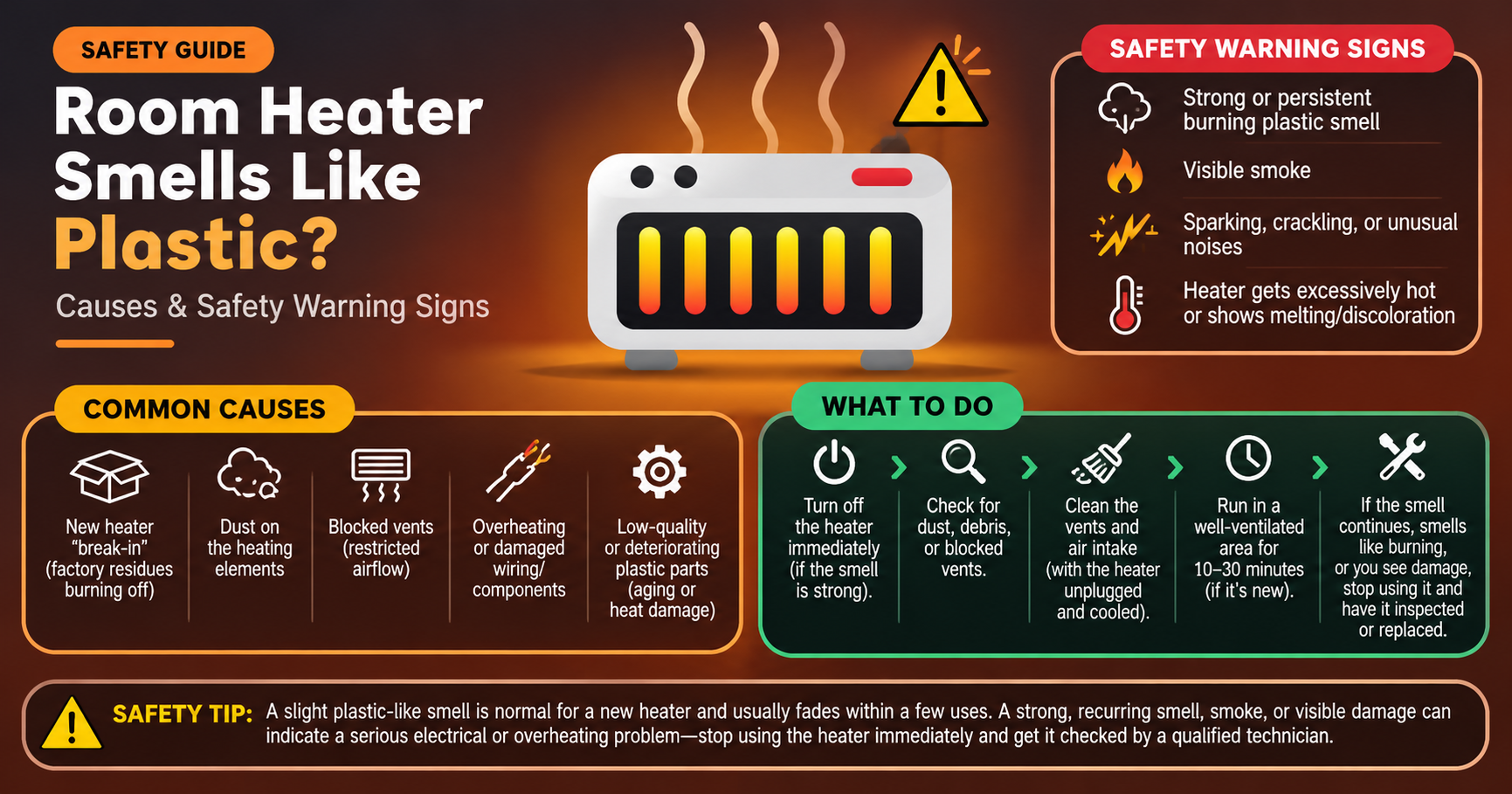
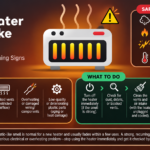
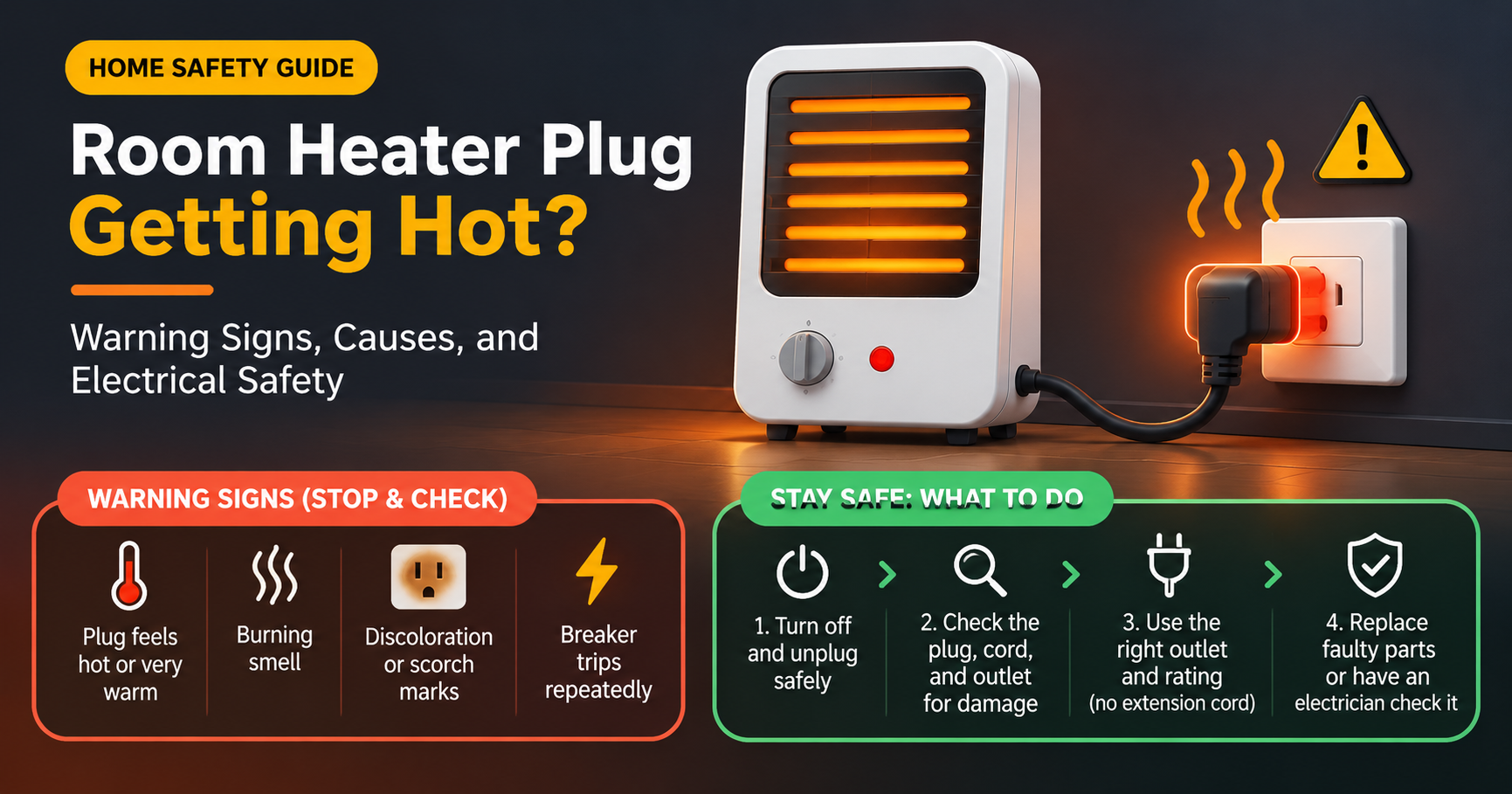
If you see any of the following, switch the heater off and disconnect it. Do not keep using it just because it still seems to work.
- A burning, hot plastic or fishy smell near the plug or socket
- Brown, yellow or black discolouration on the plug or wall plate
- Melted, warped or softened plastic
- Buzzing, crackling, hissing or popping sounds
- Visible sparks or a flash when plugging in
- A plug that is loose, wobbly or will not stay in the socket
- Lights that flicker or dim when the heater switches on
- A circuit breaker or fuse that trips repeatedly
- A cord that is hot, stiff, cracked or frayed
What to do right now if the plug is hot
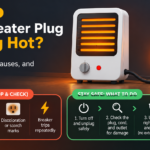
Start by turning the heater off with its own switch. Then disconnect it. If the plug is only warm or hot, grip the plug body with a dry hand and pull it straight out. If there is smoke, melting or a strong burning smell, do not touch it. Go to your main breaker or fuse box and cut power to that circuit first, then deal with the plug once it has cooled.
Give everything at least 30 minutes to cool. Move curtains, bedding, paper and anything else flammable away from the area. Once it has cooled, inspect it carefully, and do not plug the heater back in until you know what went wrong.
Safe visual inspection checklist
- Plug: any browning, melted spots, cracked casing or bent or blackened prongs?
- Cord: any cuts, crushed sections, exposed wire or sections that felt hot?
- Socket: any scorch marks, cracks, looseness, or a plug that no longer grips?
- Test the plug in a different socket on a different circuit only if both the plug and cord look completely undamaged, and monitor it closely.
Only do visual checks. Never open a wall socket, remove a faceplate or touch internal wiring unless you are qualified. Mains electricity is dangerous.
How to fix a hot heater plug
The right fix depends on what you found.
- Damaged plug or cord: have the plug or cord replaced by a qualified repairer, or replace the heater. Do not tape over damage.
- Worn or scorched socket: have an electrician replace the socket. A scorched socket may also mean the wiring behind it is damaged.
- Extension cord or power strip: remove it and plug the heater directly into a wall socket.
- Shared circuit: move other high-power appliances to a different circuit, or ask an electrician about a dedicated circuit for the heater.
- Heater drawing too much current: stop using it and have it checked or replaced.
Why extension cords and power strips are such a bad idea for heaters
Many people reach for an extension cord because the nearest socket is across the room. With a heater, this is one of the riskiest habits you can have. Extension cords add resistance and extra connection points, and coiled cords trap heat. Power strips often have internal breakers or thin internal wiring rated far below a heater’s needs.
The best solution is to place the heater near a wall socket. If it is genuinely unavoidable for a short time, use only a short, fully uncoiled, heavy-duty cord that is clearly rated for more current than your heater draws, and check it frequently. Treat that as a temporary workaround, not a habit.
Choosing a safer room heater
If your current heater keeps overheating its plug, or it is old, it may be time to replace it. When comparing models, look for features that reduce risk and make the heater easier on your electrical system.
- Adjustable thermostat: cycles the heater on and off so it does not draw full current constantly.
- Overheat protection: automatically cuts power if internal temperature gets too high.
- Tip-over switch: turns the heater off if it is knocked over.
- Thick, well-made cord and sturdy plug: look for a firm plug with solid pins and a cord that feels substantial, not thin and flimsy.
- Safety certification marks: look for recognised marks for your region on the product and packaging.
- Sensible wattage: a smaller, lower-wattage heater that suits the room is easier on your wiring than a large unit running flat out.
- Timer and cool-touch housing: useful extras for safer everyday use.
Different heater types suit different rooms. Ceramic fan heaters warm small spaces quickly, oil-filled radiators provide steady, quiet heat for longer periods, and radiant heaters warm people and objects directly. Whatever the type, make sure its power rating matches the socket and circuit you plan to use.
Everyday habits that prevent overheating
- Plug the heater directly into a wall socket and push the plug in fully.
- Do not share that socket or circuit with other high-power appliances.
- Keep the heater at least 3 feet (1 metre) away from curtains, bedding, furniture and clothes.
- Never cover the heater or use it to dry laundry.
- Check the plug temperature regularly during the first few uses of a new season.
- Turn the heater off when you leave the room or go to sleep, unless it is designed and approved for unattended use.
- Test smoke alarms regularly, and consider a carbon monoxide alarm if you use any fuel-burning appliance in the home.
When to call an electrician
Call a licensed electrician if:
- The socket is scorched, cracked or discoloured
- Different plugs get hot when used in the same socket
- The breaker trips repeatedly when the heater is on
- Lights flicker whenever the heater starts
- The wiring in your home is old, or you are not sure what the circuit can handle
- You have replaced the plug or cord and the problem keeps coming back
It is far cheaper to replace a socket or upgrade a circuit than to deal with the aftermath of an electrical fire.
Frequently asked questions
Is it normal for a heater plug to be warm?
A mildly warm plug can be normal because heaters draw a lot of current. If it is too hot to hold comfortably, keeps getting hotter, or shows discolouration, it is not normal.
Can a hot plug cause a fire?
Yes. Sustained heat can melt plastic and ignite nearby materials. Electrical faults, including overheating plugs and sockets, are a recognised cause of house fires.
Why does the plug get hot but the heater works fine?
The heater may work normally while the connection at the plug or socket is poor. Heat is generated at the weak point, not necessarily inside the appliance.
Can I use a heater with a power strip if it has a surge protector?
No. Surge protection does not protect against overheating from heavy continuous loads. Plug heaters straight into a wall socket.
Should I keep using the heater if the plug is only a little hot?
No. Switch it off, let it cool, and find the cause first. A small fault tends to get worse with continued use.
Can I fix the plug myself?
Replacing a plug or socket involves mains wiring and should be done by a qualified person. Simple things like pushing the plug in fully and removing an extension cord are safe to do yourself.
Final thoughts
A room heater plug getting hot is one of those problems that is easy to dismiss and very costly to ignore. Most of the time the cause is simple: a worn socket, an extension cord, an overloaded circuit or a damaged plug. The sooner you identify it, the easier and cheaper it is to fix.
Trust your senses. If a plug is too hot to hold, smells of burning, or looks discoloured, switch off, disconnect safely, let it cool and find the cause before using the heater again. Choose a well-made heater with proper safety features, plug it directly into a healthy wall socket, and keep an eye on it. A few minutes of care can protect your home and your family through the whole winter.
This article is for general information only and is not a substitute for advice from a licensed electrician. Electrical codes and ratings vary by country, so always follow local regulations and the instructions supplied with your heater.