


Room Heater Tripping Circuit Breaker? 9 Causes, Safe Fixes and Prevention Tips

You switch on your room heater on a cold evening, and a few minutes later, click – the power goes out. You walk to the electrical panel, flip the breaker back on, and the same thing happens again. If your room heater keeps tripping the circuit breaker, you are not alone. It is one of the most common winter electrical problems in homes and apartments.
The good news is that a tripping breaker is not your enemy. It is a safety device doing exactly what it was designed to do: cutting off power before wires overheat and cause damage or a fire. The important thing is to understand why it is tripping so you can fix the cause safely rather than simply resetting it again and again.
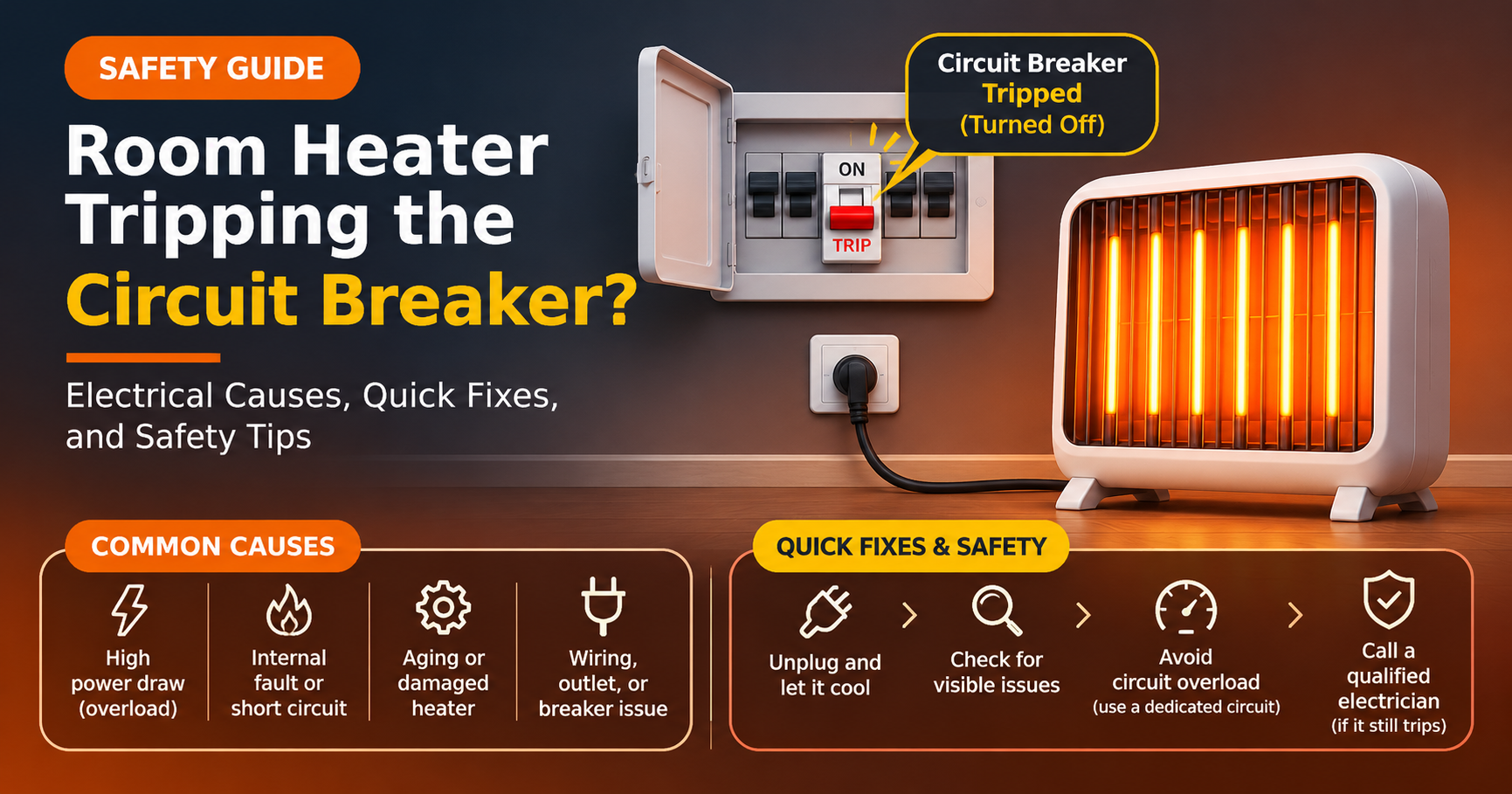
In this complete guide, you will learn how circuit breakers work, the nine most common reasons a heater trips a breaker, a simple amp-calculation method, a step-by-step troubleshooting routine, and the warning signs that mean it is time to call a licensed electrician.
Quick Answer
A room heater usually trips a breaker because it draws more current than the circuit can safely carry – most often when the heater shares a circuit with other devices, is plugged into a thin extension cord, or has a faulty heating element, plug or outlet. Unplug the heater, reset the breaker, then test the heater alone on a different circuit. If it still trips, stop using it and have it or the wiring inspected.
Table of Contents
- Why Circuit Breakers Trip in the First Place
- Understanding Heater Wattage and Amps
- The 9 Most Common Causes
- Step-by-Step Troubleshooting
- Do and Don’t When Using a Room Heater
- How to Prevent Your Heater From Tripping the Breaker
- What to Look for in a Safer Room Heater
- When to Call an Electrician
- Frequently Asked Questions
- Final Thoughts
1. Why Circuit Breakers Trip in the First Place
A circuit breaker is a switch that automatically opens when something goes wrong in an electrical circuit. Every wire in your walls can only carry a certain amount of current safely. If more current flows than the wire can handle, the wire heats up. Left unchecked, that heat can melt insulation and start a fire. The breaker is the safeguard that prevents this.
Breakers trip for three main reasons:
- Overload: too many devices, or one very powerful device, drawing more current than the circuit is rated for. This is the number one reason heaters cause trips.
- Short circuit: a hot wire touches a neutral wire, causing a sudden surge of current. This trips the breaker instantly.
- Ground fault or leakage: current escapes to the ground or through water or a person. Special protective devices (GFCI, RCD or RCCB, depending on your country) detect this.
Room heaters are among the highest-wattage appliances people plug into ordinary wall outlets, which is why they are such frequent trip culprits.
2. Understanding Heater Wattage and Amps
To know whether your heater is too much for a circuit, you need one simple formula:
Amps = Watts ÷ Volts
The wattage is printed on a label on the back or bottom of your heater. The voltage depends on where you live – typically 120 V in North America and about 220–240 V in many other countries, including most of Asia and Europe.
| Heater Power | Amps at 120 V | Amps at 230 V |
|---|---|---|
| 750 W (small personal heater) | 6.3 A | 3.3 A |
| 1000 W (oil-filled / mini ceramic) | 8.3 A | 4.3 A |
| 1500 W (standard room heater) | 12.5 A | 6.5 A |
| 2000 W (large fan heater) | 16.7 A | 8.7 A |
A common rule is that a circuit should carry no more than 80% of the breaker rating for continuous loads (anything running three hours or longer, like a heater). On a 15-amp breaker, that means about 12 amps of continuous load. A 1500-watt heater at 120 V already uses 12.5 amps by itself, so adding anything else on the same circuit pushes it past the limit. The chart below shows a typical example.

Remember that other circuits in your home may share the same breaker. A bedroom circuit might also feed hallway lights and several outlets in the next room, so your heater is competing with devices you cannot even see.
3. The 9 Most Common Causes of a Heater Tripping the Breaker
Cause 1: Circuit Overload
This is the most frequent cause. The heater alone may be close to the circuit’s limit, and anything else running – a TV, a charger, a fan, a vacuum – tips it over. Overload trips are usually delayed: the heater may run for a few minutes or even an hour before the breaker trips, because the breaker’s thermal element heats up gradually.
Cause 2: Sharing the Circuit With Other High-Power Appliances
Kettles, microwaves, hair dryers, irons, air conditioners and toasters all draw large amounts of power. If any of them are on the same circuit as your heater, a trip is almost guaranteed. Heaters should ideally have the outlet, and preferably the entire circuit, to themselves.
Cause 3: Using an Extension Cord or Power Strip
Most standard extension cords and multi-plug strips are not built for the continuous high current a heater draws. A thin cord overheats, the plug warms, and resistance rises. This can trip the breaker or, worse, melt the cord. Heater manufacturers consistently recommend plugging directly into a wall outlet.
Cause 4: A Faulty or Failing Heating Element
Heating elements age. Cracks, corrosion or insulation breakdown can cause leakage current or an internal short. If the heater trips the breaker immediately every time you switch it on – even on its own circuit – the element or internal wiring is a likely suspect.
Cause 5: Damaged, Loose or Overheated Plug and Outlet
A loose plug creates a poor connection that generates heat and arcing. Look for discoloration, a burning smell, a plug that feels hot, or an outlet that is loose in the wall. Worn outlets are a significant fire risk and a common hidden cause of trips.
Cause 6: Ground Fault or Leakage Protection Tripping
If the heater is on a circuit protected by a GFCI, RCD or RCCB, tiny leakage currents can trip it. Moisture inside the heater, dust buildup, a damaged cord or a failing element can all cause leakage. This is common with heaters used in bathrooms, basements or humid rooms.
Cause 7: Dust, Debris and Moisture Inside the Heater
Heaters that have been stored for months often collect dust. When switched on, dust can burn off, create small shorts or cause overheating. Moisture from humid storage can also create leakage that triggers protective devices. A clean, dry heater is a safer heater.
Cause 8: A Worn-Out or Weak Circuit Breaker
Breakers do not last forever. Repeated tripping, age and heat can weaken them so they trip below their rated current. If other high-wattage appliances also trip the same breaker even when the heater is not involved, the breaker itself may need replacement – a job strictly for a licensed electrician.
Cause 9: Wiring Problems in the Home
Old, undersized, loose or damaged wiring can cause trips and, more seriously, hidden hazards. Warm wall plates, flickering lights, buzzing sounds and frequent trips across several appliances all point toward wiring problems that need professional attention.
4. Step-by-Step Troubleshooting
Follow this routine to narrow down the cause. Always keep safety first: never touch exposed wires, and never work inside the electrical panel yourself.

- Unplug the heater and reset the breaker. Switch the breaker fully to OFF and then back to ON. If it will not stay on even with nothing plugged in, the problem is in the circuit, not the heater.
- Remove everything else from the circuit. Unplug other devices in that room and any nearby rooms that may share the breaker.
- Plug the heater in directly, on its lowest setting. Do not use an extension cord. If it runs fine, increase the setting gradually. If it trips only at high power, the load is too high for that circuit.
- Try a different circuit. Move the heater to an outlet on another breaker. If it works there, the first circuit is overloaded, weak or faulty.
- Inspect the plug, cord and outlet. Check for scorch marks, melted plastic, bent pins or a loose fit. Stop using any damaged part immediately.
- Test with another appliance. Plug a lamp or small device into the same outlet. If that also causes problems, the outlet or circuit is the issue. If not, suspect the heater.
- Decide next steps. If the heater trips on every circuit, it is likely faulty – stop using it. If the circuit trips with different devices, call an electrician.
5. Do and Don’t When Using a Room Heater
A few simple habits make a huge difference to both safety and reliability.

6. How to Prevent Your Heater From Tripping the Breaker
- Know your circuit: label your breaker panel so you know which outlets share a breaker. Then keep other high-power devices off the heater’s circuit.
- Use a lower power setting: many heaters have 500 W, 1000 W and 1500 W settings. A lower setting over a longer time often keeps a room warm with less strain.
- Heat the room, not the house: close doors and windows, use draft stoppers and keep the heater in the room you are using so it does not run constantly.
- Clean the heater regularly: with the heater unplugged and cool, gently remove dust from vents and grilles using a soft brush or vacuum.
- Avoid stacking loads: stagger the use of heavy appliances. Do not run the heater and a hair dryer or kettle at the same moment.
- Consider a dedicated circuit: if you rely on a heater every winter, an electrician can install a dedicated circuit with a suitably rated outlet.
- Replace aging heaters: if your heater is many years old and trips more often each season, replacement is safer than repair.
7. What to Look for in a Safer, Breaker-Friendly Room Heater
If you are shopping for a replacement, a few features can reduce the chance of nuisance trips and improve overall safety.
- Adjustable power settings: multiple wattage levels let you match the heater to your circuit capacity.
- Built-in thermostat: a thermostat cycles the heater on and off so it does not draw full power continuously.
- Tip-over and overheat protection: automatic shut-off features guard against fire and heater damage.
- Sensible wattage: a 1500-watt model is the practical maximum for a standard 15-amp household circuit; smaller rooms are often well served by 750–1000 watts.
- Oil-filled radiators: these heat steadily and cycle with a thermostat, so they tend to draw less peak power over time.
- Ceramic heaters: compact and quick to warm a small space, often with multiple settings and good safety features.
- Heavy-duty, three-prong plug and a thick cord: a quality cord handles the current without overheating.
- Recognized safety certification: look for a mark from a recognized testing laboratory or standards body in your region.
Always match the heater’s wattage to the size of your room. An oversized heater is not only wasteful, it increases the chance of overloading your wiring.
8. When to Call an Electrician
Some tripping issues are simple to solve, but others signal real danger. Stop using the heater and contact a licensed electrician if you notice any of the following:
- The breaker trips immediately when reset, even with nothing plugged in.
- The breaker feels hot, buzzes or crackles, or will not stay in the ON position.
- Outlets, switches or wall plates are warm, discolored or smell of burning plastic.
- You see sparks, smoke or melted plugs.
- Lights flicker or dim when the heater turns on.
- Several different appliances cause the same breaker to trip.
- Your home has old wiring, an old fuse box or aluminum wiring.
9. Frequently Asked Questions
Why does my heater trip the breaker after a few minutes?
A delayed trip usually means overload. The breaker’s thermal mechanism needs time to heat up, so it trips after a few minutes of too much current. Reduce the heater setting, remove other devices from the circuit or move the heater to a different circuit.
Why does my heater trip the breaker immediately?
An instant trip suggests a short circuit or ground fault in the heater, cord, plug or wiring. Unplug the heater and test whether the breaker holds without it. If the heater alone causes the trip on multiple outlets, stop using it.
Can I use an extension cord with a room heater?
It is best to avoid it. If you absolutely must, use a short, heavy-duty cord rated for at least the heater’s current. Never use a thin cord or a multi-plug strip, and never run the cord under rugs.
Is a heater that trips the breaker dangerous?
The tripping itself is the safety system working, but the underlying cause may be dangerous. Overloaded wires, damaged cords and faulty elements can all cause overheating or fire. Treat repeated trips as a warning sign, not an inconvenience.
How many watts can a 15-amp circuit handle?
At 120 V, a 15-amp circuit has a maximum of 1800 watts, with a recommended continuous load of about 1440 watts (80%). That is why 1500-watt heaters sit at the very edge and should have the circuit to themselves.
Should I replace the breaker if it keeps tripping?
Not before ruling out overload and faults. A breaker that trips for a good reason is working correctly. Only a licensed electrician should test and replace a breaker if it is suspected to be faulty.
Does a low-wattage heater still trip the breaker?
It can, if the circuit is already heavily loaded, the wiring is weak or the heater is faulty. Lower wattage reduces the risk, but it does not remove a fault.
10. Final Thoughts
A room heater tripping the circuit breaker is a clear message from your electrical system. In most cases, the cause is simple: too many watts on one circuit, a thin extension cord, or a worn plug or outlet. Following the troubleshooting steps above lets you pinpoint the cause quickly and fix it safely.
But if the breaker trips instantly, feels hot, smells of burning or keeps tripping with different appliances, do not take chances. Stop using the heater and call a licensed electrician. Staying warm is important, and staying safe is more important.
Plug your heater in directly, give it its own circuit whenever possible, choose a model with a thermostat and safety shut-offs, and keep it clean. With these habits, you can enjoy a warm room all winter without the click of a tripping breaker.