

Room Heater Power Light On but No Heat? Causes, Fixes and Safety Checks
You switch on your room heater, the power light glows reassuringly, and then… nothing. No warm air, no hot glow, just a cold room and a heater that seems to be mocking you. If you are dealing with a room heater power light on but no heat, you are far from alone. It is one of the most common heater complaints, and in many cases the cause is simple and fixable in a few minutes.
This guide explains why the light can stay on while the heater stays cold, walks you through a safe step-by-step troubleshooting routine, covers the internal parts that fail most often, and helps you decide whether to repair or replace the unit. Safety comes first throughout, because a heater that is not working correctly deserves careful handling.
Quick answer
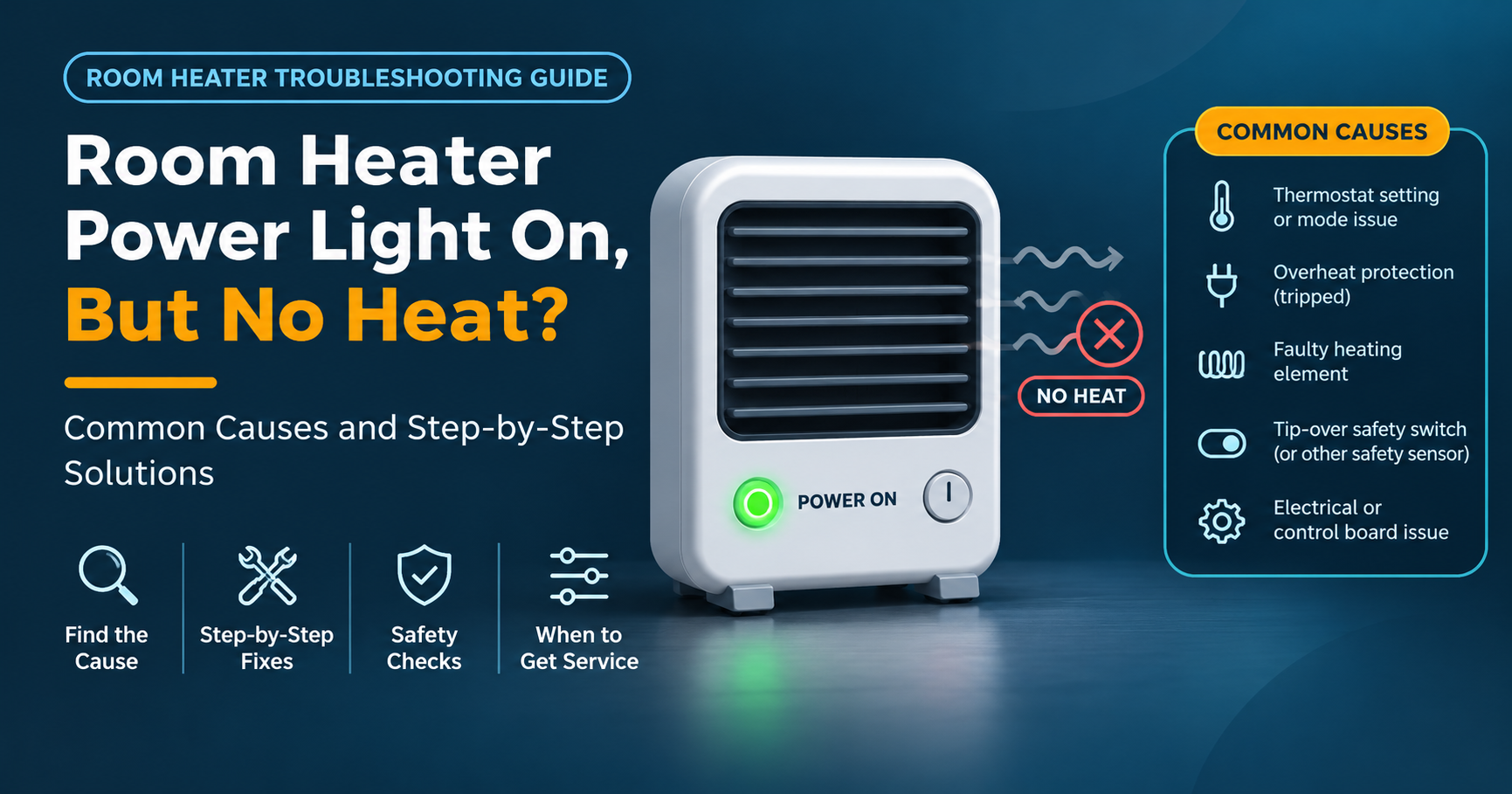
A lit power light only shows that electricity is reaching the heater. The heat itself depends on a separate chain of parts: the thermal fuse, tip-over switch, thermostat and heating element. If any one of them is open, set too low or has failed, the light stays on but the heater stays cold. Start with the simple checks (thermostat setting, mode, upright position, wall outlet, blocked vents) before suspecting an internal fault.
Why the Power Light Stays On When There Is No Heat
Most people assume the power light means the heater is working. In reality, the indicator lamp is a tiny, separate branch of the electrical circuit. It draws only a trickle of current, so it glows as soon as the plug receives electricity. The heating circuit, on the other hand, carries a large current and passes through several safety and control components before it reaches the heating element.
Think of it like a house with a doorbell and a front door. The doorbell can ring perfectly even when the front door is jammed shut. Likewise, the indicator light can glow even though a blown fuse, an open safety switch or a dead heating element is blocking the path to the heat.
Safety First: Before You Troubleshoot
- Unplug the heater before touching it, moving it or looking inside any vent.
- Let it cool down fully if it was running recently. Some parts stay hot for several minutes.
- Never open the casing while the heater is plugged in, and do not open it at all if you are not comfortable working with mains electricity.
- If you notice a burning smell, scorch marks, a melted plug or a sparking sound, stop using the heater immediately and do not attempt a repair.
Quick Checks You Can Do in Five Minutes
Before blaming a failed part, rule out the everyday causes. These account for a surprising number of “no heat” complaints.
1. Thermostat set too low
If the thermostat is set at or below the current room temperature, the heater will not switch the heating element on. Turn the dial to the maximum and wait a minute or two. On digital models, set the target at least 5 to 8 degrees above the room reading. Also check that a heater placed in direct sunlight or next to another warm appliance is not “reading” a false high temperature.
2. Wrong mode, Eco setting or timer
Many heaters have a fan-only mode, a low-power mode, an Eco mode or a timer. In fan-only or standby mode the light stays on and air may move, but the element stays off. Select the highest heat setting, cancel the timer and turn Eco off while testing.
3. Tip-over safety switch not engaged
Almost every modern heater has a tip-over switch that cuts power to the heating element if the unit tilts or falls. If the heater sits on thick carpet, a slightly uneven floor, or has debris stuck under its base, the switch may think it is tilted. Place the heater on a hard, flat surface, remove lint or pet hair from the base and test again. Some models have a small plunger or button underneath that can stick; pressing it gently a few times with the heater unplugged can free it.
4. Extension cord, power strip or faulty outlet
Heaters pull a lot of current. A thin extension cord or power strip can overheat, drop the voltage or trip its own protection, leaving the heater’s low-power light on while the element starves. Plug the heater directly into a wall outlet. Test the outlet with a lamp, and check that the circuit breaker has not tripped. If the plug itself feels hot after a short time, stop using it and have the outlet and plug inspected.
5. Overheat protection has tripped
Dust-clogged vents, a blocked grill or a covered heater can cause the unit to overheat. The overheat cutout then switches the element off to protect you. Unplug the heater, vacuum the intake and outlet vents, clear a metre (three feet) of space around it and let it rest for at least 30 minutes. Some models reset automatically; others have a small reset button on the back or bottom.
6. Voltage mismatch
A heater built for one voltage (for example 110 to 120 V) and used with a cheap converter or adapter on a different supply may never reach full power, or may blow its internal fuse. Check the rating label on the heater and make sure it matches your household supply.
Step-by-Step Troubleshooting Flowchart
Follow this sequence from top to bottom. Stop as soon as the heater starts producing heat. If you reach the final step and it is still cold, the problem is inside the heater.
Internal Parts That Commonly Fail
If the quick checks do not solve the problem, one of the internal components has probably failed. Here is what each one does and how it fails.
Thermal fuse
The thermal fuse is a one-time safety device. If the heater overheats, the fuse melts its internal link and permanently breaks the circuit to the element. It cannot be reset. A blown thermal fuse is one of the classic causes of “light on, no heat”, and it usually blows because of an underlying problem such as blocked vents, a failed fan or a faulty thermostat. Replacing a fuse without fixing the cause only leads to another failure.
Thermostat or temperature selector
The thermostat opens and closes the circuit to keep the room at the chosen temperature. Over time its contacts can wear, burn or stick open, so the heater never calls for heat. Rotary dials may feel loose or lack the normal “click” when turned.
Tip-over switch
Besides sticking from debris, the switch can fail internally. A failed tip-over switch behaves exactly like a heater that is tilted: the light and sometimes the fan work, but the element never energises.
Heating element
The element can be a nichrome coil, a ceramic PTC plate, a quartz or halogen tube, or a sealed element in an oil-filled radiator. Coils can crack or burn out, ceramic plates can fracture, and tubes can fail at their end connectors. On infrared or quartz heaters, a tube that never glows orange is a strong sign the element or its wiring has failed. Element failure on a fan heater often comes with a fan that blows only cold air.
Control board, relay or wiring
Digital and remote-controlled heaters use a control board and a relay to switch the element. A dead relay, a loose connector or a burnt wire can leave the display and the light working with no power to the element. This is more common in older units and heaters that have been moved around a lot.
What Your Symptoms Are Telling You
| Symptom | Most likely cause | What to do |
|---|---|---|
| Light on, fan silent, no heat | Blown thermal fuse or open tip-over switch | Check position, then replace unit or call a technician |
| Light on, fan runs, cold air | Failed element, thermostat set too low or wrong mode | Raise setting, select Heat mode, then inspect or replace |
| Heats for a minute, then turns cold | Overheat cutout tripping from blocked vents | Clean vents, give clearance, rest 30 minutes |
| Oil-filled radiator warm only at the top | Normal slow warm-up | Allow 15 to 30 minutes before judging |
| Digital display on, no heat, error code | Sensor, relay or control board fault | Look up the code in the manual, then repair or replace |
| Works only with the cord held in a certain position | Damaged cord or plug | Stop using immediately and replace the heater |
Testing the Parts (For Qualified Users Only)
Warning: Only attempt this if you have electrical experience. Unplug the heater, wait for it to cool and, if it has been in use, make sure no stored charge or heat remains. If in any doubt, have a qualified technician do the work.
With the heater unplugged and a multimeter set to continuity or resistance, a technician typically checks the following:
- Thermal fuse: It should show continuity (near zero ohms). An open reading means the fuse has blown.
- Tip-over switch: It should show continuity when the heater is upright and open when it is tilted.
- Thermostat: It should show continuity at the maximum setting and open at the minimum.
- Heating element: It should show a finite resistance. You can estimate the expected value with the formula resistance = voltage squared divided by wattage. For example, a 1500 W heater on 120 V should read about 9.6 ohms, and a 2000 W heater on 230 V should read about 26 ohms. An infinite reading means the element is broken.
Always replace a failed safety part with an identical part of the same rating. Never bridge, bypass or “jump” a thermal fuse or thermostat. Doing so removes the protection that prevents overheating and fire.
Repair or Replace Your Room Heater?
Many room heaters are inexpensive, sealed and not designed to be repaired. Use these points to decide:
- Replace if the heater is several years old, the plug or cord is damaged, the casing is scorched or the thermal fuse has blown more than once.
- Replace if the repair cost, including labour, is close to half the price of a new, better heater.
- Repair only if the unit is high quality, a genuine replacement part is easy to source, and a qualified technician can test it afterwards.
- Check the warranty first. A heater that fails early may be covered for a free repair or replacement.
How to Choose a Reliable Replacement Heater
If your heater is beyond saving, a better choice now can prevent the same problem later. Look for these features:
- Tip-over and overheat protection: Both should be standard on any heater you buy.
- Adjustable thermostat: It keeps the room comfortable and prevents constant full-power running.
- Safety certification: Look for a recognised mark such as UL, ETL, CE or the standard used in your country.
- Cool-touch housing and a sturdy cord: They make the heater safer around children and pets.
- Heater type to match the use: Ceramic fan heaters warm small rooms quickly, oil-filled radiators give steady, quiet heat for longer periods, and infrared heaters warm people directly in spot-heating situations.
- The right wattage for the room size: A common rule of thumb is about 10 watts per square foot of floor area.
| Room size | Suggested heater power |
|---|---|
| Up to 100 sq ft (about 9 sq m) | About 1000 W |
| Up to 150 sq ft (about 14 sq m) | About 1500 W |
| Up to 200 sq ft (about 19 sq m) | About 2000 W (check that your supply and circuit can handle it) |
| Larger rooms | Consider a more powerful unit or a second heater, and check the electrical rating of your circuit |
How to Prevent “No Heat” Problems in the Future
- Vacuum the intake and outlet vents at the start of every heating season and monthly during heavy use.
- Keep the heater on a hard, level surface and never on a bed, sofa or thick rug.
- Plug it straight into a wall outlet, and avoid extension cords and power strips.
- Never cover the heater or use it to dry clothes.
- Do not move or knock it while it is running, since impacts can loosen connections and damage the element.
- Inspect the cord and plug regularly for heat marks, cracks or discolouration.
- Store it in a dry, dust-free place when it is not in use.
Frequently Asked Questions
Why is the light on but my heater is not warming up?
The light only confirms that electricity reaches the heater. The heat depends on the thermostat, safety switches, thermal fuse and heating element all working together. Check the thermostat, mode, position and outlet first, then suspect an internal failure.
Can I reset a heater’s thermal fuse?
No. A thermal fuse is a one-time device and must be replaced once it has blown. Many heaters also have a separate resettable overheat switch, which you can reset after the heater has cooled. Check your manual to see which your model has.
Is it safe to keep using a heater that does not heat?
It is best not to. The fault may be a safety device doing its job, or a wiring problem that could worsen. Unplug the unit and fix the cause or replace the heater rather than running it repeatedly.
How long should a heater take to warm up?
Fan and ceramic heaters should deliver warm air within seconds. Infrared tubes glow within a few seconds. Oil-filled radiators can take 15 to 30 minutes to warm fully, which is normal.
Can I use an extension cord with a room heater?
It is strongly advised not to. Heaters draw high current, and most ordinary extension cords and power strips can overheat. Use a wall outlet whenever possible.
How long does a room heater usually last?
Lifespan depends on build quality, type and how often it is used. Regular cleaning, safe placement and avoiding knocks all help it last longer.
Final Thoughts
A room heater with the power light on but no heat is frustrating, but it is rarely a mystery. Start with the simple things: thermostat, mode, upright position, a working wall outlet and clear vents. If those do not help, the culprit is usually a blown thermal fuse, a failed thermostat or tip-over switch, or a burnt-out heating element, and in most cases those are jobs for a professional or reasons to buy a new heater.
Above all, never bypass a safety part to force a heater to work. A little patience and a careful routine will keep you warm and, more importantly, safe all winter.