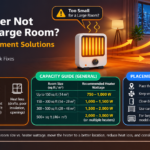




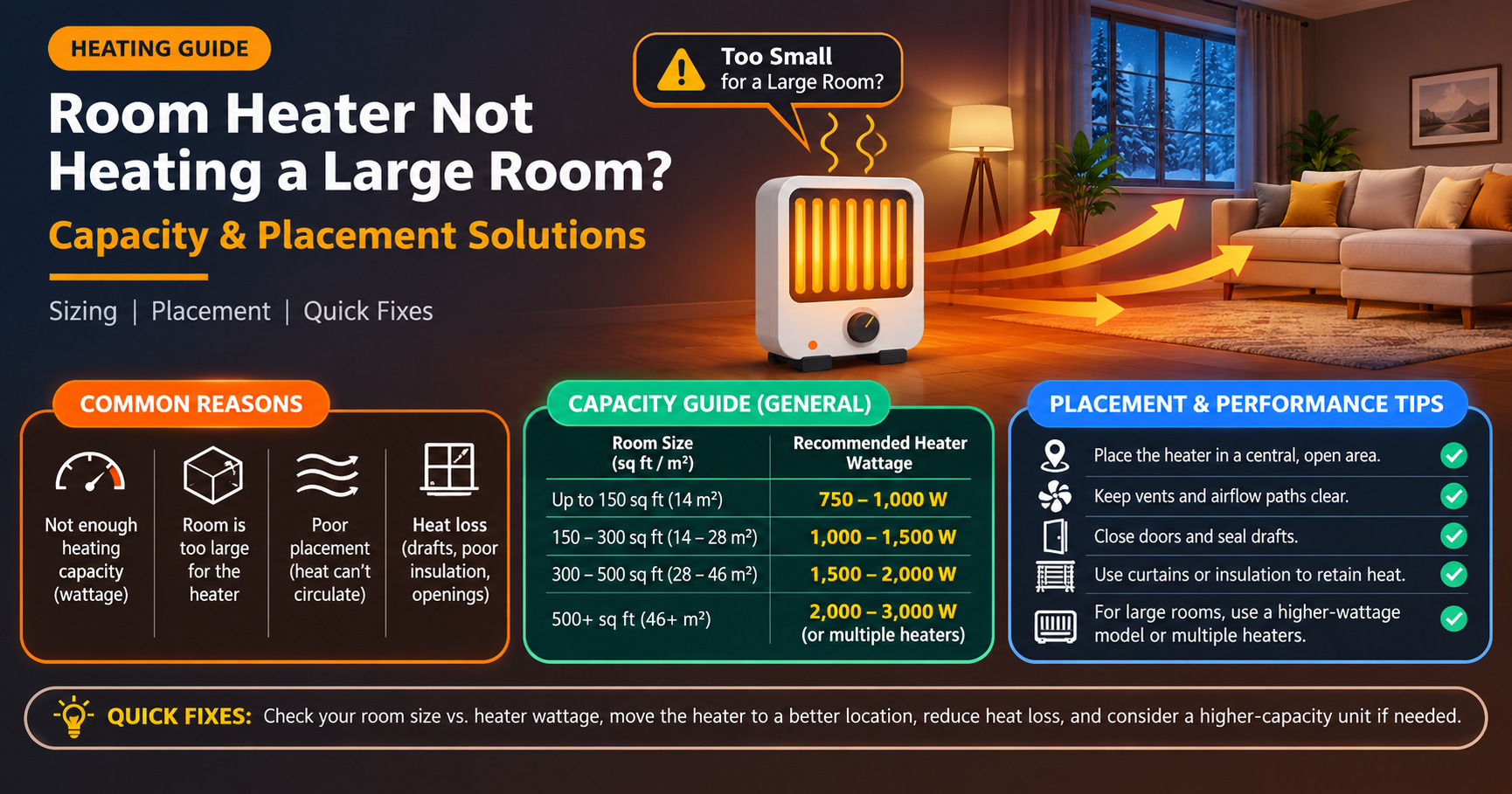

You switch the heater on, wait twenty minutes, and the only warm spot in the room is the few feet around the heater itself. Everywhere else still feels cold. If that sounds familiar, you are not alone. A room heater not heating a large room is one of the most common winter complaints, and in most cases the heater is not actually broken. The real causes are usually wrong capacity, poor placement, hidden heat loss or a mix of all three.
This guide walks you through each cause in a practical order: how to size a heater correctly, how to rule out a fault, where your heat is escaping, where the heater should sit, and how to spread warm air across a big space. By the end you will know exactly what to change, and what to look for if you decide a new heater is the better answer.
Quick answer
- Plan on roughly 10 watts per square foot (about 100 watts per square metre) for a room with an 8 ft ceiling and average insulation.
- A standard 1,500 W plug-in heater realistically covers only about 150 sq ft.
- Place the heater on the cold side of the room (near a window or outer wall) with about 3 ft of clear space around it.
- Close doors, block drafts and use a ceiling fan on low to push warm air down and around.
Why a Heater Struggles in a Large Room
Heating a room is a balance between two numbers: the heat your heater adds and the heat the room loses. A large room has more air to warm, more wall, window and floor surface to leak heat through, and often more drafts. When losses equal or exceed what the heater delivers, the temperature simply stops rising, no matter how long the heater runs.
One point surprises many buyers: every electric resistance heater turns practically all of its electricity into heat. A 1,500 W ceramic heater and a 1,500 W oil-filled radiator release the same amount of heat per hour. The difference is how that heat is delivered and how it feels, not how much of it you get. So if your heater is too small for the room, switching to another type with the same wattage will not solve the problem.
Step 1: Match Heater Capacity to Room Size
Start with the simplest question: is your heater big enough for the space? Use this formula as a starting point:
Room length x room width (sq ft) x 10 = watts needed
Multiply watts by 3.412 to get BTU per hour.

| Room size (sq ft) | Room size (m²) | Watts needed | Approx. BTU/hr |
|---|---|---|---|
| 100 | 9.3 | 1,000 W | 3,400 |
| 150 | 13.9 | 1,500 W | 5,100 |
| 200 | 18.6 | 2,000 W | 6,800 |
| 250 | 23.2 | 2,500 W | 8,500 |
| 300 | 27.9 | 3,000 W | 10,200 |
| 400 | 37.2 | 4,000 W | 13,600 |
| 500 | 46.5 | 5,000 W | 17,100 |
Adjust the Number for Your Room
The table assumes an 8 ft ceiling and average insulation. Real rooms rarely match that, so adjust:
- Taller ceilings: multiply the result by (ceiling height divided by 8). A 10 ft ceiling needs about 25% more power.
- Poor insulation, large windows or an outer-wall exposure: add 15 to 30%.
- Very cold climate or an unheated floor below: add another 10 to 20%.
- Open-plan layouts: measure the whole connected area, not just the corner where the heater sits.
- Well-insulated, modern rooms: you may be able to go a little below the rule of thumb.
Worked Example
Suppose your living room is 20 ft x 12.5 ft (250 sq ft) with a 9 ft ceiling and older windows.
- Base need: 250 x 10 = 2,500 W
- Ceiling adjustment: 2,500 x (9 / 8) = about 2,813 W
- Poor insulation (+25%): about 3,500 W, or roughly 12,000 BTU/hr
A single 1,500 W heater delivers less than half of that. This is exactly why one small heater leaves a big room cold, and why the answer is often a larger system or a second heater, not a longer run time.
Step 2: Rule Out a Fault First
Before you change anything else, confirm that the heater itself is working. A heater that is on but not producing proper heat will never keep up with a large room. Use the flowchart below, then work through the checklist.

Common Heater Faults to Check
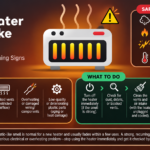
- Tripped breaker or loose plug: if the heater cuts in and out, check the outlet and the breaker. A warm plug or outlet is a warning sign. Stop using it and have it inspected.
- Tip-over or overheat protection: most modern heaters switch off if tilted or if airflow is blocked. Place the unit on a flat, hard surface, switch it off, let it cool, then restart.
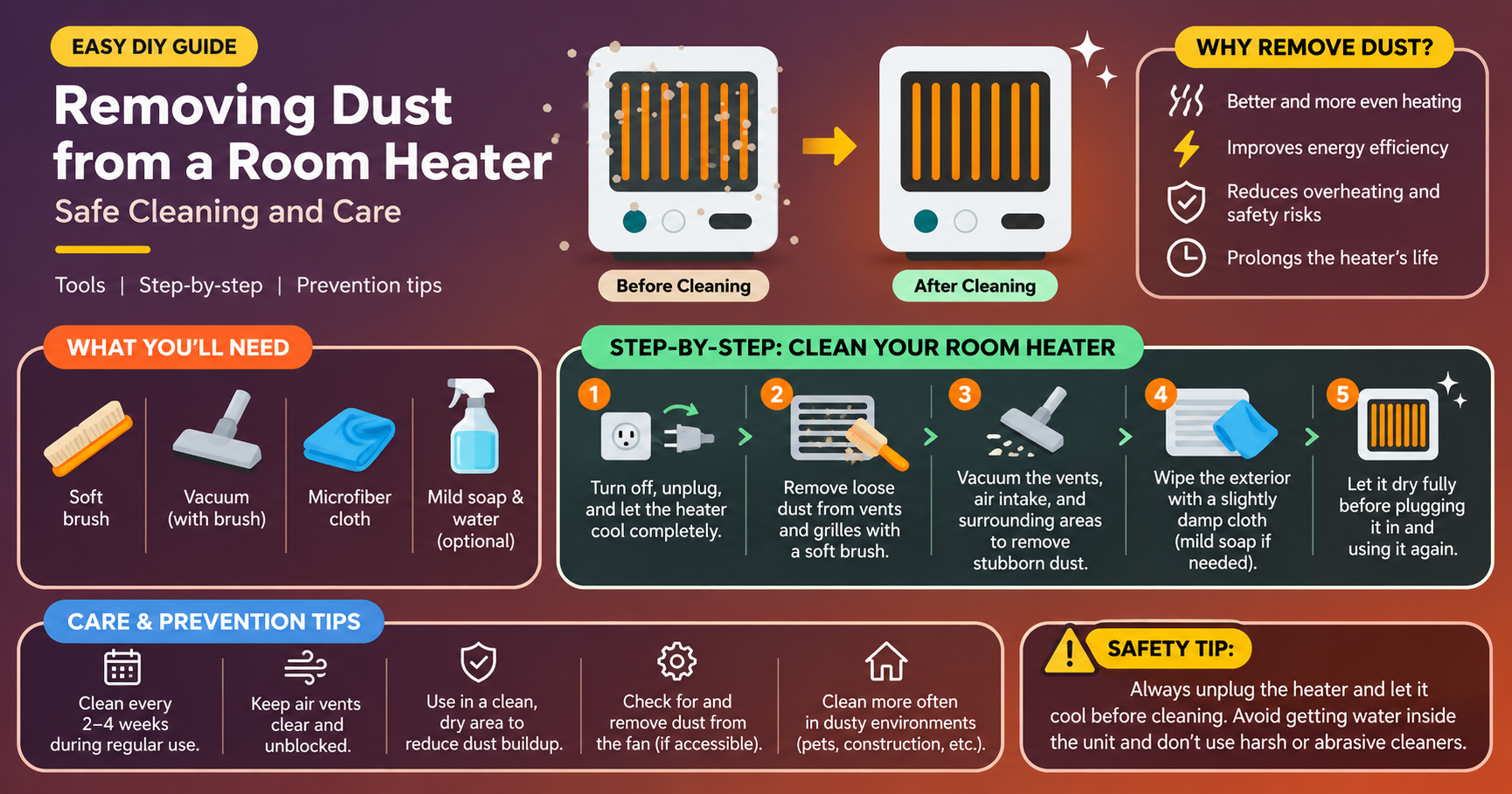
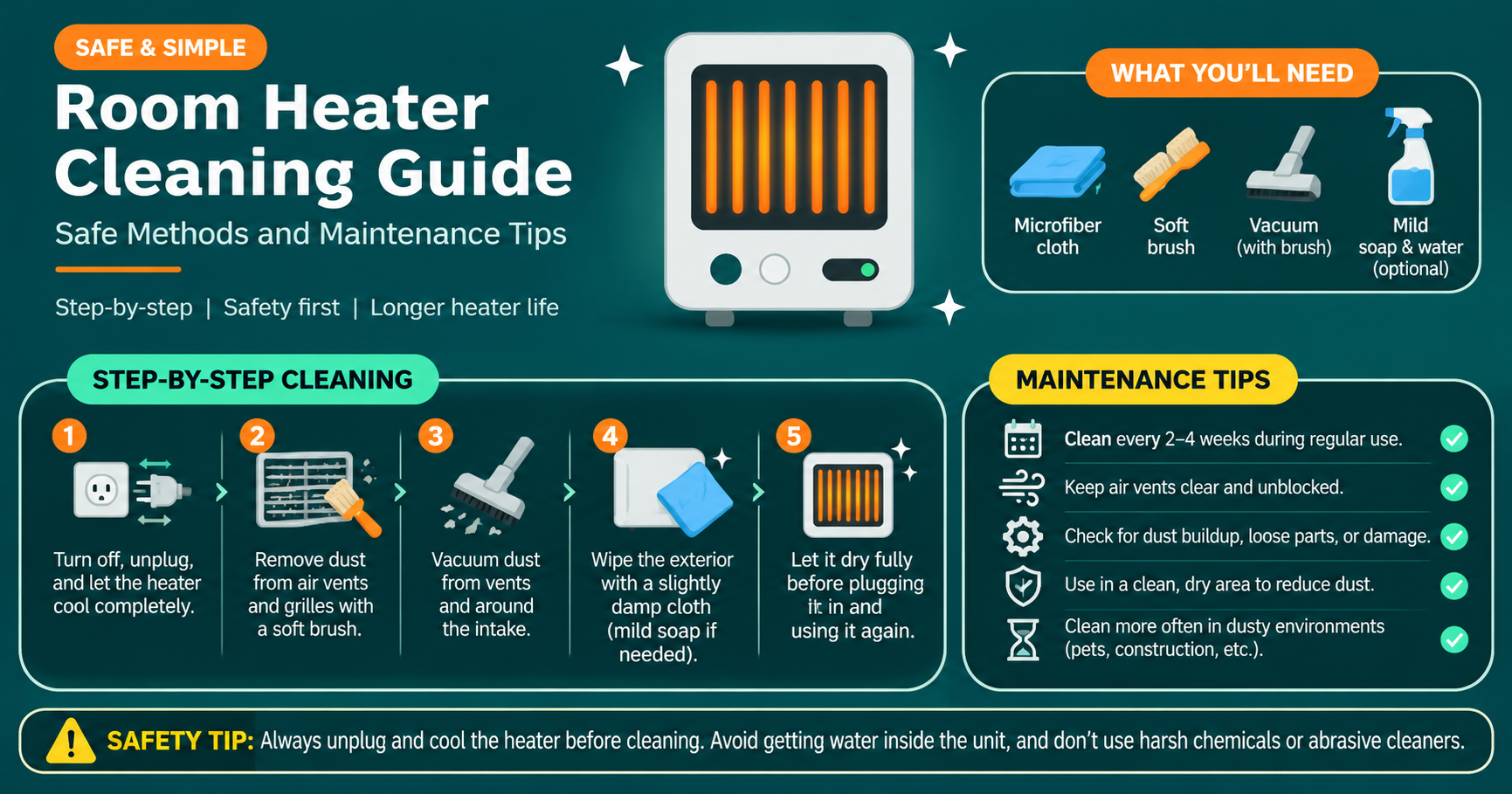
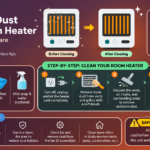
- Dust-clogged intake or filter: blocked airflow makes the heater overheat and shut down early. Unplug it, let it cool and clean the grille gently with a soft brush or vacuum.
- Thermostat set too low: if the dial is below the current room temperature, the heater will idle. Turn it up and test again.
- Failed heating element or fan: if air blows but stays cool even on the highest setting, the element may have failed. Check the warranty and consider replacement.
- Wrong voltage or damaged cord: never use a heater with a frayed cord, and make sure the rated voltage matches your supply.
Step 3: Find and Fix Where the Heat Is Escaping
If the heater is healthy and the wattage is reasonable, heat loss is the next suspect. Warm air leaves a room through the ceiling, walls, windows, floor and every small gap. In a large room, even small leaks add up quickly.

You do not need expensive renovation to improve this. These low-cost fixes make a visible difference:
- Seal door and window gaps with weatherstripping or foam tape. Hold a thin piece of paper in a gap, and if it moves, you have a draft.
- Use a draft stopper (door snake) along the bottom of doors that lead to colder areas.
- Hang thick, lined or thermal curtains and close them at dusk. Windows are one of the biggest weak points in any room.
- Add window insulation film to single-pane glass for a cheap, temporary upgrade.
- Lay rugs on bare floors. Tile, concrete and hardwood pull heat from your feet and the air above.
- Close doors to rooms you are not using, so the heater is not warming the whole house.
- Cover unused chimneys, vents and extractor fans when they are not in use.
Step 4: Fix Your Heater Placement
Placement is the most overlooked fix, and it costs nothing. In a large room, the goal is to make warm air travel through as much of the space as possible before it cools.

Placement Rules That Work
- Put the heater on the cold side. A spot beneath or near a window, or against an outer wall, lets the heater counter the cold air where it enters. Warm air then spreads across the room as cold air is drawn back toward the heater.
- Keep about 3 ft (1 m) clear on all sides. This is a safety rule and a performance rule. Sofas, beds, curtains and boxes block airflow and can create a fire risk.
- Avoid corners. A heater in a corner wastes half of its output on two walls and recirculates the same pocket of air.
- Do not hide it behind furniture. Blocked heat only warms the furniture.
- Aim fan heaters across the room, not at a wall or toward the ceiling. Use oscillation if available.
- Place radiant or infrared heaters where people sit. They warm objects and people directly, so aim them at the seating area.
- Keep it away from the thermostat’s blind spots. If the heater has a built-in thermostat, do not place it in a draft or beside a cold door. It will misread the temperature and cycle off too early.
- Use two heaters for very large spaces. Two 1,500 W units in different zones usually beat one unit placed in the middle, as long as each is on a suitable circuit.
Step 5: Move the Warm Air Around the Room
Warm air rises, so in a large room with a tall ceiling the heat collects up high while your feet stay cold. A few simple habits help:
- Run the ceiling fan on low in winter, in the direction that pushes air gently downward (usually clockwise when viewed from below). Avoid high speeds that create a cooling breeze.
- Use a small circulating fan on the floor to move warm air from the heater toward the far side of the room.
- Give the room time. A large room may need 30 to 60 minutes to reach a comfortable temperature, especially if the walls and floor are cold.
- Preheat before you need the space, and use a timer if your heater has one.
- Set a sensible thermostat target, around 20 to 22 degrees Celsius (68 to 72 degrees Fahrenheit) for most living areas, and let the heater cycle instead of constantly changing the dial.
Which Heater Type Works Best for a Large Room?
If your calculations show you need a lot more capacity, choosing the right type matters as much as choosing the right wattage. Here is how the common options compare for big spaces.
| Heater type | Strengths | Limits in a large room |
|---|---|---|
| Ceramic / fan heater | Heats quickly, compact, affordable, moves air | Limited to about 1,500 W on a plug, can be noisy, warm air fades fast |
| Oil-filled radiator | Quiet, steady heat that lingers after switch-off | Slow to warm up, needs a long run time for big areas |
| Infrared / radiant | Warms people and objects directly, instant comfort | Heats only what it faces, not the whole air volume |
| Convection panel / wall-mounted | Silent, even warmth, saves floor space | Moderate output per unit, may need several panels |
| Heat pump / mini-split | Typically delivers two to four times more heat per unit of electricity, strong capacity for large rooms | Higher upfront cost and professional installation |
For a single very large room that is used for many hours every day, a heat pump or properly sized wall-mounted system is often the most economical long-term solution. For occasional use, one or two portable heaters placed in separate zones are usually enough.
Power and Safety Limits You Should Know
- Circuit capacity: on a typical 120 V, 15 A household circuit, the maximum is 1,800 W, and continuous loads should stay near 1,440 W. That is why most portable heaters stop at 1,500 W. In regions with 220 to 240 V supply, higher-wattage units are available, so check your own supply and the heater’s rating plate.
- One heater per circuit: do not run two high-wattage heaters, or a heater plus other large appliances, on the same circuit.
- Avoid extension cords and power strips. If one is unavoidable, use a heavy-duty cord rated for the full load and fully uncoiled.
- Look for safety features: tip-over switch, overheat protection, a cool-touch housing and a recognised safety certification mark.
- Never leave a portable heater running unattended or while you sleep unless the manufacturer explicitly allows it, and keep it away from curtains, bedding and anything flammable.
- Keep smoke alarms working in rooms where space heaters are used.
What It Costs to Run a Heater in a Large Room
Running cost is simple to estimate: kilowatts x hours x your electricity rate. For example, a 1.5 kW heater running 6 hours at an example rate of 0.15 per kWh uses 9 kWh and costs about 1.35 for the day, at full power with no cycling. Because a thermostat switches the heater off when the room reaches temperature, real costs are often lower. But a heater that is too small will run flat out and still not reach the target, which is the most expensive outcome of all. Fixing insulation and placement usually saves more money than any new feature.
Buying Checklist: What to Look For in a Heater for a Large Room
- Correct capacity: calculate your required watts first, then choose a heater, or a combination of heaters, that covers at least 80 to 100% of that number.
- Adjustable thermostat and multiple power settings so the heater can cycle instead of running at full blast.
- Oscillation or a wide-angle fan for better coverage in open spaces.
- Timer or remote control so you can preheat the room and avoid unnecessary running.
- Safety protections: tip-over switch, overheat shut-off and a stable base.
- Reasonable noise level: check sound ratings if the room is a bedroom or home office.
- Easy-to-clean filter or grille for consistent performance.
- Warranty and customer support that give you confidence if a component fails.
Common Mistakes That Keep a Large Room Cold
- Relying on a single small heater for a room that needs three times the output.
- Pushing the heater into a corner or behind a sofa.
- Leaving doors open to hallways, garages or unheated rooms.
- Ignoring cold windows and bare floors.
- Using a high ceiling fan speed that creates a chill.
- Not cleaning the dust from the intake, causing early overheat shut-offs.
- Judging the room too early, before it has had time to warm up.
Frequently Asked Questions
Why is my room heater running but the room is still cold?
The most likely reason is that the heater’s capacity is too small for the room, or that heat is escaping faster than it is being added. Check the wattage against your room size, seal drafts and make sure the heater is not blocked by furniture or tripping on its safety cut-off.
How many watts do I need to heat a 300 sq ft room?
As a starting point, about 3,000 W for a room with an 8 ft ceiling and average insulation. Add 15 to 30% if the room has poor insulation, large windows or tall ceilings. That usually means two portable heaters or a wall-mounted or heat pump system, not one plug-in unit.
Is a higher-wattage heater always better?
For heat output, yes: more watts means more heat per hour. But it also means higher running cost and a heavier load on your circuit. The goal is a heater that matches your room size, not simply the biggest one available.
Can I use two room heaters in one large room?
Yes, and it often works better than one heater. Place them in different zones, ideally on separate circuits, keep both clear of furniture and never use extension cords for high-wattage units.
Where is the best place to put a heater in a big room?
On the cold side of the room, near a window or outer wall, with about 3 ft of open space around it and pointed across the room. Avoid corners and spots behind furniture.
Do oil-filled radiators heat large rooms well?
They provide steady, quiet heat, but they warm up slowly. In a large room they work best when run for long periods with the doors closed, or when combined with a faster heater for the first hour.
Does a ceiling fan help or hurt room heating?
It helps when it runs on low in the winter direction, pushing warm air that has gathered near the ceiling back down into the living space. On a high setting it can create a cooling breeze.
Final Thoughts
When a room heater is not heating a large room, the fix is rarely mysterious. First, confirm that the heater works. Second, compare its wattage with your real room size, adjusted for ceiling height and insulation. Third, plug the biggest heat leaks. Fourth, place the heater on the cold side with clear space around it, and finally move the warm air around with a fan and a little patience.
If the numbers show that your current heater is simply too small, add a second unit or move to a larger, better-suited system. Combining the right capacity with smart placement and a little draft-proofing will give you a room that is warm, comfortable and far cheaper to heat this winter.