







When the temperature drops, one question comes up again and again: should you buy a portable electric heater or an infrared heater? Both plug into a wall outlet and both promise instant comfort, yet they warm you up in completely different ways. Choosing the wrong one can mean higher bills, cold spots, and a heater that never quite does what you hoped.
In this guide we compare portable electric heater vs infrared heater on how they work, speed, running cost, safety, noise, and the best use cases, so you can pick with confidence.
What Is a Portable Electric Heater?
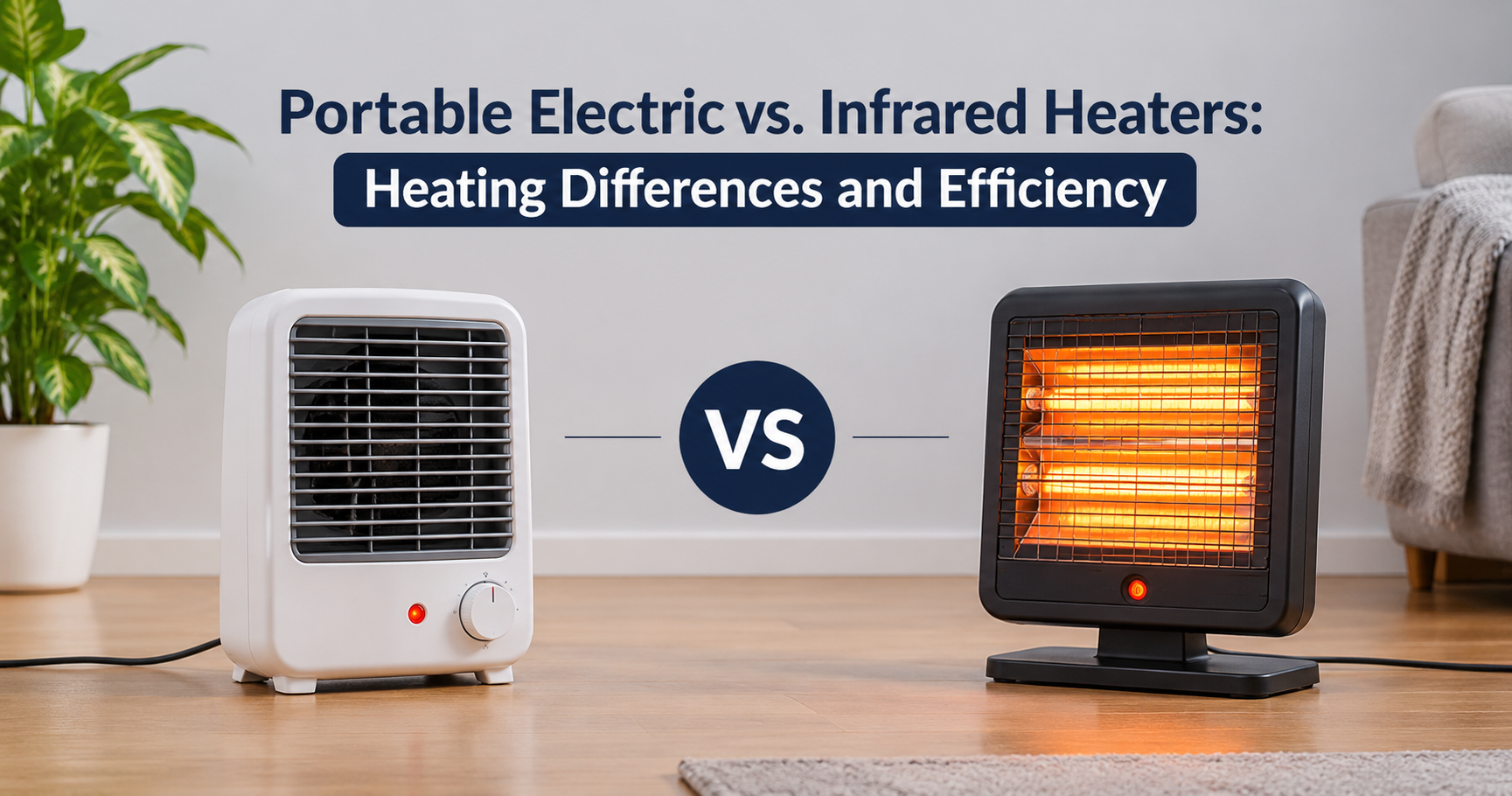
“Portable electric heater” is a broad category. These units use a resistive heating element and warm the room mainly through convection: the element heats the air, and that warm air circulates until the room reaches the set temperature. Common types include:
- Ceramic fan heaters: a fan blows air across a hot ceramic element. They heat up fast and are compact.
- Oil-filled radiator heaters: sealed oil is heated and releases warmth slowly and quietly. They are great for long, steady heating.
- Convection panel heaters: slim, often wall-mountable or freestanding, with gentle and even heat.
What Is an Infrared Heater?
An infrared heater produces radiant heat. Instead of warming the air, it emits infrared waves that travel in straight lines and warm the people and objects they hit, in the same way the sun feels warm on your skin on a cold day. Typical elements are quartz, halogen, or carbon. Many models are designed as tower, panel, or cabinet-style units.

Portable Electric Heater vs Infrared Heater: Key Differences
| Feature | Portable Electric Heater | Infrared Heater |
|---|---|---|
| Heating method | Convection (heats air) | Radiant (heats objects/people) |
| Best for | Whole-room heating | Spot heating, personal warmth |
| Feels warm in | Seconds (fan) to 20+ minutes (oil-filled) | Almost instantly when in the line of sight |
| Noise | Fan models are audible; oil-filled is silent | Usually silent |
| Effect of drafts | Warm air can be lost to drafts | Less affected, since it heats you directly |
| Heat spread | Even across the room | Directional; warmth stops where the beam stops |
| Typical power | 750W to 1500W | 400W to 1500W |

1. Heating Speed
Infrared heaters feel warm almost the moment they switch on, because the heat reaches your skin directly. Ceramic fan heaters are also quick to deliver warm airflow, but it takes longer to raise the temperature of a whole room. Oil-filled radiators are the slowest to start, but they keep radiating heat long after cycling off.
2. Room Coverage
If you want an entire bedroom or living room to feel evenly warm, a portable electric (convection) heater is generally the better choice because it raises the air temperature. An infrared heater will only warm what it “sees,” so you may feel a chill the moment you step out of its path.
3. Energy Use and Running Cost
Here is a common myth: nearly all plug-in electric heaters turn almost 100% of the electricity they use into heat. A 1500W heater uses 1.5 kWh per hour whether it is infrared or convection. The real difference is how useful that heat feels.
Infrared can feel cheaper in small spaces or drafty areas because you can run a lower-wattage unit pointed at where you sit. For whole-room heating, a thermostat-controlled convection heater avoids running nonstop once the room is warm.
4. Noise Level
Infrared heaters and oil-filled radiators are essentially silent. Fan heaters produce a constant whirr, which can be distracting in a bedroom or home office.
5. Safety
Both types can be safe when used correctly. Look for these features whatever you buy:
- Tip-over protection that cuts power if the unit falls.
- Overheat protection with an automatic shut-off.
- Safety certification from a recognized testing lab (such as UL, ETL, CE, or your local equivalent).
- Cool-touch housing, especially with kids or pets.
Never plug a heater into an extension cord or power strip, keep it at least 3 feet (about 1 meter) from curtains, bedding, and furniture, and never leave it running unattended while you sleep. Infrared heater elements can get very hot, so keep flammable items well clear of the front.
6. Durability and Maintenance
Oil-filled and panel heaters have no moving parts and can last many years. Fan heaters wear out faster and collect dust, so clean the grille regularly. Infrared tubes and halogen elements may eventually need replacing, so check the warranty.
Pros and Cons at a Glance
Portable Electric Heater
Pros:
- Warms the whole room evenly
- Thermostat control on most models
- Wide range of types and budgets
Cons:
- Fan models can be noisy
- Heat is lost through drafts and open doors
- Oil-filled units are slow to warm up
Infrared Heater
Pros:
- Near-instant, silent warmth
- Great in drafty or semi-open spaces
- No dry, blown air
Cons:
- Directional; you must stay in its path
- Weak at heating a large room
- Surfaces can get very hot
Which One Should You Buy?
Choose a portable electric heater if:
- You want to heat a whole bedroom or living room.
- You need a thermostat and a timer for steady, hands-off heating.
- You prefer a silent night-time option (choose oil-filled).
Choose an infrared heater if:
- You sit or work in one spot, such as a desk, sofa, or workbench.
- The space is drafty, high-ceilinged, or a garage.
- You want instant warmth without fan noise.
How to Choose the Right Size
A simple rule of thumb is about 10 watts per square foot of floor area (roughly 100 watts per square meter). A 150 sq ft room therefore needs around 1500W. For spot heating you can go lower, since you are warming yourself and not the whole room.
Buying Checklist
- Adjustable thermostat and multiple heat settings
- Tip-over and overheat protection
- Timer or remote control
- Energy-saving or eco mode
- Weight and carry handle if you plan to move it often
- Warranty length and customer reviews
Frequently Asked Questions
Is an infrared heater cheaper to run than a portable electric heater?
Per watt, no. Both convert electricity to heat with similar efficiency. Infrared can feel more economical when you only need to warm yourself, since you can use a lower setting.
Can an infrared heater heat a whole room?
Not very well. It heats whatever its rays hit, so for whole-room comfort a convection heater is usually better.
Is it safe to leave a heater on overnight?
Most manufacturers and fire-safety authorities advise against it. Use a model with a timer and auto shut-off, and never leave a heater unattended while you sleep.
Which is better for a bedroom?
An oil-filled or panel convection heater is the best fit, thanks to silent, steady, gentle heat.
Which is better for a garage or workshop?
An infrared heater, because it warms you directly even when the air stays cold.
Do infrared heaters dry out the air?
They do not blow air, so they feel less drying than fan heaters, although any electric heater can make a room feel drier in winter.
Final Verdict
There is no single winner in the portable electric heater vs infrared heater debate; the right choice depends on how you plan to use it. For whole-room comfort and thermostat control, go with a portable electric heater. For instant, silent, targeted warmth, an infrared heater is hard to beat. If your budget allows, many households keep both: a convection heater for the main space and an infrared unit for the spot where they spend the most time.