


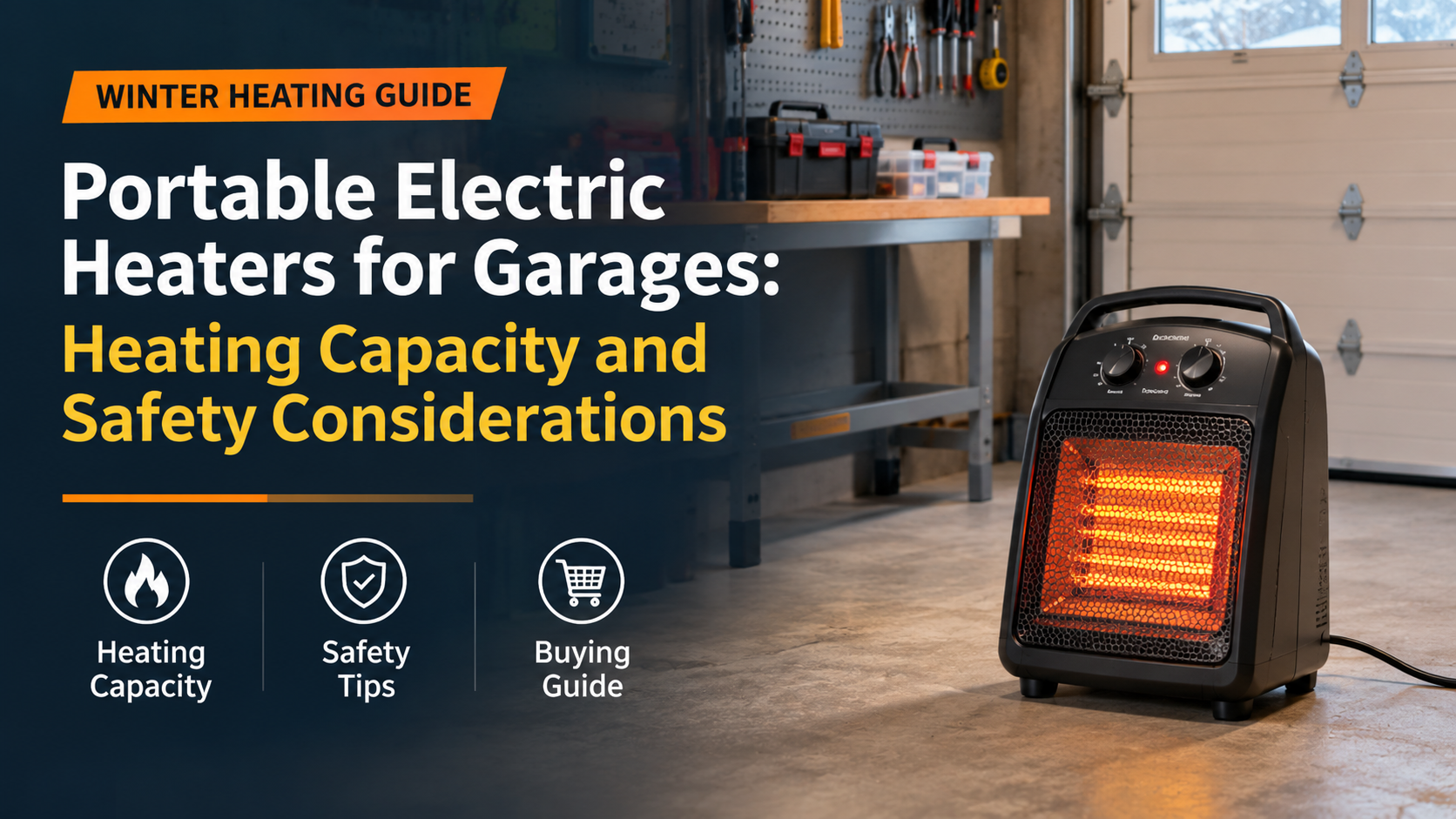
A cold garage can make even a simple weekend project feel like a chore. Fingers go stiff, tools feel like ice, paint and glue refuse to cure, and the car battery protests every morning. A portable electric heater for a garage is one of the quickest and most flexible ways to fix that problem, because it needs no ductwork, no gas line and no permanent installation.
Garages are not ordinary rooms, though. They are usually larger, leakier and less insulated than a living space, and they often contain fuel, solvents, paint and other flammable materials. That means the heater that works well in a bedroom may be a poor (or even unsafe) choice in a garage.
This guide walks you through everything you need to know: how much power your garage really needs, the main types of electric heaters, the safety rules that matter most, how to estimate running costs, how to make any heater work harder, and a practical checklist for choosing the right model.
Quick Summary
- Plan on roughly 10 watts per square foot for an insulated garage and 15 watts or more for an uninsulated one.
- A standard 120V plug-in heater tops out at 1,500 watts, which suits a one-car garage or a single work zone.
- Larger garages usually need a 240V heater (3,000 to 5,000 watts or more).
- Keep everything flammable at least 3 feet (about 1 meter) away and never use a household extension cord.
- Choose a model with a thermostat, tip-over switch and overheat protection.
Why Use a Portable Electric Heater in a Garage?
Garage heating is a classic “just enough” problem. You rarely need to heat the space around the clock. You need it warm for a few hours while you work on a car, build furniture, do laundry, train in a home gym or simply find something in storage. A portable electric heater is well suited to that style of use for several reasons.
- No fuel and no combustion. Electric resistance heaters do not burn anything, so they do not produce carbon monoxide or exhaust gases on their own.
- Almost no setup. Many models simply plug into a wall outlet. Larger 240V units may need a suitable outlet or a licensed electrician.
- Heat where you need it. A portable unit moves with you from the workbench to the car bay to the laundry corner.
- Efficient at turning power into heat. Virtually every watt that an electric heater draws ends up as heat in the room. The real difference between models is how and where that heat is delivered.
- Lower upfront cost. Compared with a permanently installed gas or hydronic system, a portable heater costs far less to buy and install.
The trade-off is the electricity bill. Electric heat can be costly to run for long periods, which is why sizing, insulation and smart usage matter so much (more on that below).
How Much Heater Power Does a Garage Need?
The most common mistake garage owners make is buying a heater that is too small. A 1,500-watt heater that comfortably warms a bedroom may barely change the temperature in a drafty two-car garage with a large uninsulated door.
The Simple Sizing Rule
A widely used rule of thumb is about 10 watts of heating power per square foot for a reasonably insulated space with a standard ceiling height of around 8 feet. For an uninsulated garage, plan on 15 watts per square foot or more, and add extra capacity if you live in a very cold climate or have a high ceiling.
To find your garage’s area, multiply the length by the width. For example, a 20 ft by 20 ft garage is 400 square feet, so you would need roughly 4,000 watts if it is insulated and about 6,000 watts if it is not.

Understanding Watts and BTUs
Many heaters list their output in watts, while others use BTU per hour. The conversion is simple: 1 watt equals about 3.41 BTU per hour. A 1,500-watt heater therefore produces about 5,100 BTU per hour, and a 5,000-watt heater produces about 17,000 BTU per hour.
When a Smaller Heater Is Enough
You do not always need to heat the entire garage. If you only work at one bench or one corner, a smaller heater can be perfectly adequate, especially an infrared (radiant) model that warms you and nearby objects directly rather than all of the air in the room. Think of it as heating the “work zone” instead of the “whole building.”
Check Your Electrical Circuit First
Power is only useful if your wiring can safely deliver it. In North America, a standard 120V, 15-amp circuit can supply a maximum of 1,800 watts, and safety guidelines recommend that continuous loads stay at about 80 percent of that, which is around 1,440 watts. This is why most plug-in heaters are limited to 1,500 watts or less. Garage circuits are often shared with lights, tools, a freezer or a garage door opener, so a heater can easily overload them.
| Circuit | Maximum Power | Practical Continuous Heater Load |
|---|---|---|
| 120V / 15 amp | 1,800 W | About 1,440 W (a 1,500 W heater is the usual limit) |
| 120V / 20 amp | 2,400 W | About 1,920 W |
| 240V / 20 amp | 4,800 W | About 3,840 W |
| 240V / 30 amp | 7,200 W | About 5,760 W |
Important: Electrical codes and wiring conditions vary by country and home. If you are unsure what your garage circuit can handle, or if you plan to add a 240V outlet, have a qualified electrician inspect the wiring first. Voltage and plug standards also differ around the world, so always match the heater to your local supply.
Types of Portable Electric Garage Heaters
Not all electric heaters behave the same way. Understanding how each type delivers heat will help you pick one that matches the way you actually use your garage.

1. Ceramic Fan Heaters
A ceramic fan heater passes air over a heated ceramic element and blows it into the room. These units warm up quickly, are compact and lightweight, and usually plug into a normal 120V outlet. They are a good fit for a single-car garage or for warming a small area before you start work. The downsides are fan noise and the fact that they heat the air, which can escape quickly when the garage door leaks or is opened.
2. Infrared (Radiant) Heaters
Infrared heaters work like the sun: they send out radiant energy that warms people, tools and surfaces directly instead of relying on warm air. That makes them especially useful in drafty garages or when you leave the door open for ventilation or car work. The warmth is felt almost immediately, but it is directional, so you need a clear line of sight between the heater and where you are working. They are popular for workbenches, car bays and hobby corners.
3. Convection and Oil-Filled Radiators
These heaters warm the air gradually and hold heat for a long time. Oil-filled models are quiet and steady, which is pleasant for long sessions in a well-insulated space. However, they are slow to heat a cold garage, heavy to move and not ideal when you need warmth fast. They suit small, tight, insulated garages or garage gyms where steady background warmth matters more than speed.
4. 240V Forced-Air Shop Heaters
When you need serious power, a 240V forced-air heater delivers it. Rated from around 3,000 watts up to 5,000 watts or more, these rugged units are designed for workshops and larger garages. Many are still considered “portable” because they can sit on a stand or be moved between locations, but they need a compatible 240V outlet or professional wiring. For a two-car or three-car garage, they are often the only electric option that heats fast enough.
| Heater Type | Typical Power | Speed | Best Use |
|---|---|---|---|
| Ceramic fan | Up to 1,500 W | Fast | Small garages, spot heating |
| Infrared radiant | 1,000 to 1,500 W (120V) or higher (240V) | Instant on the body | Workbenches, car bays, drafty spaces |
| Convection / oil-filled | Up to 1,500 W | Slow | Insulated garages, long sessions |
| 240V forced-air | 3,000 to 5,000 W or more | Fast | Large garages and workshops |
What About Propane and Kerosene Heaters?
Fuel-burning portable heaters are sometimes used in garages, but they introduce combustion byproducts such as carbon monoxide and moisture, they need careful ventilation, and many are restricted or unsuitable for enclosed spaces. Because this guide focuses on electric heaters, which do not burn fuel, always read the manufacturer’s instructions and local regulations before considering any fuel-burning option indoors.
Garage Heater Safety: What Really Matters
Safety deserves more attention in a garage than in almost any other room. Space heaters are involved in a significant share of home heating fires every year, and garages add extra risks because of what is stored there. Gasoline, paint thinner, aerosol sprays, propane cylinders, oily rags, sawdust and cardboard are all common garage items, and several of them release flammable vapors.

The Vapor Problem
Many flammable vapors, including those from gasoline, are heavier than air. They sink and spread along the floor, where they can drift toward a heater sitting at ground level. A heater with glowing elements, a switch, or a thermostat that clicks on and off can act as an ignition source. For that reason, you should store fuel and solvents in approved, tightly sealed containers, keep them as far from the heater as possible (ideally outside the garage or in a separate shed), and consider raising the heater off the floor on a stable, non-combustible surface or choosing a model designed for garage and workshop use.
Essential Safety Rules
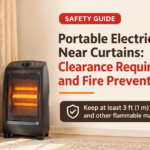
- Keep a 3-foot clear zone. Nothing flammable should be within at least 3 feet (about 1 meter) of the heater on any side, including above it.
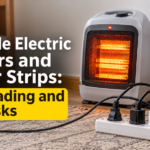
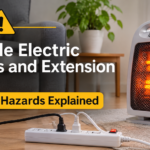
- Plug directly into a wall outlet. Avoid extension cords and power strips. They can overheat under a heater’s heavy, continuous load. If a cord is unavoidable, it must be heavy-duty and rated for the heater’s power, and it should never be coiled or covered.
- Use a dedicated circuit when possible. Do not run a heater on the same circuit as other high-draw tools or appliances.
- Choose certified equipment. Look for a recognized safety certification mark (such as UL, ETL or an equivalent in your region) on the product and the plug.
- Insist on built-in protections. A tip-over switch and overheat protection are essential in a garage, where a heater can easily be bumped by a car door, a bike or a stray tool.
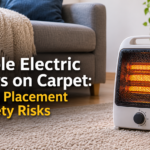
- Place it on a flat, hard surface. Never put a heater on a rug, a workbench stacked with paper, or an unstable stool.
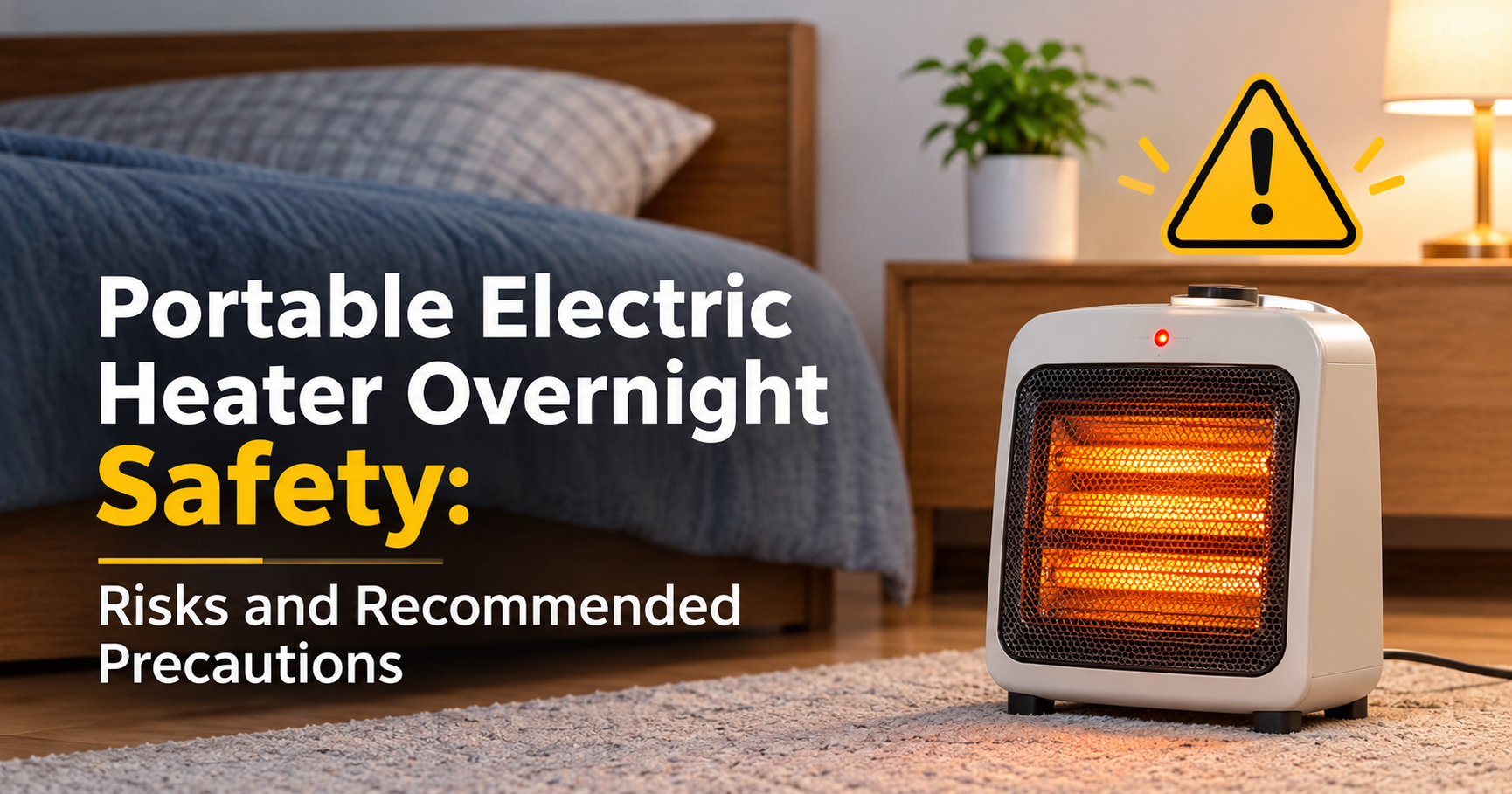
- Never leave it running unattended. Turn it off when you leave the garage and before you go to sleep. Heating a garage overnight is not recommended.
- Do not use it to dry clothes, rags or towels. Fabric draped over a heater is a serious fire hazard.
- Inspect the cord and plug. If the plug feels hot, shows discoloration or the cord is frayed, stop using the heater immediately.
- Install working alarms. Smoke alarms should be present in or near the garage. A carbon monoxide alarm is also wise if your garage is attached to the house, since cars, mowers and other equipment can produce carbon monoxide.
- Keep a suitable fire extinguisher nearby. Make sure everyone in the household knows where it is and how to use it.
Never run a vehicle in a closed garage. Car exhaust contains carbon monoxide, which is invisible, odorless and deadly. Always open the garage door fully before starting an engine, even for a short time.
Think About Dust, Moisture and Rough Treatment
Garages are dusty, damp and occasionally dirty. Sawdust, lint and cobwebs can build up inside a heater and become a hazard or reduce its performance. Damp floors and splashing water can also affect electrical equipment. Where possible, pick a heater with a sturdy housing, easy-to-clean intake grills and, for wet environments such as a garage where washing happens, a suitable ingress-protection (IP) rating. Always follow the manufacturer’s instructions regarding where and how the heater may be used.
Features to Look for When Buying
Once you know the power you need and the type that fits your garage, the following features separate a good garage heater from a disappointing one.
| Feature | Why It Matters in a Garage |
|---|---|
| Adjustable thermostat | Maintains a steady temperature and prevents wasted electricity once the space is warm. |
| Tip-over protection | Shuts the heater off automatically if it is knocked over. |
| Overheat protection | Cuts power if internal temperatures climb too high, for example when airflow is blocked. |
| Rugged, durable housing | Handles bumps, dust and temperature swings better than lightweight household plastics. |
| Safety certification | Shows the heater has been independently tested against recognized safety standards. |
| Adjustable power settings | Lets you run lower power once the space is warm and saves energy. |
| Timer or auto shut-off | Reduces the risk of leaving the heater on accidentally. |
| Mounting or stand options | Lifts the heater off the floor and aims heat where you need it. |
| Heavy-duty cord and plug | Handles high power draw with less heat build-up at the plug. |
| Noise level | Matters if you listen to music, make calls or work for long periods. |
| Portability | Carry handles, wheels and a manageable weight make it easy to move around the garage. |
How Much Does It Cost to Run a Garage Heater?
The running cost depends on two things: the heater’s power in kilowatts and your local electricity rate. The formula is simple:
Cost per hour = Heater power (kW) × Electricity rate (per kWh)
As an example, using an illustrative rate of 0.16 per kilowatt-hour (your own rate will be different):
| Heater Power | Energy per Hour | Cost per Hour | Cost for 4 Hours |
|---|---|---|---|
| 1,500 W | 1.5 kWh | 0.24 | 0.96 |
| 3,000 W | 3.0 kWh | 0.48 | 1.92 |
| 5,000 W | 5.0 kWh | 0.80 | 3.20 |
Keep in mind that a heater with a thermostat does not draw full power continuously. Once the garage reaches the set temperature, it cycles on and off, so real-world consumption is often lower than the numbers above, especially in a well-sealed space. On the other hand, a leaky, uninsulated garage will keep the heater running almost nonstop.
Ways to Make Any Garage Heater More Effective
Buying a bigger heater is not the only way to get a warmer garage. In many cases, reducing heat loss will do more for comfort and cost than adding more watts. Try these practical steps:
- Seal the garage door. Replace worn bottom seals and add weatherstripping along the sides and top. The door is often the biggest source of heat loss.
- Insulate the door. Insulation panels or kits designed for garage doors can noticeably reduce heat loss, especially on thin, single-layer doors.
- Close air gaps. Caulk or foam gaps around windows, vents, pipes and the wall where it meets the foundation.
- Insulate walls and the ceiling. If you spend a lot of time in the garage, wall and attic insulation pays off over several winters.
- Warm the floor. A bare concrete slab is a huge cold surface. Interlocking foam or rubber mats make standing and kneeling more comfortable and cut the chill from below.
- Heat only the work zone. Use a curtain, a divider or a moving blanket to create a smaller heated area around your bench or project.
- Pre-heat before you start. Turn the heater on 20 to 30 minutes before you begin work, then lower the setting to maintain temperature.
- Use a thermostat or timer. This prevents overheating and keeps energy waste in check.
- Keep the door closed. Every time the door opens, a large volume of warm air escapes in seconds.
- Position the heater wisely. Place it where air can flow freely, away from walls, and aim it at the area where you work. Avoid pushing it into a corner or behind objects.
What Temperature Should You Aim For?
You do not need to turn your garage into a living room. Choose a target based on what you are doing:
- Around 40 to 50°F (4 to 10°C): Enough to keep stored items, liquids, batteries, pipes and equipment from freezing.
- Around 55 to 60°F (13 to 16°C): Comfortable for light work in warm layers, such as hobby projects and tool maintenance.
- Around 65°F (18°C) or higher: Better for longer sessions, fine motor work, home workouts or when working with paints, epoxies and adhesives that need a minimum temperature to cure properly. Always check the product label for its recommended range.
Remember that every extra degree increases the load on the heater and your bill, so set the thermostat only as high as you actually need.
Which Heater Is Best for Your Situation?
| Your Garage | Recommended Approach |
|---|---|
| Small one-car garage, occasional use | A 1,500 W ceramic or infrared heater with a thermostat. |
| Workbench or car repair corner in a drafty garage | An infrared radiant heater aimed at the work zone. |
| Insulated garage gym or hobby room | A quiet convection or oil-filled heater for steady warmth, plus a ceramic unit to pre-heat. |
| Two-car garage or larger workshop | A 240V forced-air heater rated for the garage’s square footage. |
| Only need to prevent freezing | A small thermostat-controlled heater set to a low temperature, installed with extra attention to safety. |
Common Mistakes to Avoid
- Buying by price alone. A cheap, uncertified heater can be unreliable and unsafe.
- Underestimating the size of the space. An underpowered heater runs constantly and still never feels warm.
- Using a household extension cord. This is one of the most common causes of overheated plugs and cords.
- Ignoring the stored items. Fuel, aerosols and paint near a heater are a dangerous combination.
- Blocking airflow. Covering or crowding the heater can trigger overheating and shorten its life.
- Leaving it on overnight or while away. Heaters should be supervised whenever they are on.
- Skipping insulation fixes. Plugging air leaks is often the cheapest way to get more heat from the same power.
- Forgetting maintenance. Dust buildup reduces efficiency and can create hazards.
Basic Maintenance and Storage Tips
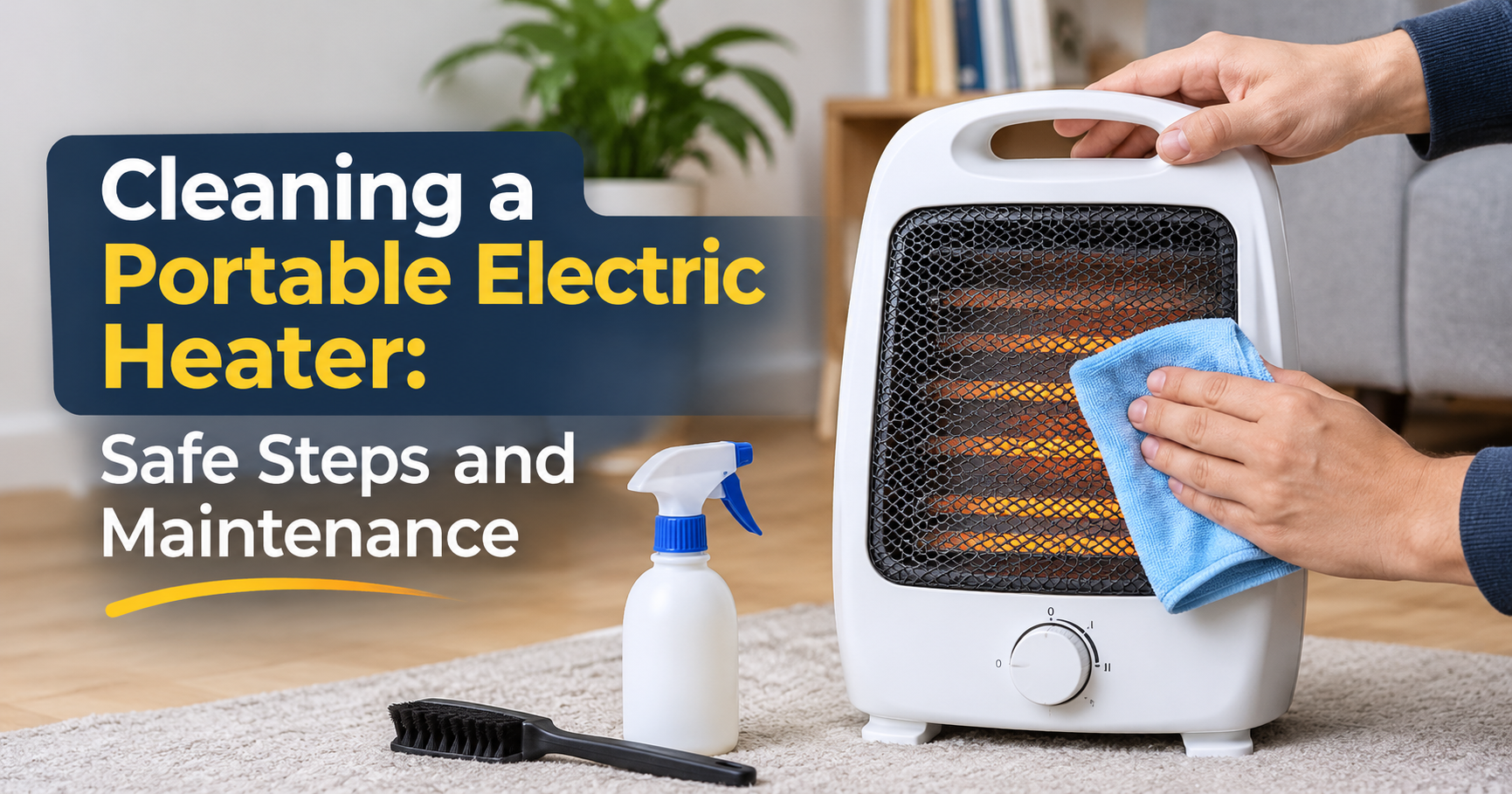
- Unplug the heater and let it cool completely before cleaning.
- Vacuum the intake and outlet grills regularly, and wipe the housing with a dry or slightly damp cloth.
- Check the cord, plug and switches for signs of wear before each heating season.
- Test the tip-over switch gently according to the manual, and stop using the heater if anything fails to work correctly.
- Store the heater in a dry place away from dust and moisture during warm months, ideally in its original box or under a cover.
- Never attempt to repair the internal components yourself. Contact the manufacturer or a qualified technician.
Frequently Asked Questions
Is it safe to use a portable electric heater in a garage?
It can be, provided you choose a certified heater with tip-over and overheat protection, keep flammable items well away from it, plug it directly into a suitable outlet, and never leave it running unattended. A garage’s stored fuels and solvents make strict safety habits especially important.
What size heater do I need for a 2-car garage?
A typical two-car garage is around 400 square feet. As a rough guide, that means about 4,000 watts if it is insulated and 6,000 watts or more if it is not. In practice, this usually calls for a 240V heater, or for a combination of heater plus better insulation.
Can a 1,500-watt heater warm a whole garage?
It can adequately warm a small, well-insulated one-car garage or a localized work zone, but it will struggle in a larger or uninsulated space. In those cases, it is better used as a spot heater near where you are working.
Are infrared heaters better than ceramic heaters for garages?
It depends on how you use the space. Infrared heaters excel at warming people and objects directly and are less affected by drafts, so they are great for workbenches. Ceramic fan heaters warm the air faster and distribute it more evenly in smaller enclosed spaces.
Can I use an extension cord with a garage heater?
It is best to avoid it. High-wattage heaters draw a lot of current, and light-duty cords can overheat. Plug the heater directly into a wall outlet whenever possible. If you absolutely must use a cord, follow the heater manufacturer’s guidance and use a heavy-duty cord rated for the load.
Can I leave a garage heater on overnight?
Leaving any portable heater running unattended overnight is not recommended. If you need freeze protection for a long period, look into a permanently installed solution designed and approved for continuous operation.
Do electric garage heaters produce carbon monoxide?
Electric resistance heaters do not burn fuel, so they do not produce carbon monoxide themselves. However, vehicles, lawn equipment and fuel-burning appliances in or near the garage can, which is why a carbon monoxide alarm is still a smart precaution.
How can I heat a garage cheaply?
Seal air leaks, insulate the door, heat only the work zone, use a thermostat, and choose the right type of heater for the job. Reducing heat loss usually saves more than switching to a different heater.
Final Thoughts
A portable electric heater for a garage can turn a cold, unusable space into a comfortable place to work, exercise or tinker, but only if you choose and use it wisely. Start by measuring your garage and estimating the power it needs. Match the heater type to how you use the space, whether that is a ceramic heater for a small garage, an infrared heater for a workbench, or a 240V forced-air model for a large workshop. Check that your electrical circuit can safely support it, insist on proven safety features, and always keep fuels and flammable materials well clear.
Finally, do not overlook the basics. Sealing the door, insulating where you can and heating only the area you are using will make any heater perform better and cost less to run. Combine the right equipment with smart habits, and you can enjoy a warm, safe and productive garage all winter long.
Disclaimer: This article is for general information only. Electrical systems, codes and safety requirements vary by location. Always follow the heater manufacturer’s instructions and consult a qualified electrician for wiring questions.