
Portable Electric Heater Circuit Breaker Trips: 9 Causes and How to Fix Them Safely
You switch on your portable electric heater on a cold evening, and a few minutes later the room goes dark. The circuit breaker has tripped again. It is frustrating, but it is also a warning. A breaker that trips is doing its job: it is protecting your wiring from overheating.
In this guide you will learn exactly why a portable electric heater trips a circuit breaker, how to find the cause step by step, how to fix it without taking risks, and what to look for when buying a heater that works well on a normal household circuit.
Quick answer: Most of the time a space heater trips the breaker because it draws too much current for the circuit. A 1,500W heater pulls about 12.5 amps on a 120V circuit, and a standard 15-amp breaker should only carry about 12 amps continuously. Add a TV, a lamp or a thin extension cord, and the breaker trips. Move the heater to its own circuit, plug it straight into the wall, and avoid sharing the outlet with other devices.
Why Does a Portable Heater Trip the Breaker?
Heating is the most power-hungry job an ordinary appliance does. A laptop uses about 60 watts and an LED bulb about 10 watts, while a standard space heater uses 1,500 watts. That single plug-in device can use as much power as a whole room of electronics.
A circuit breaker watches the current flowing through a circuit. If the current stays too high for too long (overload), or suddenly jumps because of a fault (short circuit or ground fault), the breaker opens and cuts the power. Understanding which of these is happening is the key to fixing the problem.
The Simple Math Behind Overloads
You do not need to be an electrician to check this. Use this formula:
Amps = Watts ÷ Volts
On a 120V circuit (North America), a 1,500W heater draws 1,500 ÷ 120 = 12.5 amps. On a 230V circuit (much of Europe, Asia and Australia) the same heater draws only about 6.5 amps, which is why overload trips are less common there, although cheap cords and loose sockets can still cause problems.
Electrical codes treat anything running for three hours or more as a continuous load, and a continuous load should stay under 80% of the breaker rating. That gives you these safe limits:
| Breaker Size | Max Continuous Load | Approx. Watts at 120V |
|---|---|---|
| 15 amp | 12 amps | 1,440W |
| 20 amp | 16 amps | 1,920W |
Notice the problem: a standard 1,500W heater already exceeds the 1,440W safe continuous limit of a 15-amp circuit, even when nothing else is plugged in. Anything extra on that circuit makes a trip very likely.
9 Common Reasons a Space Heater Keeps Tripping the Breaker
1. The circuit is overloaded
This is the number one cause. Bedrooms, living rooms and offices often share one 15-amp circuit across several outlets and lights. Your heater, a TV, a phone charger and a lamp can easily add up to more than the breaker allows.
2. The heater is too powerful for the circuit
A 1,800W or 2,000W model is simply too much for most 15-amp circuits. Even on its own, it can trip the breaker once the heating element and fan reach full power.
3. Using an extension cord or power strip
Thin or long extension cords create resistance, heat up and cause voltage drop. Power strips are designed for light loads and often have their own small breaker that trips first. Heaters should be plugged directly into a wall outlet.
4. A faulty heating element or internal short
If the heater trips the breaker within a second or two, even when it is the only device plugged in, an internal component may have failed. Damaged wiring or a cracked element can cause a short circuit.
5. A ground fault (GFCI trips)
Outlets in bathrooms, kitchens, garages and basements are protected by GFCI devices. They trip when even a tiny amount of current leaks to ground, which can be caused by moisture, condensation or a damaged cord. Use only heaters that are specifically rated for damp areas in such rooms.
6. Arc faults (AFCI breakers)
Newer bedroom circuits often have AFCI breakers that detect dangerous sparking. A loose plug, a worn cord or a damaged outlet can trigger them, and some AFCI breakers are also sensitive to the electrical noise of cheap heaters.
7. Loose plug or worn outlet
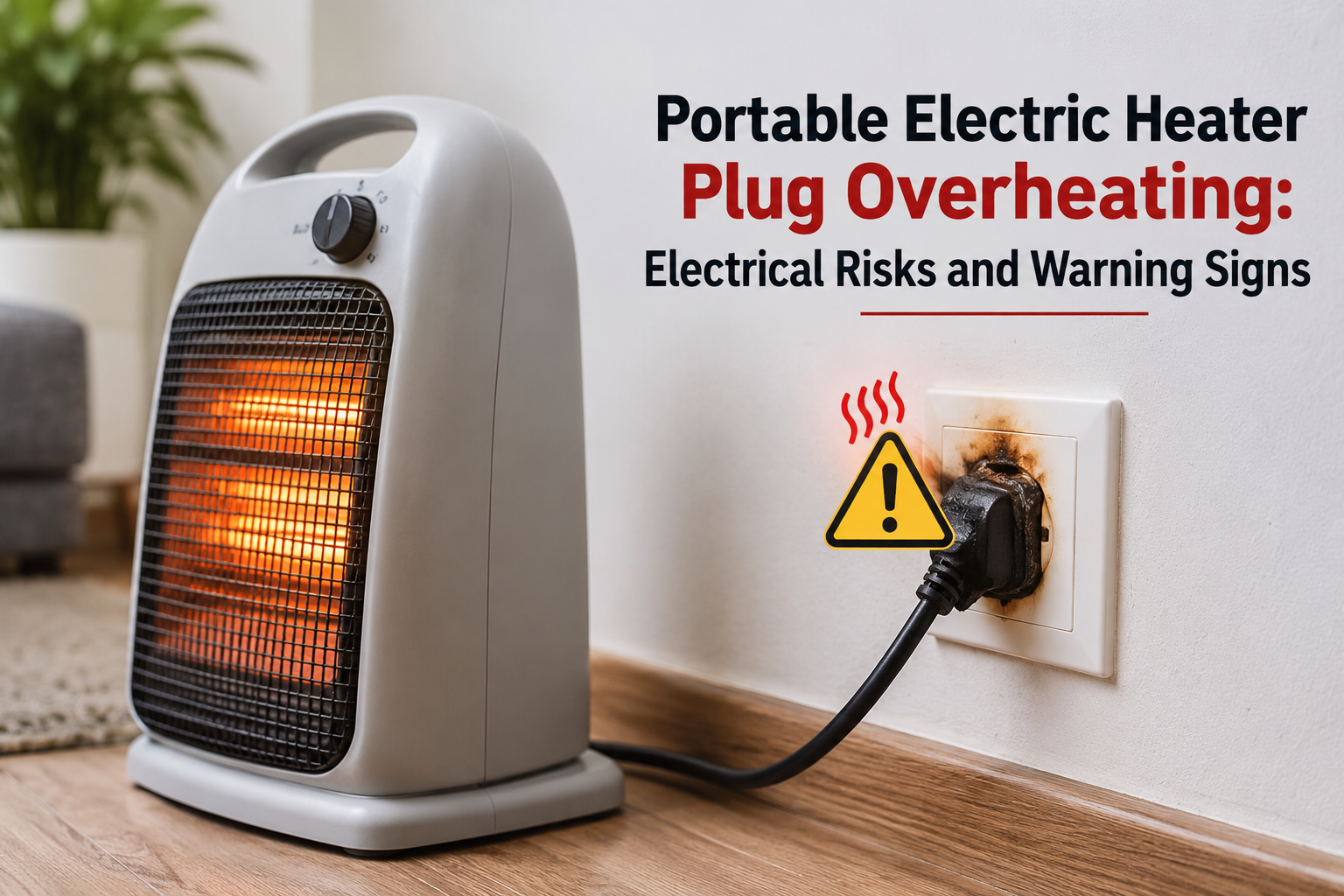
If the plug feels loose in the socket, it creates a poor connection that heats up. Scorch marks, a warm plug or a burning smell are signs of trouble.
8. Dust and blocked airflow
Dust on the element and a clogged air intake make the heater run hotter. Some models then draw more current or shut down on overheat protection, which can look like a tripping problem.
9. A weak or aging breaker
Breakers wear out. An old or damaged breaker can trip below its rated load or fail to hold a normal load. If the heater works fine on a different circuit, the breaker itself may be the issue.
How to Troubleshoot Step by Step
Follow these steps in order. Stop and call a licensed electrician if you notice heat, smoke or burning smells at any stage.
- Unplug the heater and everything else on the circuit, then reset the breaker. If it trips again with nothing plugged in, the problem is in the wiring or breaker, not the heater.
- Plug the heater in by itself, directly into the wall with no extension cord. Start on the low setting.
- If it trips instantly, try the heater on a different circuit. If it trips there too, the heater is faulty and should be replaced.
- If it runs alone but trips with other devices, you have an overload. Move the other devices to a different circuit.
- Check the plug, cord and outlet after 15 minutes of use. They should be warm at most, never hot.
- Clean the heater with a dry cloth or soft brush while it is unplugged and cool.
Safety warning: Never hold a breaker switch on, never replace it with a bigger one, and never tape or bypass it. A larger breaker does not make the wiring stronger. It only removes the protection and can lead to a fire inside the wall.
How to Stop the Breaker From Tripping Again
- Give the heater its own circuit. This is the best long-term solution. An electrician can install a dedicated outlet if you use a heater every winter.
- Use a lower wattage. A 750W or 1,000W heater leaves plenty of room on a 15A circuit.
- Use the thermostat and low setting. Once the room is warm, the heater cycles off and the average load drops.
- Turn off other high-draw devices such as hair dryers, microwaves, toasters and vacuum cleaners while the heater runs.
- Know your circuits. Label your breaker panel and find out which outlets share the same breaker.
- Do not use an extension cord. If you absolutely must, use a heavy-duty 12 or 14 gauge cord rated for the heater and keep it as short as possible, fully uncoiled.
Pro tip: Run the heater at 1,500W for a short time to warm the room quickly, then switch to the lower setting. This keeps the average load well below the breaker limit while still keeping you comfortable.
Choosing a Portable Heater That Is Less Likely to Trip Your Breaker
If you are shopping for a new heater, a few features make a big difference for both safety and reliability.
| Feature | Why It Matters |
|---|---|
| Adjustable wattage (e.g., 600W / 900W / 1,500W) | Lets you stay under the circuit limit when needed |
| Adjustable thermostat | Cycles the heater on and off, reducing average load |
| Tip-over switch | Cuts power if the heater is knocked over |
| Overheat protection | Shuts the unit down if internal temperature gets too high |
| Safety certification (UL, ETL, CE) | Shows the product passed independent safety testing |
| Heavy-gauge cord and solid plug | Reduces heat at the connection point |
| Cool-touch housing | Safer around children and pets |
| Timer and remote | Avoids leaving the heater on unnecessarily |
Heater types compared
| Type | Best For | Things to Note |
|---|---|---|
| Ceramic fan heater | Small to medium rooms, quick heat | Fast and compact, usually 1,500W max |
| Oil-filled radiator | Bedrooms, steady all-night warmth | Heats slowly but cycles on and off, gentler on circuits |
| Infrared / radiant heater | Spot heating a person or desk | Warms objects directly, good for local heat |
| Micathermic panel heater | Quiet rooms and offices | Silent operation, moderate heat-up time |
| Mini / personal heater | Desks and tight spaces | Low wattage (200 to 750W), least likely to trip a breaker |
For anyone who struggles with tripping, a lower-wattage oil-filled radiator or a heater with multiple power settings is usually the most breaker-friendly option, since it can warm a room slowly without hitting the circuit limit.
Common Mistakes to Avoid
- Plugging a heater into a power strip or surge protector
- Running several heaters on the same circuit
- Leaving a heater on all night in a room with other devices running
- Ignoring a warm or discolored plug
- Resetting the breaker again and again without finding the cause
- Covering a heater with clothes or blankets
- Placing a heater close to curtains, beds or furniture. Keep at least 3 feet (about 1 metre) of clear space on all sides
When to Call a Licensed Electrician
Call a professional if any of these apply:
- The breaker trips with nothing plugged in
- The breaker feels hot, buzzes or smells burnt
- Lights flicker or dim when the heater turns on
- Outlets are discolored, loose or warm
- Your home has old aluminum or knob-and-tube wiring
- You want a dedicated heater circuit installed
Frequently Asked Questions
Why does my space heater trip the breaker after a few minutes?
This usually points to an overload. The breaker tolerates a high load briefly, but trips when the current stays high over time, especially when other devices share the circuit or an extension cord adds resistance.
Can a 1,500W heater run on a 15-amp circuit?
Yes, but only if it is the only significant load on that circuit. It sits right at the continuous-use limit, so there is almost no margin for other appliances.
Is it safe to keep resetting the breaker?
Resetting once after reducing the load is fine. Repeatedly resetting without changing anything is risky because the underlying fault is still there.
Why does my heater trip the GFCI outlet?
GFCIs react to current leaking to ground. Moisture, a damaged cord or a failing heater element can cause it. Test the heater on a different, non-GFCI outlet in a dry room to learn more, and replace the heater if it keeps tripping.
Will a bigger breaker fix the problem?
No. The breaker is sized to match the wire in the wall. Installing a larger one can allow the wires to overheat and start a fire. Only an electrician should change a breaker or the wiring.
Does a heater trip more often in cold weather?
Yes, because it runs longer and other loads, such as lighting and electronics, are also used more in winter, which adds to the total on the circuit.
Is a low-wattage heater worth it?
For small rooms, desks and bedrooms, absolutely. A 750W or 1,000W heater is far less likely to trip a breaker and can still make a small room comfortable.
Final Thoughts
A portable electric heater that trips the circuit breaker is rarely a mystery. In most homes the cause is simple: too much power on one circuit. By checking the wattage, avoiding extension cords, separating other devices and choosing a heater with adjustable power settings, you can solve the problem and stay warm safely.
If the breaker still trips after you have followed the steps above, do not keep trying. Have an electrician check the circuit and the outlet. A small repair today is far cheaper than the damage a wiring fault can cause tomorrow.
Disclaimer: This article is for general information only and is not a substitute for professional electrical advice. Electrical codes and ratings differ by country, so always consult a licensed electrician for work on your home wiring.