


A portable electric heater is one of the quickest ways to warm a cold room, but it can also be one of the most expensive appliances in your home to run. Before you buy one, or before your next electricity bill arrives, it helps to understand exactly how much power a portable electric heater consumes and what that means in real money.
In this guide you will learn how heater wattage works, how many kilowatt-hours (kWh) different types use, how to calculate your own running cost, how much current a heater draws from your wall socket, and practical ways to stay warm while spending less.
Quick Answer
Most portable electric heaters use 500W to 1500W. A 1500W model uses 1.5 kWh of electricity for every hour it runs at full power. At an example price of $0.16 per kWh, that is about $0.24 per hour, or roughly $57.60 per month if it runs 8 hours a day without the thermostat switching it off.
What “Power Consumption” Means for a Space Heater
Three terms appear on every heater label and on every electricity bill. Understanding them makes the rest of this article easy.
- Watts (W): how much power the heater draws at any given moment. A 1500W heater draws 1500 watts while its element is on.
- Kilowatts (kW): watts divided by 1000. A 1500W heater is a 1.5 kW heater.
- Kilowatt-hours (kWh): power used over time. Running a 1 kW appliance for one hour uses 1 kWh. This is the unit your electricity company bills you for, and on many bills it is simply called a “unit”.
Nearly every watt a heater draws is turned into heat, which is why heaters feel so powerful and why they cost so much to run compared with devices like laptops or LED bulbs.
Typical Wattage of Portable Electric Heaters
The rated wattage depends on the heater’s design and size. Most heaters sold for 120V sockets are capped at 1500W so they can safely plug into a standard outlet. In regions with 220–240V power, higher ratings such as 2000W are common.

| Heater type | Typical wattage | How it heats | Best for |
|---|---|---|---|
| Personal / desk ceramic | 150–750W | Small ceramic element and fan | Desks, feet, tiny spaces |
| Ceramic fan heater | 750–1500W | Fan blows air across a hot ceramic plate | Fast heat in small to medium rooms |
| Oil-filled radiator | 600–1500W | Heats oil that slowly releases warmth | Bedrooms and long, steady heating |
| Infrared / quartz | 400–1500W | Radiates heat directly onto people and objects | Spot heating, drafty or open areas |
| Convection panel | 750–1500W | Warms air that circulates naturally | Quiet rooms and offices |
| Micathermic panel | 750–1500W | Combines radiant and convection heat | Medium rooms, quiet operation |
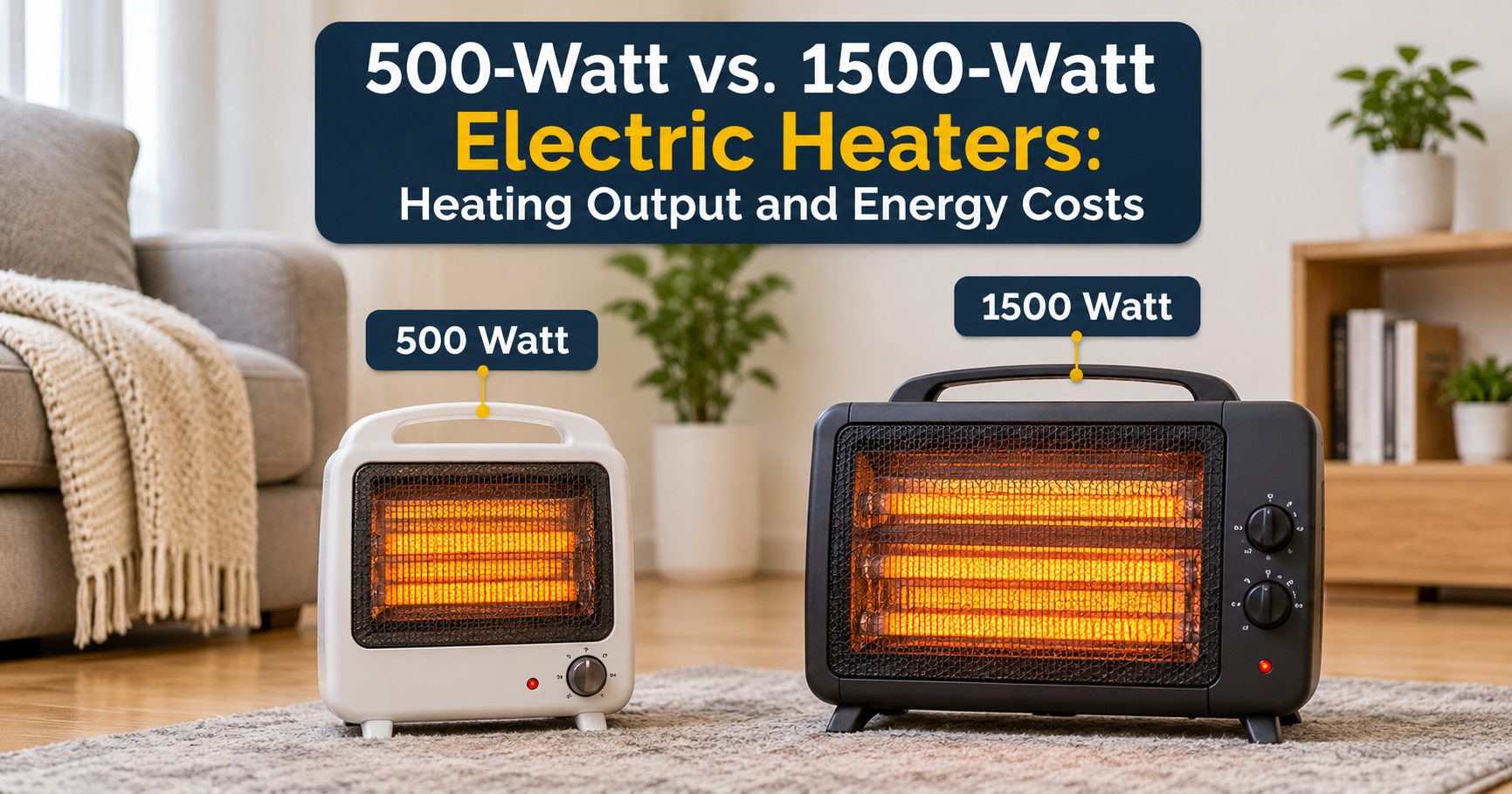
Many models offer two or three power settings, such as 750W and 1500W. The low setting simply uses half the element, so it draws roughly half the electricity.
How to Calculate Portable Heater Running Cost
You only need three numbers: the heater’s wattage, how many hours you run it, and your electricity price per kWh. The price is printed on your bill.

- Divide the wattage by 1000 to get kilowatts.
- Multiply kilowatts by the hours of use to get kWh.
- Multiply kWh by your price per kWh to get the cost.
Worked Example
A 1500W heater runs for 6 hours. 1500 ÷ 1000 = 1.5 kW. 1.5 kW × 6 hours = 9 kWh. At $0.16 per kWh, 9 × 0.16 = $1.44.
Use your own local rate. The formula works in any currency.
How Much Does It Cost to Run a Portable Heater?
The chart below shows estimated costs at an example rate of $0.16 per kWh, assuming the heater runs continuously at full power. Your actual cost will move up or down with your local tariff.

| Heater power | Energy per hour | Cost per hour | Cost for 4 hrs/day (30 days) |
|---|---|---|---|
| 500W | 0.5 kWh | $0.08 | $9.60 |
| 750W | 0.75 kWh | $0.12 | $14.40 |
| 1000W | 1.0 kWh | $0.16 | $19.20 |
| 1500W | 1.5 kWh | $0.24 | $28.80 |
The numbers add up quickly. Heating one room with a 1500W heater for 8 hours every day for a month can cost more than many people spend on all their lighting and electronics combined.
Does the Thermostat Reduce Power Consumption?
Yes, and this is the most overlooked factor. The wattage on the label is the maximum draw while the heating element is on. Once the room reaches your chosen temperature, a thermostat switches the element off and on to hold it there.
In a well-insulated room that has already warmed up, a heater may run for only about half of each hour or even less. That means your real consumption is often lower than the continuous-run figures above. In a cold, drafty room the heater will run much more of the time and your costs will be closer to the maximum.
Do oil-filled heaters use less electricity?
Not in terms of watts. A 1500W oil-filled radiator and a 1500W ceramic heater convert electricity to heat at essentially the same rate. The difference is how the heat is delivered. Oil-filled units take longer to warm up but keep radiating after the element switches off, which can feel steadier and quieter. Fan heaters feel warmer faster but stop heating the moment they switch off.
Myth Check
Any claim that one electric heater is far “more energy efficient” than another at the same wattage should be treated with caution. Per kWh, resistance heaters produce about the same amount of heat. Real savings come from right-sizing, thermostats, timers and insulation, not from a bigger promise on the box.
How Many Amps Does a Portable Heater Draw?
Power consumption is not only about cost. It also determines how much current the heater pulls through your wall socket and wiring. Amps equal watts divided by volts.

A 1500W heater on a 120V supply draws about 12.5 amps, which is most of the capacity of a typical 15A household circuit. If a refrigerator, microwave, kettle or hair dryer is on the same circuit, the breaker can trip or wiring can overheat. In 220–240V regions the same heating power needs fewer amps, but the same principle applies.
Can you use an extension cord with a space heater?
It is best not to. Plug the heater directly into a wall outlet. If you absolutely must use an extension, choose a heavy-duty cord rated for at least the heater’s wattage, keep it as short as possible and fully uncoiled, and check it regularly for warmth. Power strips and cheap multi-plug adapters are not suitable for heaters.
What Wattage Do You Need for Your Room?
A heater that is too small will run constantly and never reach your target temperature. One that is too large wastes money and cycles on and off. A common guideline is about 10 watts of heating power per square foot in a room with standard ceiling height and decent insulation.

| Room size | Suggested wattage | Typical rooms |
|---|---|---|
| Up to 70 sq ft (≈ 6.5 m²) | 500–750W | Small bathroom, study nook, desk area |
| About 100 sq ft (≈ 9.3 m²) | 1000W | Small bedroom, home office |
| About 150 sq ft (≈ 14 m²) | 1500W | Average bedroom, study or nursery |
| Over 150 sq ft (> 14 m²) | More than one portable unit, or central heating | Living rooms and open-plan spaces |
Poor insulation, high ceilings, large windows and cold climates all increase the heat you need. If your room is drafty, fixing the draft often saves more than buying a stronger heater.
Space Heater vs Central Heating: Which Costs Less?
A portable electric heater is cheapest when it heats only the space you are actually using. If you spend an evening in one room, warming that room with a 1000–1500W heater and lowering the central heating elsewhere can reduce your total bill. If you try to heat several rooms or an entire home with portable heaters, costs usually climb faster than with central heating, especially when central heating runs on a cheaper fuel such as natural gas or when you have an efficient heat pump.
Think of a portable heater as a targeted tool, not a whole-house solution.
10 Proven Ways to Lower Your Portable Heater’s Electricity Use
- Choose the right wattage. Match the heater to the room using the size guide above.
- Use the thermostat. Set it to a comfortable 18–21°C (about 65–70°F) rather than the maximum.
- Add a timer. A built-in or plug-in timer stops the heater running after you fall asleep or leave.
- Close the door. Heat only the room you are using and keep warm air from escaping.
- Seal drafts. Door sweeps, window film and weatherstripping keep heat inside.
- Use the low setting once the room is warm. Start on high, then drop to 750W to maintain temperature.
- Pick the right type. Use infrared for personal spot heating and oil-filled units for steady all-night warmth.
- Put the heater in the right spot. Keep it on a hard, level floor, away from curtains, furniture and cold outer walls.
- Dress for warmth. A sweater, socks and a blanket can let you lower the thermostat by a few degrees.
- Track your usage. A plug-in energy monitor shows real kWh used so you can see what your heater actually costs.
Safety Tips for Using a Portable Electric Heater
High power draw means high heat, so safe use matters as much as saving money.
- Keep at least three feet (about one metre) of clear space around the heater.
- Never leave a heater running unattended or while you sleep unless it has tip-over and overheat protection and you are comfortable with its use.
- Look for automatic tip-over shut-off and overheat protection.
- Do not place heaters on carpets that block airflow, on soft furniture or on unstable surfaces.
- Never dry clothes or cover the heater with fabric.
- Inspect the plug and cord. If either feels hot, discolored or damaged, stop using the heater.
- Keep heaters away from bathrooms and wet areas unless specifically rated for them.
- Test smoke alarms regularly.
What to Look for When Buying a Portable Heater
Once you understand wattage, choosing becomes much simpler. Use this checklist when comparing models.
- Adjustable power settings such as 500W, 750W and 1500W so you can match your room.
- Adjustable thermostat with accurate temperature control.
- Programmable timer or eco mode to prevent unnecessary running.
- Safety certifications from a recognised testing body, plus tip-over and overheat protection.
- Noise level if you plan to use it in a bedroom or office.
- Portability including weight, handle and cord length.
- Room-size rating from the manufacturer to confirm it fits your space.
Frequently Asked Questions
How much electricity does a 1500W portable heater use per hour?
It uses 1.5 kWh for every hour it is heating at full power. Because the thermostat cycles the element off once the room is warm, the average over an hour is often lower.
How much does it cost to run a space heater overnight?
A 750W heater running continuously for 8 hours uses 6 kWh, which is about $0.96 at $0.16 per kWh. A 1500W heater doubles that to about $1.92 if it never cycles off.
Does a heater use less power on the low setting?
Yes. The low setting typically halves the wattage, so a 1500W heater on its 750W setting uses about half the energy while it is running.
Which type of portable heater uses the least electricity?
At the same wattage they all use about the same electricity. The lowest consumption comes from choosing a lower-wattage model that suits your room, using a thermostat and timer, and heating only occupied spaces. Infrared and personal heaters can use less overall because they warm you directly instead of the whole room.
Can a portable heater trip my breaker?
Yes. A 1500W heater draws around 12.5 amps on 120V, so it can trip a 15A breaker if other appliances share the circuit. Use a dedicated outlet where possible.
Is it cheaper to use a space heater or central heating?
It depends on your fuel prices and how much space you heat. A portable heater is usually cheaper for a single room used for a few hours, while central heating is usually cheaper for heating a whole home.
Final Thoughts
The power consumption of a portable electric heater comes down to one simple idea: watts become kilowatt-hours, and kilowatt-hours become money. A typical 1500W heater uses 1.5 kWh each hour at full power, and the real cost depends on your electricity rate, your room, and how well you use the thermostat.
Pick a wattage that suits your room, use timers and thermostats, seal drafts, and heat only the spaces you are using. Do that, and you can stay comfortably warm without an unpleasant surprise on your next bill.