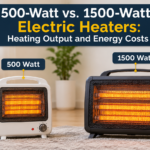

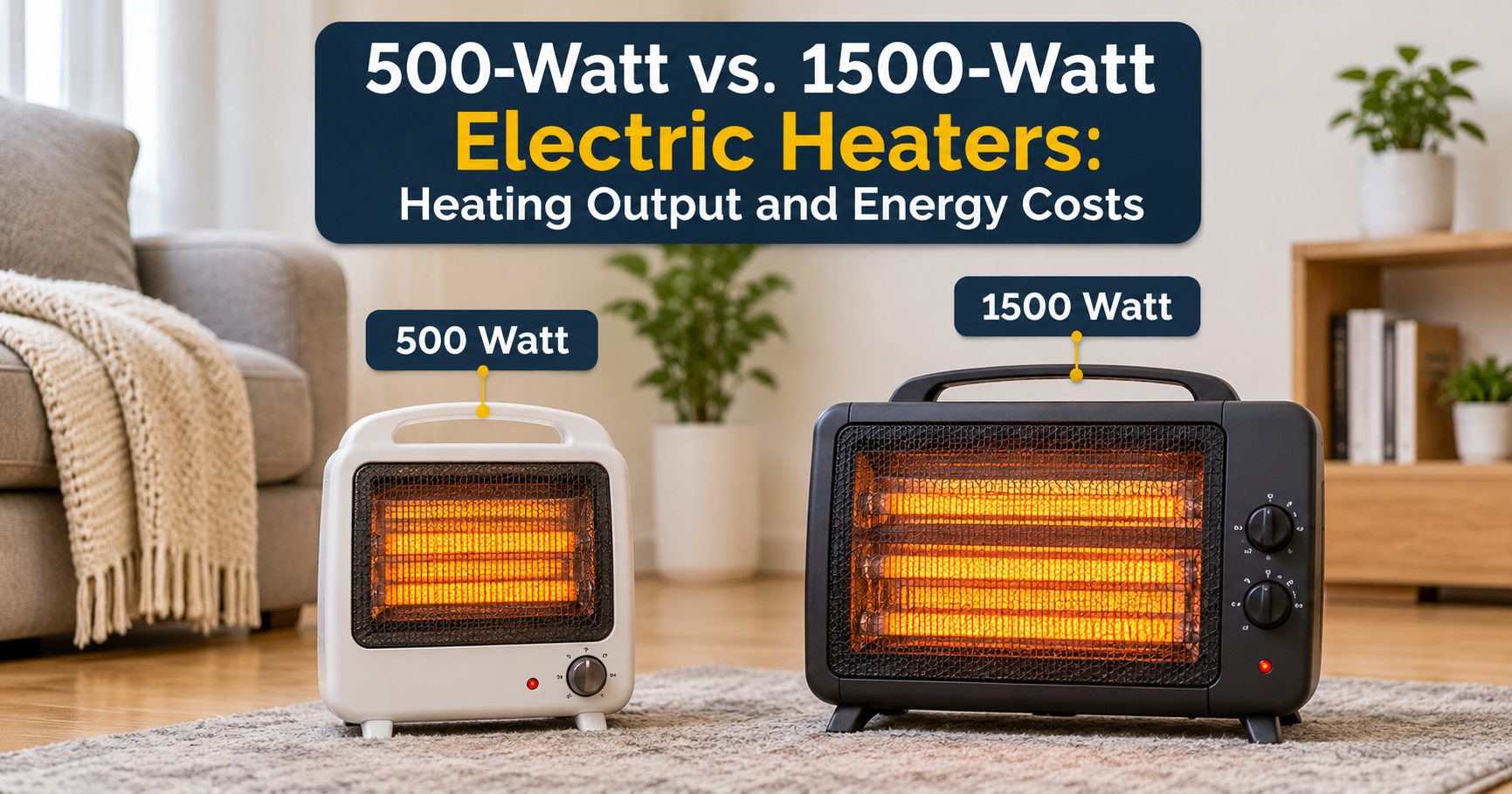

Choosing between a 500 watt vs 1500 watt electric heater looks simple on paper: one is small, the other is big. In real life, the wrong choice means a freezing room, a shocking electricity bill, or a tripped circuit breaker in the middle of winter. Wattage decides how much heat a heater can produce, how much power it pulls from your wall socket, and how large a space it can realistically warm.
This guide explains the real differences between 500W and 1500W electric heaters in plain language. You will learn how much heat each one produces, which room sizes they suit, what they cost to run, how safe they are, and exactly which one to buy for your situation.
Quick Answer: 500W or 1500W?
- Choose a 500W heater if you want to warm a very small space (a desk area, a bathroom, a small study nook) or if you want personal, low-cost warmth close to your body.
- Choose a 1500W heater if you want to heat a full bedroom, living room, or home office of average size.
- Remember: a heater cannot overcome a room that is too large for it. Matching wattage to room size matters more than any brand or feature.

What Does Heater Wattage Actually Mean?
Wattage is the rate at which a heater consumes electricity. Almost all of that electricity is converted into heat, so a higher wattage means more heat produced every hour. Electric resistance heaters are close to 100% efficient at turning electricity into heat, which means a 500W heater and a 1500W heater are equally efficient. The 1500W model simply produces three times as much heat, and uses three times as much power to do it.
Heat output is often measured in BTU per hour. One watt equals about 3.412 BTU per hour, so:
- A 500W heater produces roughly 1,706 BTU per hour.
- A 1500W heater produces roughly 5,118 BTU per hour.
This single fact explains most of the difference between the two. Everything else, from the running cost to the room size, follows from this threefold gap in heat output.
500W vs 1500W Electric Heater: Side-by-Side Comparison
| Feature | 500W Heater | 1500W Heater |
|---|---|---|
| Heat output | About 1,706 BTU/hr | About 5,118 BTU/hr |
| Suggested room size | Up to about 50 sq ft | Up to about 150 sq ft |
| Energy used per hour | 0.5 kWh | 1.5 kWh |
| Current draw at 120V | About 4.2 amps | About 12.5 amps |
| Current draw at 230V | About 2.2 amps | About 6.5 amps |
| Warm-up speed | Slow in anything but tiny spaces | Noticeably faster |
| Portability | Usually very compact and light | Larger, sometimes with wheels or handles |
| Running cost | Low | Three times higher per hour |
| Best use | Spot heating, personal warmth | Whole-room heating |
Heating Power and Room Size
A widely used rule of thumb is that you need about 10 watts of heating power for every square foot of floor area. This assumes a standard ceiling height of around 8 feet and average insulation. Using that rule:
- A 500W heater covers roughly 50 square feet, which is about the size of a small bathroom, a walk-in closet, or a compact desk corner.
- A 1500W heater covers roughly 150 square feet, which is a typical small to medium bedroom or a modest living room.

Several things can change these numbers. Rooms with high ceilings, large windows, poor insulation, uncarpeted floors, or drafty doors need more heating power than the rule suggests. Rooms that are well insulated, small, and closed off may need a little less. If your room is on the borderline, going up to the larger wattage is usually the safer choice because a thermostat will simply cycle the heater off once the target temperature is reached.
What Happens If You Use a 500W Heater in a Large Room?
It will run constantly and still struggle to raise the temperature noticeably. You will feel warmth only if you sit very close to it. Because it never reaches the target temperature, the thermostat never switches it off, so you pay for hours of power without getting a comfortable room.
What Happens If You Use a 1500W Heater in a Small Room?
The room will warm up quickly, sometimes too quickly. A good thermostat will then cut the power and keep the temperature steady, so the actual energy use can be lower than you expect. Without a thermostat, however, the room can become uncomfortably hot and you would need to switch the heater off manually.
Electricity Cost: 500W vs 1500W
Running cost is where most buyers get surprised. The formula is simple:
Cost = Power in kilowatts x Hours of use x Price per kWh
Using an example electricity price of $0.16 per kWh (your actual rate will differ, so replace it with the figure on your own bill):
- 500W heater: 0.5 kWh per hour, costing about $0.08 per hour.
- 1500W heater: 1.5 kWh per hour, costing about $0.24 per hour.

Over a month, the gap becomes significant. At 8 hours of daily use, a 500W heater costs about $19.20 while a 1500W heater costs about $57.60. These are maximum figures that assume the heater runs without pause. In practice, a thermostat cycles the heater on and off, so the true bill is often noticeably lower, especially in a well-insulated room.
Is a 500W Heater Cheaper to Use?
Per hour, yes. Per unit of heat, no. Both heaters convert electricity to heat at nearly the same efficiency, so the cost of each BTU is almost identical. A 500W heater costs less simply because it produces less heat. If it cannot warm your space properly, the lower hourly cost is not a real saving.
How to Lower the Cost of Either Heater
- Use a model with an adjustable thermostat so it does not run non-stop.
- Close doors and windows, and seal drafts around frames and under doors.
- Heat only the room you are using, not the whole home.
- Choose a timer function so the heater does not run when nobody is there.
- Use thick curtains and rugs to hold the warmth inside.
Electrical Load and Safety
A 1500W heater is a heavy electrical load, and this is the part that many buyers ignore.
- Circuit capacity: At 120V, a 1500W heater draws about 12.5 amps, which is close to the limit of a standard 15 amp household circuit. Running other high-power devices on the same circuit can trip the breaker.
- Extension cords: Avoid extension cords and cheap power strips with high-wattage heaters. If you must use one, it must be rated for the load and as short and thick as possible. Plugging the heater straight into a wall socket is best.
- 500W heaters draw far less current, which makes them gentler on old wiring, but they still need proper care.
Essential Safety Features to Look For
- Tip-over protection: shuts the heater off automatically if it falls.
- Overheat protection: cuts power if internal temperature gets too high.
- Cool-touch housing: reduces burn risk, especially around children and pets.
- Certified safety marks: look for recognised safety certification for your country.
- A stable, wide base that does not easily wobble.
Basic Safety Rules for Every Electric Heater
- Keep the heater at least three feet away from curtains, bedding, furniture, and paper.
- Never cover a heater or use it to dry clothes.
- Do not leave it running while you sleep unless the model is designed for it and includes proper safeguards.
- Unplug it when not in use and inspect the cord and plug regularly for damage.
- Never use a heater in a wet area unless it is specifically rated for bathrooms.
Types of Electric Heaters in 500W and 1500W
Wattage is only one part of the decision. The heater type changes how the heat feels and where it works best.
- Ceramic heaters: heat up quickly and are popular in small and medium rooms. Common in both 500W and 1500W versions.
- Fan heaters: blow warm air for fast room warming. Usually compact and affordable, though they can be noisy.
- Oil-filled radiators: warm up slowly but keep radiating heat even after being switched off, and run quietly. Mostly sold at 1500W for bedrooms.
- Infrared or radiant heaters: warm objects and people directly rather than the air. Great for spot heating.
- Panel and mini heaters: slim, wall-mountable, and often found at lower wattages.
Which Heater Is Best for Which Situation?
Best Uses for a 500W Heater
- Keeping your feet and legs warm under a desk.
- Taking the chill off a small bathroom before a shower.
- Warming a small study corner or reading nook.
- Supplementing central heating in a single cold spot.
- Use in places where the electrical supply is limited or older.
Best Uses for a 1500W Heater
- Heating an average bedroom through the night with a thermostat.
- Warming a living room or family room during the evening.
- Heating a home office so you can work comfortably through winter.
- Quickly warming a space that is cold from the start of the day.
Is Neither the Right Choice?
If your room is far larger than 150 square feet, a single 1500W heater will not be enough. Consider a higher-capacity heating solution, two heaters in separate zones where the electrical circuits allow, or a different heating system altogether. Using two 1500W heaters on one circuit is not safe and can overload it.
How to Choose the Right Heater: A Simple Buying Checklist
- Measure your room. Multiply length by width to get square footage.
- Apply the 10-watts-per-square-foot rule and adjust upward for high ceilings, big windows, or poor insulation.
- Check your circuit. Confirm the socket and wiring can handle a 1500W load before you buy.
- Look for an adjustable thermostat and a timer to control running costs.
- Confirm safety features such as tip-over and overheat protection.
- Consider noise level if the heater will be used in a bedroom or office.
- Check portability, such as handles, cord length, and weight, if you plan to move it between rooms.
- Verify the voltage and plug type match your local power supply.
Pros and Cons Summary
| Pros | Cons | |
|---|---|---|
| 500W | Low hourly cost, small and light, gentle on the circuit, ideal for personal warmth | Cannot heat average rooms, slow results, limited usefulness in very cold weather |
| 1500W | Heats full rooms, fast warm-up, wide choice of types and features, strong value for whole-room warmth | Higher electricity cost, heavy circuit load, larger and sometimes noisier |
Frequently Asked Questions
Can a 500W heater heat a whole room?
Only a very small one. For a standard bedroom or living room, a 500W heater will feel underpowered. It works best for spot heating close to where you sit.
Is a 1500W heater too much for a bedroom?
Not for an average bedroom. With a thermostat, a 1500W heater warms the room quickly and then cycles off. It is more likely to be too powerful for a tiny room of under 60 square feet.
How much more electricity does a 1500W heater use than a 500W heater?
Exactly three times as much while running. A 1500W heater uses 1.5 kWh per hour compared with 0.5 kWh for a 500W model.
Can I run two 500W heaters instead of one 1500W heater?
Electrically, two 500W units draw 1000W in total, so they give about two thirds of the heat of a 1500W heater. They can be useful for heating two separate spots, but one 1500W unit is usually more practical for a single room.
Is it safe to leave a 1500W heater on all night?
It depends on the model. Only use a heater overnight if it has thermostat control, tip-over and overheat protection, and is placed well away from bedding and curtains. Many safety experts advise against leaving any portable heater unattended for long periods.
Will a 1500W heater trip my breaker?
It can, if the circuit is already carrying other loads such as a kettle, hair dryer, or air conditioner. Plug it into its own socket and avoid sharing the circuit with other high-power appliances.
Does a higher wattage heater last longer or shorter?
Wattage on its own does not decide lifespan. Build quality, heating element design, and how often the heater cycles matter more. A well-made heater of either wattage can last many winters with proper care.
Which is more energy efficient, 500W or 1500W?
Both convert almost all electricity into heat, so their efficiency is practically the same. What matters is choosing the wattage that suits your room, so the heater is neither struggling nor overpowered.
Final Verdict: 500W vs 1500W Electric Heater
There is no universal winner in the 500 watt vs 1500 watt electric heater debate. The right choice depends on the space you want to warm.
- Pick a 500W heater for personal warmth, desks, bathrooms, and small nooks where low running cost and compact size matter most.
- Pick a 1500W heater for bedrooms, living rooms, and offices where you actually need the room itself to become comfortable.
Measure your room, check your circuit, choose a model with a thermostat and proper safety protection, and you will get warmth that is comfortable, safe, and affordable all winter long.
Note: Room-size figures and cost examples are general estimates. Actual results depend on insulation, ceiling height, climate, and your local electricity rate.