





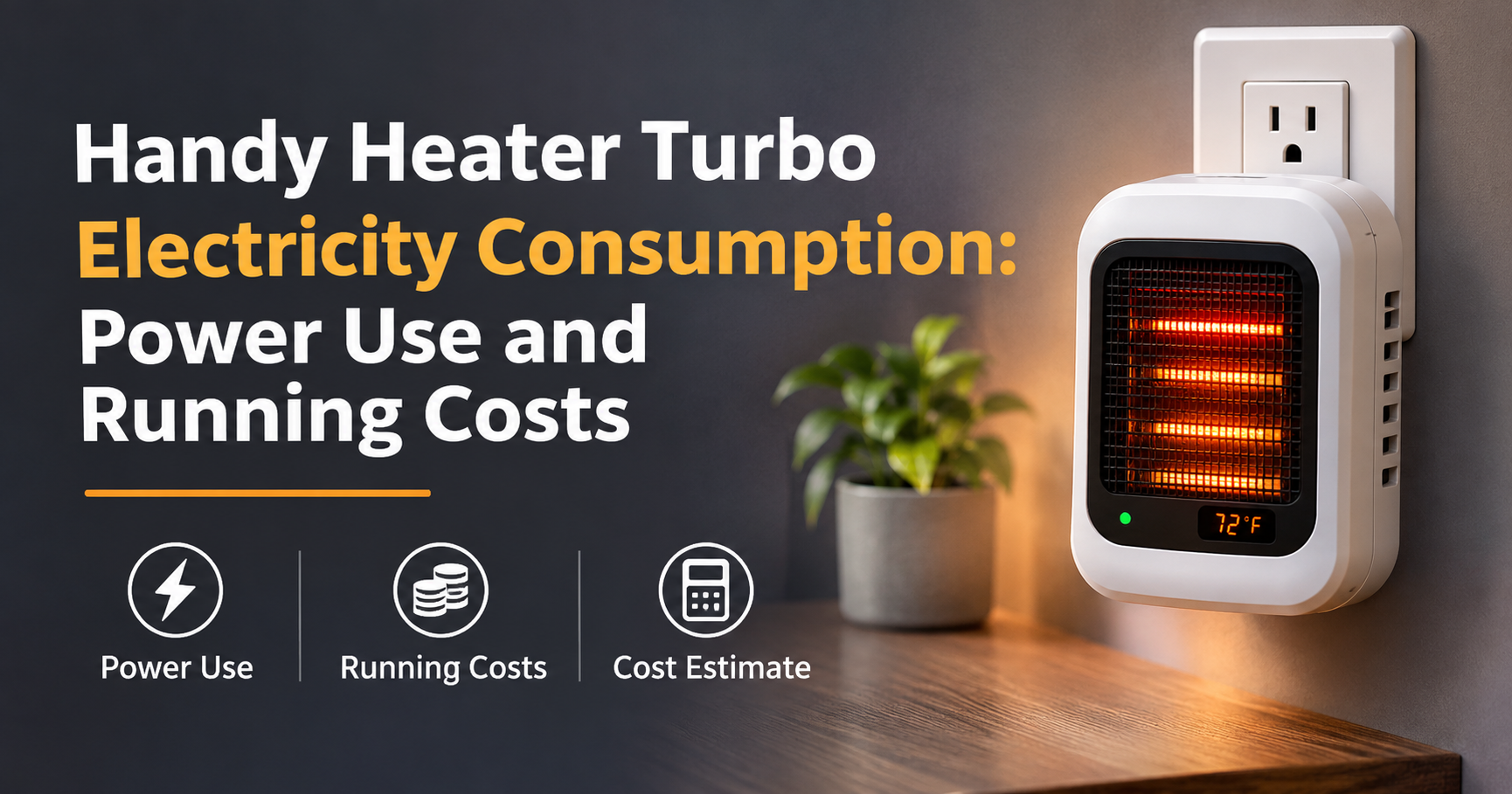
Plug-in wall heaters look tiny, so it is easy to assume they cost next to nothing to run. The Handy Heater Turbo is a popular example: a compact ceramic heater that sits right in your wall outlet. But before you rely on it all winter, you should know exactly what it does to your power bill.
In this guide we break down Handy Heater Turbo electricity consumption in plain numbers: wattage, amps, kWh, and the real cost per hour, per day, and per month. We also compare it with a standard 1500W heater and share practical ways to keep your costs low.
Quick Answer
The Handy Heater Turbo 800 is rated at 800 watts. At full power it uses 0.8 kWh per hour. At an electricity rate of $0.15 per kWh, that is about 12 cents per hour, roughly $0.96 for an 8-hour day, and up to $28.80 per month if it runs at full power 8 hours every day. Because of its thermostat, real-world cost is usually lower.
Table of Contents
- What is the Handy Heater Turbo?
- How many watts does it use?
- How to calculate the running cost
- Cost per hour, day, and month
- Does the thermostat reduce consumption?
- Handy Heater Turbo vs a 1500W heater
- Is it really energy efficient?
- Who should (and should not) buy it
- Safety tips for wall outlet heaters
- How to lower your heating cost
- Pros and cons
- Frequently asked questions
- Final verdict
What Is the Handy Heater Turbo?
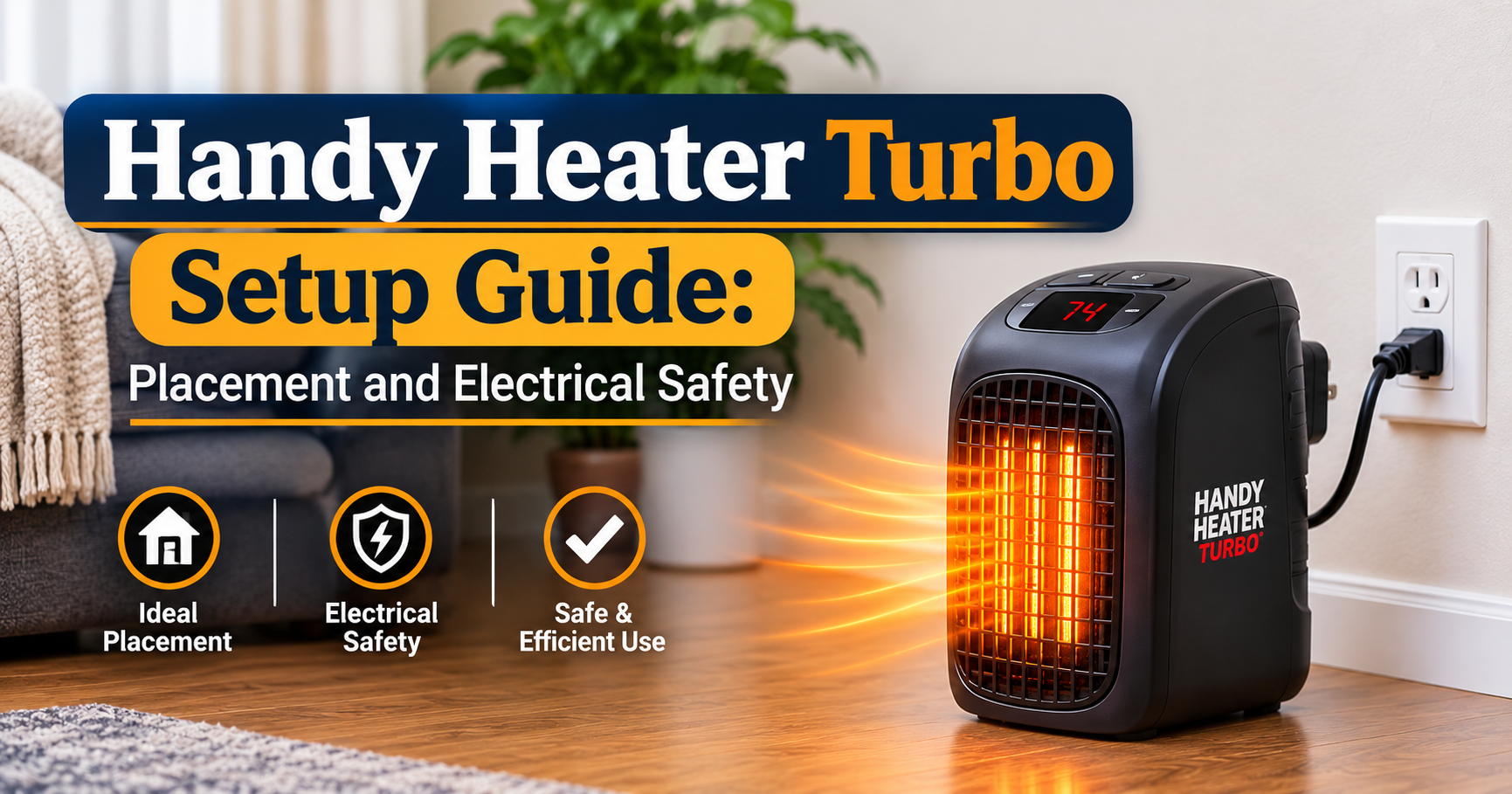
The Handy Heater Turbo (sold as the Turbo 800) is a personal ceramic space heater made by Ontel. Instead of sitting on the floor, it plugs straight into a wall outlet, which saves floor space and removes cord clutter. It is designed for small areas such as bedrooms, bathrooms, home offices, and small living spaces.
Key features listed by retailers include a digital LED display, an adjustable thermostat from roughly 60°F to 90°F, a 12-hour programmable timer, a stay-cool housing, auto shut-off, and quiet operation.
| Specification | Details |
|---|---|
| Model | Handy Heater Turbo 800 |
| Power | 800 watts |
| Voltage | 120V (US version) |
| Heating element | Ceramic (PTC) |
| Thermostat range | About 60°F to 90°F |
| Timer | 12-hour programmable |
| Best for | Small rooms and personal spaces |
Specifications can vary slightly by seller and region, so always check the label on your unit.
How Many Watts Does the Handy Heater Turbo Use?
The Turbo 800 is rated at 800 watts. That number tells you how much electrical power the heater draws when it is actively heating. Here is what it means in everyday units:

- Watts: 800 W
- Amps: about 6.7 A on a 120V circuit (800 ÷ 120)
- Energy: 0.8 kilowatt-hours (kWh) for every hour at full power
- Heat output: about 2,730 BTU per hour (800 × 3.412)
Almost every watt that goes into an electric heater comes out as heat, so the 800W rating is both its power draw and, effectively, its heating capacity.
How to Calculate the Running Cost
You only need three things: the wattage, the hours of use, and your electricity rate (found on your bill in cost per kWh).
Cost = (Watts ÷ 1000) × Hours × Rate per kWh
Example: (800 ÷ 1000) × 8 hours × $0.15 = $0.96
This works for any country and currency. Just use your own local rate per kWh.
Handy Heater Turbo Cost per Hour, Day, and Month
Electricity prices differ widely, so here are four sample rates. The monthly figure assumes 8 hours a day for 30 days at full power (192 kWh), which is the worst case.
| Rate per kWh | Per hour | 8 hours | Month (8 hrs/day) |
|---|---|---|---|
| $0.10 | $0.08 | $0.64 | $19.20 |
| $0.15 | $0.12 | $0.96 | $28.80 |
| $0.20 | $0.16 | $1.28 | $38.40 |
| $0.30 | $0.24 | $1.92 | $57.60 |

Does the Thermostat Reduce Electricity Consumption?
Yes, in most real situations. The Turbo has a built-in digital thermostat. Once the room reaches the temperature you set, the heater cycles off and only turns back on when the room cools. That means it does not draw 800 watts nonstop.
How much you save depends on room size, insulation, outdoor temperature, and your target setting. As a rough illustration, if the heater is actively heating about 60 percent of the time, the monthly figures drop to around 115 kWh, or about $17.28 at $0.15 per kWh (shown in the chart above). In a drafty room or on a very cold night it will run closer to full time, so treat these as estimates, not guarantees.
The 12-hour timer also helps. Setting it to warm a room before you wake up or while you work, instead of leaving it on all day, is one of the easiest ways to trim consumption.
Handy Heater Turbo vs a 1500W Space Heater
A standard portable space heater is usually rated at 1500 watts. That is almost twice the draw of the Turbo 800. Here is how monthly energy use compares at full power, 8 hours a day:

The 800W unit uses roughly 47 percent less energy at full power. But remember: lower wattage also means lower heat output (about 2,730 BTU per hour versus about 5,120 for a 1500W heater). The Turbo 800 costs less to run because it heats less. It will warm a small room well, but it will struggle in a large or poorly insulated space.
Is the Handy Heater Turbo Really Energy Efficient?
Here is the honest answer. All electric resistance and ceramic heaters convert nearly 100 percent of the electricity they use into heat. The Turbo is not magically more efficient than another electric heater of the same wattage. Marketing phrases like “energy efficient” usually refer to its low 800W draw, not to a special ability to create more heat from less power.
Where it can save money is targeted heating. Warming one small room or one workspace is cheaper than turning up central heating for the whole house. If you only need to heat the space you are actually in, a low-wattage personal heater can lower your overall bill.
If you heat large areas for many hours a day, a heat pump or central heating system is far more efficient than any plug-in electric heater.
Who Should Buy the Handy Heater Turbo?
Good fit for:
- Small bedrooms, bathrooms, and home offices
- Renters who want a heater that takes no floor space
- People who want a quiet heater with a timer and thermostat
- Anyone looking for low-wattage spot heating
Not ideal for:
- Large living rooms or open-plan spaces
- Very cold, uninsulated rooms such as garages in deep winter
- Anyone who needs fast, powerful heat
Sellers quote different coverage areas, from about 100 square feet up to around 250 square feet. For the best results, think of it as a small-room heater and expect the lower end of that range in cold weather.
Safety Tips for Wall Outlet Heaters
Any heater that draws close to 7 amps deserves a little care. Follow these basics:
- Plug directly into the wall. Do not use an extension cord or a cheap power strip.
- Check the outlet. Loose, warm, or discolored outlets should be inspected by an electrician before use.
- Avoid overloading the circuit. A 15A circuit can handle the heater alone, but adding other high-draw devices on the same circuit can trip the breaker.
- Keep the area clear. Leave space around the unit and keep curtains, bedding, and furniture away.
- Do not leave it running unattended for long periods, and always follow the user manual.
- Check certifications on the product you receive, since listings differ by seller.
How to Lower Your Handy Heater Turbo Electricity Bill
- Use the timer. Heat the room only when you are in it.
- Set a moderate temperature. Each extra degree makes the heater run longer.
- Seal drafts. Door sweeps and window seals keep warm air inside, so the thermostat cycles off sooner.
- Close the door. Heat one small room instead of letting warmth escape into the hallway.
- Dress warm. A sweater and a blanket let you set the thermostat lower.
- Place it wisely. Avoid outlets behind furniture or heavy curtains where airflow is blocked.
- Track your usage. A plug-in energy meter or your smart meter will show your real consumption.
Pros and Cons
Pros
- Low 800W power draw
- Saves floor space
- Thermostat and 12-hour timer
- Quiet operation
- Affordable to buy
- Auto shut-off and stay-cool housing
Cons
- Limited to small spaces
- Slower heating than 1500W models
- Not more efficient than other electric heaters
- Needs a free, healthy wall outlet
- Specs and certifications vary by seller
Frequently Asked Questions
How many watts does the Handy Heater Turbo use?
The Turbo 800 is rated at 800 watts, which equals 0.8 kWh of electricity per hour at full power.
How much does it cost to run the Handy Heater Turbo for 24 hours?
At full power for 24 hours it would use 19.2 kWh, which is about $2.88 at $0.15 per kWh. In practice the thermostat cycles the heater off at times, so the actual cost is usually lower.
Does the Handy Heater Turbo use a lot of electricity?
Not compared with most space heaters. At 800 watts it uses about half the power of a 1500W heater, but it also heats a smaller area.
Can it trip a circuit breaker?
On its own, a heater drawing about 6.7 amps is well within a typical 15A circuit. Problems usually appear when other heavy appliances share the same circuit, or when the outlet is worn.
Can I use it overnight?
It includes a timer and auto shut-off, which are helpful for sleeping hours. Still, follow the manufacturer’s instructions, keep the area clear, and make sure the outlet is in good condition.
Will it work in 220-240V countries?
The US model is built for 120V. If you live in a 220-240V region, buy a version made for your local voltage and check its wattage label. The cost formula in this article works the same way with any wattage.
Final Verdict
The Handy Heater Turbo draws 800 watts, uses 0.8 kWh per hour, and typically costs around 8 to 24 cents per hour depending on your electricity rate. Thanks to its thermostat and timer, many users will pay less than the full-power estimates above.
It is a sensible, space-saving option for warming a small room, an office corner, or a bathroom. It is not a whole-room solution for large spaces, and it is no more efficient per watt than any other electric heater. If your goal is low-cost, targeted warmth in a compact area, it is a good choice. If you need strong heat for a big room, look at a higher-wattage heater or a more efficient heating system instead.
Disclosure: This article may contain affiliate links on the page where it is published. If you buy through them we may earn a small commission at no extra cost to you. Cost figures are estimates based on sample electricity rates and manufacturer-listed wattage; your actual costs will vary.