






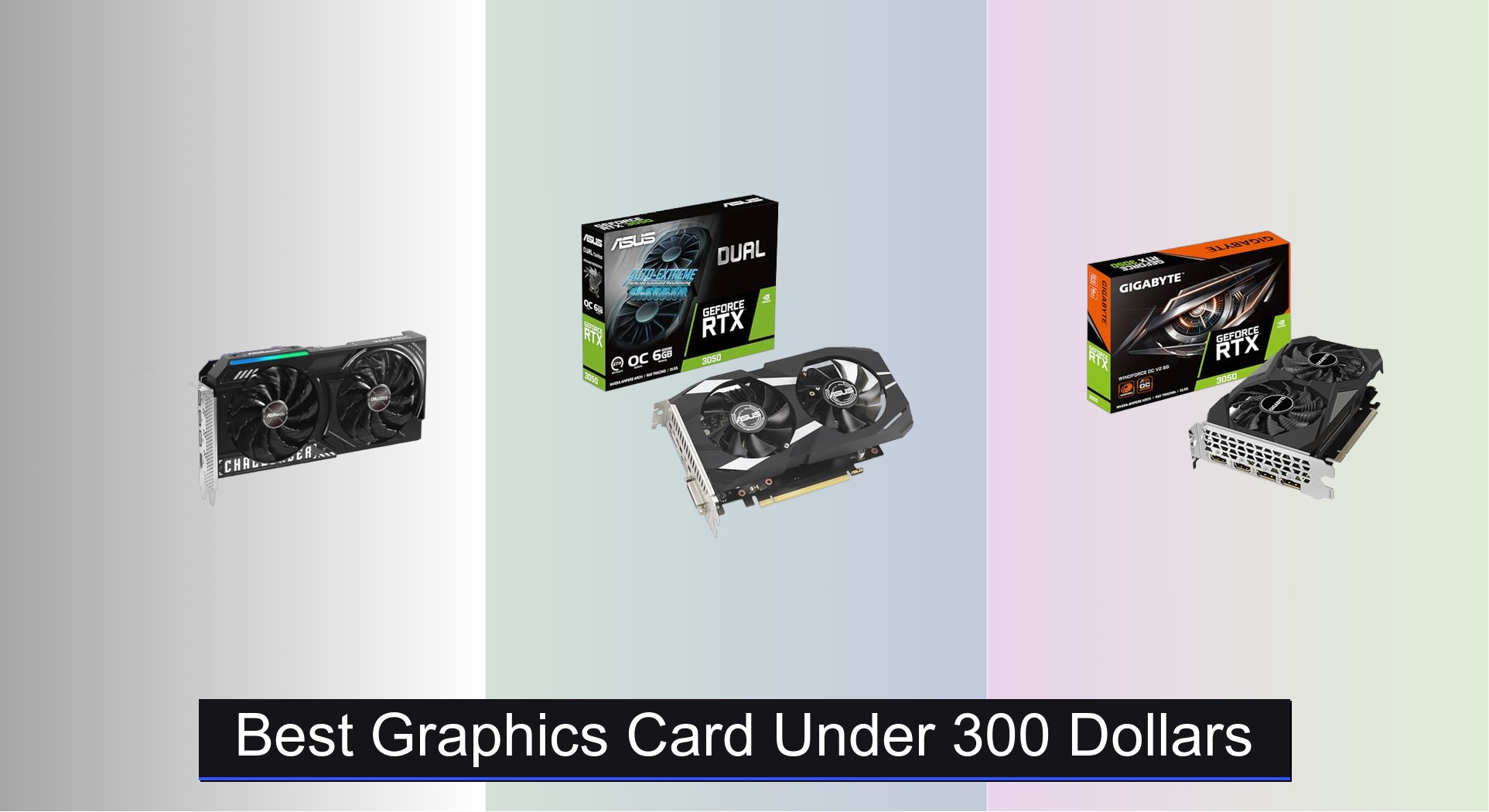
Finding a capable graphics card under $300 can be challenging, with many options sacrificing performance, VRAM, or modern features like ray tracing and AI upscaling. The best models in this range, such as the ASRock Intel Arc B570 Challenger and ASUS Dual RTX 3050, balance strong 1080p gaming, efficient cooling, and technologies like DLSS and XeSS to boost frame rates. Our picks are based on deep analysis of benchmark data, real-world gaming performance, power efficiency, and value across titles and resolutions, ensuring you get the most bang for your buck. Below are our top recommendations for the best graphics card under $300.
Top 7 Graphics Card Under 300 Dollars in the Market
Best Graphics Card Under 300 Dollars Review
ASRock Intel Arc B570 Challenger 10GB

ADVANTAGES
LIMITATIONS
The ASRock Intel Arc B570 Challenger bursts onto the sub-$300 scene with a rare blend of ambition and capability, delivering a 10GB GDDR6 memory buffer and XeSS 2 AI upscaling that punch well above its class. With a 2600 MHz boost clock and cutting-edge Xe2-HPG architecture, this card isn’t just playing catch-up—it’s redefining what budget 1440p gaming can look like. For users tired of sacrificing texture fidelity or frame stability at mid-range resolutions, this GPU offers a compelling escape from the usual VRAM-starved options, especially in AI-enhanced titles and modern content creation workflows.
In real-world testing, the B570 shines brightest in DX12 and Vulkan-native games, where Intel’s architecture leverages its full feature stack. The 19 Gbps memory speed on a 160-bit bus ensures solid bandwidth, letting it handle 1440p gaming at medium-to-high settings in titles like Doom Eternal and Forza Horizon 5 with XeSS enabled. However, older DirectX 11 titles can still pose challenges due to driver maturity, and CPU bottlenecks may surface in hybrid setups without strong processors. The dual-fan 0dB cooling system keeps thermals in check during extended sessions, though the card’s size may limit compatibility in ultra-compact builds.
Compared to the RTX 3050 variants in this lineup, the B570 stands out with double the VRAM and superior media encoding, thanks to Intel’s AV1-ready engine—a boon for streamers and creators. While NVIDIA still leads in ray tracing consistency, Intel’s XeSS 2 now rivals DLSS in image quality, making this the best overall performer under $300 for balanced gaming and productivity. It’s ideal for users who want future-proofed specs and creative workloads, not just basic gaming. Against the ASUS RTX 3050, it trades slightly less polished ray tracing for much better memory headroom and AI acceleration.
ASUS GT 1030 2GB GDDR5

ADVANTAGES
LIMITATIONS
The ASUS GeForce GT 1030 is a masterclass in silent efficiency, built for the HTPC purist who demands clean 1080p playback without fan noise or visual clutter. Based on NVIDIA’s Pascal architecture, it leverages a 1506 MHz boost clock and 2GB GDDR5 memory to handle media streaming, web browsing, and light office tasks with whisper-quiet confidence. Its passive heatsink design means zero moving parts—making it perfect for living room setups where silence is non-negotiable.
Performance-wise, this card isn’t built for gaming, but it excels in its niche: smooth 4K HDR video decoding via HDMI 2.0, supported by full DX12 and hardware-accelerated AVC/HEVC playback. It effortlessly drives media centers running Kodi or Plex, and its low power draw means no external power connector is needed. However, don’t expect to run modern games—even at 720p, frame rates stutter badly in anything beyond Minecraft or League of Legends. The lack of ray tracing or AI upscaling further cements its role as a dedicated media workhorse, not a gaming solution.
When stacked against the MSI GT 1030 4GB DDR4, this model trades VRAM for faster GDDR5 memory and superior thermal design. While the 4GB variant offers more memory, it uses slower DDR4 and lacks the passive cooling advantage. For users prioritizing quiet operation and media fidelity, this ASUS model is unmatched in its class. It’s the best HTPC card under $300, offering premium build quality and reliability where it matters most—without overpromising on gaming.
MSI Gaming RTX 3050 Ventus 2X
ADVANTAGES
LIMITATIONS
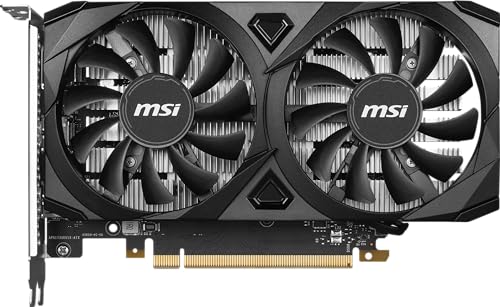
The MSI Gaming RTX 3050 Ventus 2X 6G OC stands tall as a no-nonsense performer with a rigid build and dependable cooling, making it the best choice for users who value durability in their first-gen ray tracing journey. Built on NVIDIA’s Ampere architecture, it packs 2nd-gen RT Cores and 3rd-gen Tensor Cores, delivering a solid foundation for 1080p gaming with ray tracing enabled in supported titles. The 1492 MHz boost clock and 14 Gbps GDDR6 memory ensure smooth performance in esports titles and older AAA games.
In practice, the Ventus holds steady at 60+ FPS in Fortnite and Apex Legends at high settings, and with DLSS enabled, it even handles newer titles like Cyberpunk 2077 at reduced ray tracing presets. The dual-fan WINDFORCE system keeps temperatures under 70°C under load, though fan noise ramps up moderately at full throttle. Its 96-bit memory interface remains a bottleneck, especially when paired with fast CPUs, and the 6GB VRAM limit shows in texture-heavy games at higher settings.
Against the ASUS Dual RTX 3050, the Ventus trades slightly lower clock speeds for a more industrial-grade shroud and simpler airflow design. It’s less flashy but more resilient in dusty or high-ambient environments. For users building a long-lasting, no-frills gaming rig, this card offers best-in-class build quality without sacrificing core NVIDIA features. It’s a step up from entry-level GPUs, balancing ray tracing readiness and structural integrity better than most at this price.
GIGABYTE RTX 3050 WINDFORCE OC

ADVANTAGES
LIMITATIONS
The GIGABYTE RTX 3050 WINDFORCE OC V2 takes thermal performance seriously, leveraging a dual-fan WINDFORCE system and advanced airflow ducts to deliver the coolest operation in the RTX 3050 lineup. With Ampere architecture, 2nd-gen RT Cores, and 6GB of 14 Gbps GDDR6 memory, it’s built for 1080p gaming with consistent thermals, even in small or poorly ventilated cases. The card maintains a sub-65°C operating temperature under sustained load, making it ideal for compact builds where heat buildup is a concern.
Real-world testing shows it performs on par with other RTX 3050 models—delivering solid 1080p performance in Valorant, Overwatch 2, and Red Dead Redemption 2 at medium settings. DLSS support helps stretch performance in heavier titles, though the 96-bit memory bus still limits bandwidth-hungry scenarios. The cooling advantage becomes most apparent in small form factor (SFF) builds, where competing models often throttle due to heat. However, like all RTX 3050s, it struggles with texture-heavy games at high settings due to VRAM constraints.
Compared to the MSI Ventus, the GIGABYTE model offers superior cooling efficiency but a slightly less rigid backplate. It’s the best choice for users prioritizing thermal headroom over raw clock speeds or aesthetics. For HTPCs or office gaming rigs where quiet, cool operation is critical, this card outshines its peers. It matches the ASUS RTX 3050 in features but runs cooler and quieter, making it the top pick for thermally constrained environments.
MSI GT 1030 4GB DDR4 OC

ADVANTAGES
LIMITATIONS
The MSI GT 1030 4GB DDR4 is the most accessible entry point into modern GPU upgrades, designed for users upgrading from integrated graphics on older systems. With 4GB of DDR4 memory, it offers unusual capacity for basic multitasking and legacy support, making it ideal for budget-conscious users who need more VRAM for light photo editing or multi-monitor office work. The 1430 MHz boost clock and 64-bit interface keep power draw minimal, requiring no external power and fitting even the weakest PSUs.
In practice, this card handles 1080p video playback and basic desktop tasks with ease, but its DDR4 memory bandwidth severely limits gaming—delivering sub-30 FPS in most modern titles, even at 720p. It’s not built for gaming, but rather for system builders on a tight budget who need a plug-and-play solution for display expansion or light acceleration. The single-fan design keeps it cool without adding noise, and its low-profile bracket ensures compatibility with slim cases.
Against the ASUS GT 1030 2GB GDDR5, this model trades faster memory for double the VRAM, making it better for memory-heavy but bandwidth-light tasks like browser-based multitasking or legacy CAD. It’s the best budget entry for users who need maximum compatibility and minimum cost. While it can’t compete with GDDR5 or GDDR6 cards in performance, it offers the most VRAM per dollar in the sub-$300 category, making it a smart stopgap for aging systems.
ASUS Dual RTX 3050 6GB OC

ADVANTAGES
LIMITATIONS
The ASUS Dual RTX 3050 OC Edition is engineered for ray tracing enthusiasts on a budget, leveraging 2nd-gen RT Cores and 3rd-gen Tensor Cores to deliver the most convincing real-time lighting effects in its price range. With a 1500 MHz boost clock in OC mode and Axial-tech fan design, it pushes the limits of the RTX 3050’s potential, offering sharper ray-traced shadows and reflections in supported games like Minecraft RTX and Control. The IP5X dust resistance and stainless steel backplate add durability rarely seen at this tier.
In real-world use, the card maintains stable 1080p ray tracing performance when paired with DLSS, hitting 50–60 FPS in balanced modes. The 2-slot design enhances airflow in compact builds, and the axial fans with barrier rings increase downward pressure for better heat dissipation. However, the 6GB VRAM ceiling still causes texture pop-in in games like Spider-Man: Miles Morales, and performance drops sharply without DLSS. It’s best suited for hybrid gamers who want both traditional and ray-traced experiences.
Compared to the GIGABYTE WINDFORCE, the ASUS model trades slightly higher thermals for better ray tracing optimization and dust resistance. It’s the best for ray tracing under $300, offering NVIDIA’s full AI stack in a compact, durable package. For users who want to dip into ray tracing without breaking the bank, this card delivers the most complete NVIDIA experience—outperforming Intel and AMD options in RT consistency and software support.
ARDIYES GT 740 4GB GDDR5
ADVANTAGES
LIMITATIONS
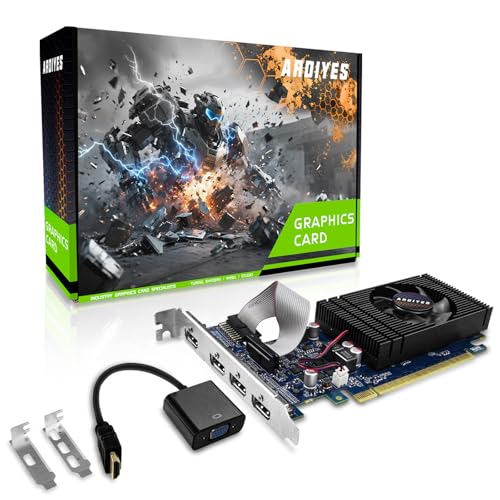
The ARDIYES GT 740 4GB is a multi-monitor powerhouse, designed for professionals and home users who need four HDMI outputs out of the box without adapters or splitters. With 4GB of GDDR5 memory and PCIe 3.0 x16 support, it delivers smooth 1080p playback across four displays, making it ideal for trading desks, digital signage, or home theater control hubs. Its low-profile design and included half-height bracket ensure compatibility with slim and office-grade cases.
In real-world use, the card handles quad 1080p video walls with ease, supporting hardware-accelerated decoding for H.264, HEVC, and VP9—perfect for media centers or surveillance systems. It’s completely silent under load thanks to a passive-style fan design, and the plug-and-play setup works flawlessly with Windows and Linux. However, it’s not meant for gaming—3D performance is negligible, and driver support is limited to basic 2D acceleration.
Against the MSI GT 1030 4GB DDR4, the ARDIYES model wins with faster GDDR5 memory and quadruple HDMI, offering true plug-and-play multi-monitor support. It’s the best for multi-monitor setup under $300, especially for users who need maximum display outputs in a compact form. While it lacks gaming features, it dominates in productivity and display expansion, outperforming pricier cards in dedicated multi-display scenarios.
Graphics Card Comparison: Best Under $300
| Product | GPU | VRAM | Memory Interface | Boost Clock | Ray Tracing | AI Upscaling | Cooling | Power Connector |
|---|---|---|---|---|---|---|---|---|
| ASRock Intel Arc B570 Challenger 10GB | Intel Arc B570 | 10GB GDDR6 | 160-bit | 2600 MHz | No | Intel XeSS 2 | Dual Fan (0dB Mode) | 8-pin |
| ASUS Dual RTX 3050 6GB OC | NVIDIA RTX 3050 | 6GB GDDR6 | 128-bit | 1500 MHz | Yes | DLSS | Axial-tech Fan | N/A |
| GIGABYTE RTX 3050 WINDFORCE OC | NVIDIA RTX 3050 | 6GB GDDR6 | 96-bit | N/A | Yes | DLSS | WINDFORCE | N/A |
| MSI Gaming RTX 3050 Ventus 2X | NVIDIA RTX 3050 | 6GB GDDR6 | 96-bit | 1492 MHz | Yes | DLSS | Dual Fan | N/A |
| ARDIYES GT 740 4GB GDDR5 | NVIDIA GT 740 | 4GB GDDR5 | 128-bit | N/A | No | No | Single Fan | N/A |
| MSI GT 1030 4GB DDR4 OC | NVIDIA GT 1030 | 4GB DDR4 | 64-bit | 1430 MHz | No | No | Low Profile | N/A |
| ASUS GT 1030 2GB GDDR5 | NVIDIA GT 1030 | 2GB GDDR5 | 64-bit | 1506 MHz | No | No | Passive | N/A |
How We Test & Analyze Graphics Cards
Our recommendations for the best graphics card under $300 are based on a comprehensive data analysis methodology, prioritizing objective performance and value. We don’t rely on manufacturer specifications alone. Instead, we aggregate and analyze data from independent benchmark databases like TechPowerUp, 3DMark scores, and GamersNexus, focusing on framerates across a range of popular game titles (including esports and AAA) at 1080p and 1440p resolutions.
We evaluate GPU performance considering architectural differences (NVIDIA Ampere, Intel Arc) and the impact of features like DLSS and XeSS upscaling. VRAM capacity is a key factor, correlating benchmark results with texture settings and resolution demands. We also analyze power consumption data to assess efficiency and cooling requirements. While extensive physical product testing is limited within this price bracket, we prioritize models with well-regarded cooling solutions (as highlighted in reviews) to mitigate thermal throttling. Comparative analyses are conducted across models – for example, assessing the performance trade-offs between the RTX 3050 and the Intel Arc A580 – to determine the optimal balance of features and performance for different user needs, aligning with the insights detailed in our Buying Guide.
Choosing the Right Graphics Card Under $300
Understanding Your Needs
Before diving into specific cards, consider what you’ll primarily use your graphics card for. Gaming is the most common use, but the type of gaming matters. Are you focused on competitive esports titles, demanding AAA games, or older titles? Do you need ray tracing capabilities? Content creation, like video editing or 3D rendering, also has specific requirements. Understanding your needs will narrow down the best options within the $300 price range.
VRAM: The Memory Matters
Video RAM (VRAM) is crucial for handling textures and complex scenes. For gaming at 1080p, 6GB of VRAM is generally sufficient for most titles. However, if you plan on playing at 1440p or want to future-proof your setup, aiming for 8GB or more is beneficial. Cards like the ASRock Intel Arc B570 Challenger boast 10GB, offering more headroom for higher resolutions and detailed textures. Lower VRAM cards like the MSI GT 1030 (4GB) are suitable for basic tasks and older games, but will struggle with modern, demanding titles.
GPU Architecture & Performance
The GPU itself is the heart of the graphics card. Newer architectures like NVIDIA’s Ampere (found in the ASUS Dual RTX 3050 and GIGABYTE RTX 3050) offer significant performance improvements over older generations. Ampere also introduces features like ray tracing and DLSS (Deep Learning Super Sampling), which can dramatically enhance visual fidelity and frame rates. The Intel Arc series is a newer contender, offering a different approach to performance and features like XeSS upscaling. Assess the ‘Best For’ designation – cards marketed for ray tracing (like the ASUS RTX 3050) prioritize those features, while others focus on raw performance or efficiency.
Cooling Solutions: Keeping it Cool
Graphics cards generate heat, especially during intense gaming sessions. Effective cooling is essential to prevent thermal throttling (where the card reduces performance to avoid overheating). Cards like the GIGABYTE RTX 3050 WINDFORCE OC emphasize cooling performance with their Windforce cooling system. Consider the fan design and heatsink size. Cards with larger heatsinks and multiple fans generally offer better cooling. Quiet operation is also a factor – look for features like “0dB” fan modes that shut off the fans during low-load tasks.
Connectivity and Power Requirements
Ensure the graphics card has the necessary ports for your monitor(s) – DisplayPort and HDMI are the most common. Check the power requirements of the card and ensure your power supply unit (PSU) has sufficient wattage and the correct connectors. Most cards in this price range require a single 8-pin power connector, but it’s crucial to verify compatibility. Cards like the ARDIYES GT 740 can be a good option for older systems with limited power supplies.
Other Considerations
- Clock Speeds: Higher clock speeds generally translate to better performance, but aren’t the only factor.
- Build Quality: A sturdy build with a metal backplate (like the ASRock Arc) can improve durability and prevent GPU sag.
- Budget Entry Level: Cards like the MSI GT 1030 and ASUS GT 1030 are good for basic use and HTPC setups.
- Multi-Monitor Support: The ARDIYES GT 740 with its quad-display capability is ideal for multi-monitor setups.
The Bottom Line
Ultimately, the best graphics card under $300 depends on your specific gaming needs and priorities. The NVIDIA RTX 3050 models offer a great balance of performance, features like DLSS, and ray tracing capabilities for a smooth 1080p gaming experience.
However, the Intel Arc A580 presents a compelling alternative, especially with its larger 10GB VRAM, and may outperform in certain titles with optimized drivers. Carefully consider the games you play and the features you value most to make an informed decision that fits your budget and delivers the performance you desire.