
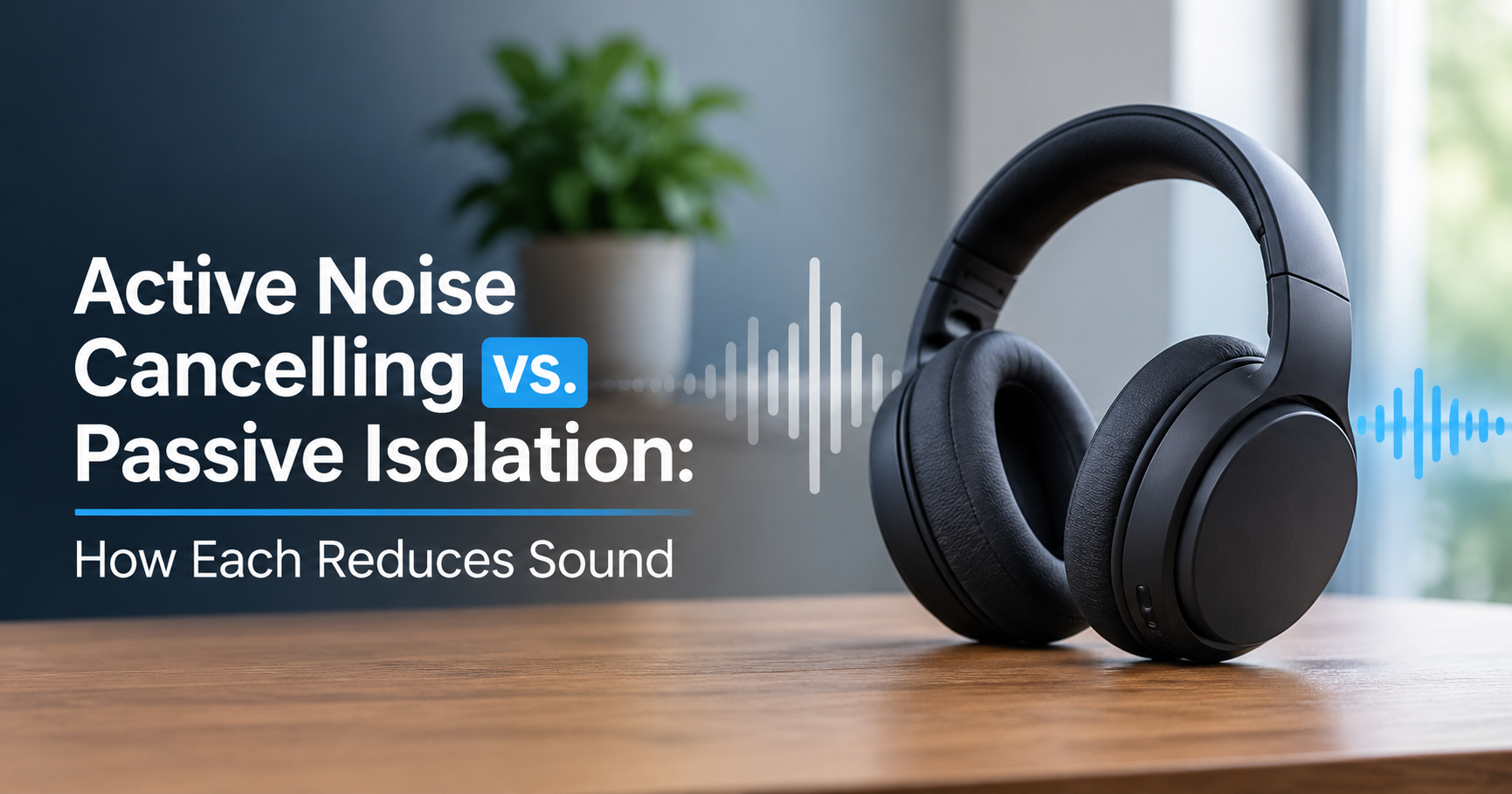
Shopping for headphones or earbuds today means facing a choice: active noise cancelling vs passive isolation. Both promise a quieter listening experience, but they work in completely different ways, and the right pick depends on where and how you listen. This guide explains how each technology works, where it shines, where it falls short, and how to choose confidently.
What Is Passive Noise Isolation?
Passive isolation is the original form of noise reduction. It relies purely on physical design: the shape of the ear cup, dense padding, snug ear tips and the materials around the driver. Nothing needs power. If you have ever pressed your hands over your ears or used foam earplugs, you have used the same principle.
How Passive Isolation Works
Sound travels through air as pressure waves. A good seal between the headphone and your ear blocks many of those waves from entering the ear canal. Over-ear headphones do this with thick cushions and a closed-back shell. In-ear earphones do it with silicone or memory-foam tips that sit inside the canal.
Pros of Passive Isolation
- No battery needed for the noise-reduction feature
- Very effective against mid and high frequencies such as voices and clattering
- No electronic hiss or “pressure” sensation
- Usually lighter and more affordable
- Reliable: nothing to switch on, fail or update
Cons of Passive Isolation
- Weak against low, steady rumble like airplane engines and buses
- Depends heavily on fit, so a poor seal means poor results
- Tight tips or heavy clamping can become uncomfortable in long sessions
What Is Active Noise Cancelling (ANC)?
Active noise cancelling uses electronics to fight noise. Tiny microphones on the headphones listen to the environment, and a processor generates a sound wave that is the exact opposite (inverted phase) of the incoming noise. When the two waves meet, they largely cancel each other out, which is why the technique is also called destructive interference.
Types of ANC
- Feedforward: microphones sit on the outside of the ear cup and react to noise before it reaches you.
- Feedback: microphones sit inside the ear cup and correct what you actually hear.
- Hybrid: uses both for the strongest and most consistent cancelling, found in most premium models.
- Adaptive ANC: automatically adjusts the strength based on your surroundings and the fit.
Pros of ANC
- Excellent at reducing constant low-frequency noise such as engines, fans and air conditioning
- Reduces listening fatigue, so you can enjoy music at lower volume
- Often includes transparency or ambient mode to hear announcements and traffic
- Great for travel, open offices and commuting
Cons of ANC
- Needs battery power; ANC usually shortens playtime
- Typically costs more
- Less effective against sudden, sharp sounds such as a shout or a dropped plate
- Some people notice ear pressure or a faint hiss
Active Noise Cancelling vs Passive Isolation: Key Differences
| Feature | Active Noise Cancelling | Passive Isolation |
|---|---|---|
| How it works | Microphones and anti-noise signal | Physical blocking of sound |
| Best against | Low, steady noise | Mid and high-pitched noise |
| Needs power | Yes | No |
| Price | Mid to high | Low to mid |
| Battery impact | Reduces playtime | None |
| Depends on fit | Yes, but less | Very much |
Which Noises Does Each One Handle Best?
Sound is not all the same. Low-frequency noise has long wavelengths that slip past physical barriers, so ANC handles it far better. High-frequency sounds have short wavelengths that padding and good seals block easily, but they change too quickly for ANC to predict. That is why the strongest headphones combine both technologies.
Which Should You Choose?
Choose ANC If You…
- Fly, take trains or ride buses regularly
- Work in an open office or noisy home
- Want to listen at lower volume to protect your hearing
- Do not mind charging your device
Choose Passive Isolation If You…
- Are on a tighter budget
- Exercise, where a secure fit and long battery life matter
- Dislike the pressure sensation some ANC systems create
- Want simple, dependable headphones for study or the studio
Choose a Hybrid Approach If You…
Want the best of both worlds. Well-designed ANC headphones already include strong passive isolation from cushions and ear tips, so the two work together. Many people find this combination gives the quietest result.
Buying Tips Before You Decide
- Prioritize fit: Both technologies fail without a good seal. Try different ear-tip sizes.
- Check battery life: Look at hours with ANC turned on, not off.
- Look for a transparency mode: It is useful for safety and quick conversations.
- Consider call quality: Good microphones matter if you take meetings.
- Read real-world reviews: Marketing claims about decibels rarely tell the full story.
- Think about comfort: You may wear them for hours, so weight and clamping force matter.
Frequently Asked Questions
Is active noise cancelling bad for your ears?
No. ANC does not emit harmful signals. It can actually help, because you are less likely to raise the volume to overcome background noise. Some people feel temporary pressure, which is not a sign of damage.
Can ANC completely eliminate noise?
No. It greatly reduces constant sounds but cannot remove everything, especially sudden or high-pitched noise.
Does ANC drain the battery faster?
Yes, usually by a modest amount, since the microphones and processor are always working.
Is passive isolation enough for a flight?
It helps, but engine rumble is low-frequency, so ANC generally performs noticeably better on planes.
Can I use ANC headphones with ANC off?
Yes. Most models still deliver good passive isolation when ANC is switched off or the battery is empty.
Final Verdict
There is no single winner in the active noise cancelling vs passive isolation debate. ANC is the stronger choice for travel and steady background noise, while passive isolation offers simplicity, value and battery freedom. For the quietest experience, pick headphones that pair great physical isolation with quality ANC. Match the technology to your daily routine, and you will enjoy cleaner sound and less fatigue wherever you listen.