









If you have ever pasted a long document into an AI chatbot and watched it forget the beginning of your conversation, you have already met the context length limit. It is one of the most important specs of any large language model (LLM), yet it is also one of the most misunderstood.
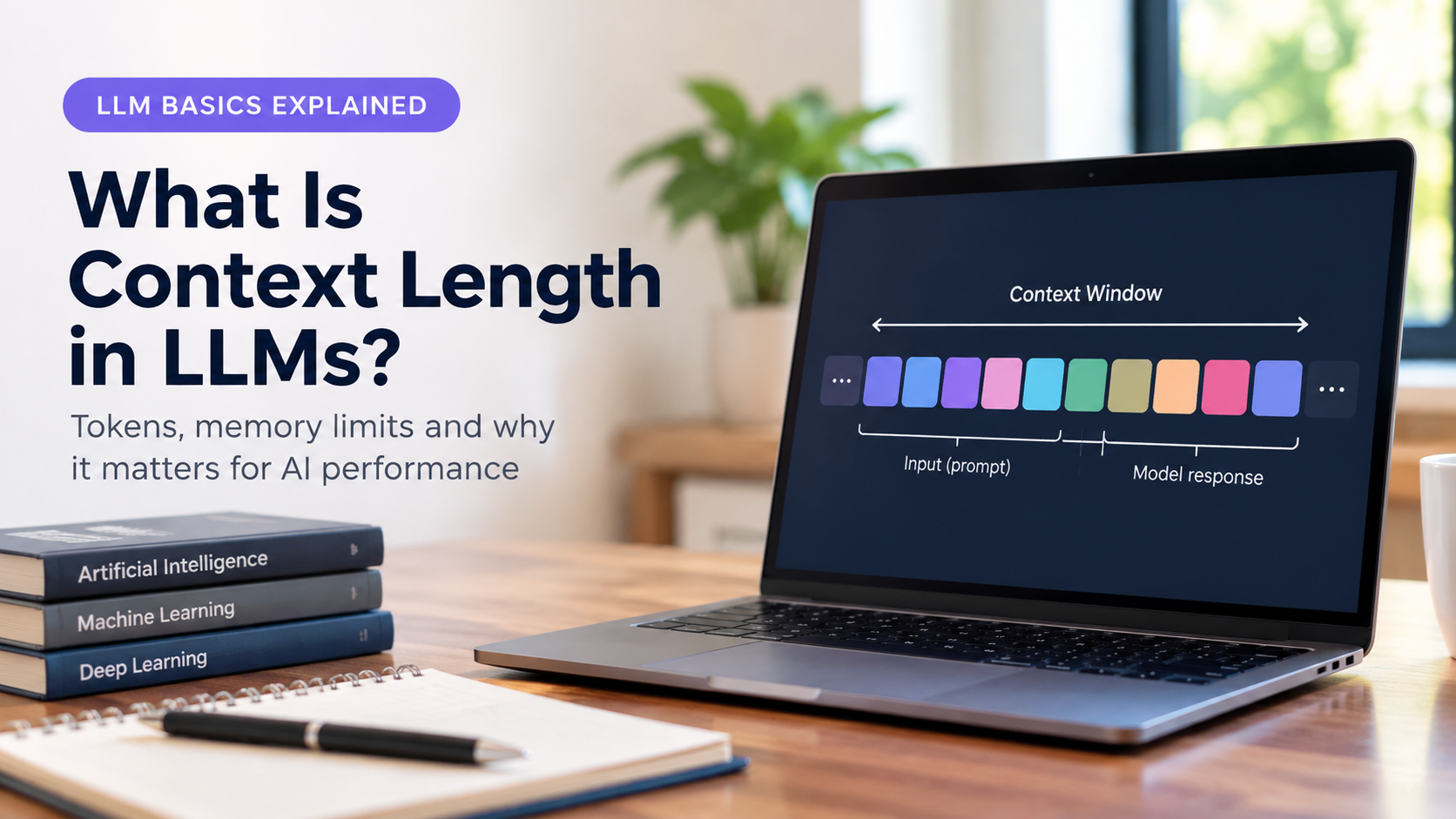
So, what is context length in LLM? In simple terms, context length is the maximum amount of text, measured in tokens, that a language model can read and consider at one time. It covers everything: your instructions, the conversation so far, any files you add, and the answer the model writes back. In this guide, you will learn how context length works, how tokens are counted, why bigger is not always better, and how to choose the right setup for your needs.
Context Length in LLM: A Simple Definition
Think of context length as the model’s working memory, like a desk. Everything on the desk is visible and usable. If the desk is small, older papers must be removed to make room for new ones. A model with a short context length has a small desk, and a model with a long context length has a large one.
You will see several terms used for the same idea:
- Context length is the maximum number of tokens the model can handle.
- Context window is the same limit, described as the “window” of text the model can see.
- Token limit is a common everyday phrase for it.
Some people separate these terms slightly, using context length for what the model was trained on and context window for what a product allows in practice. For most readers, treating them as the same thing works well.
What Is a Token?
LLMs do not read words the way people do. They break text into small pieces called tokens. A token can be a whole word, part of a word, a number, a punctuation mark, or even a space.

As a general rule for English text:
- 1 token is roughly 4 characters
- 1 token is roughly three quarters of a word
- 100 tokens are about 75 words
- 1,000 tokens are about 750 words, or around a page and a half of text
These numbers change with the language and content. Programming code, tables, URLs, math, and many non-English languages usually need more tokens for the same amount of meaning. This is why a prompt that looks short can still use a surprising amount of your limit.
What Counts Toward the Context Length?
Many beginners assume the limit applies only to what they type. In reality, the context window is shared by everything the model processes in one request.

- System prompt. Hidden instructions that set the model’s behavior.
- Conversation history. Earlier messages from both you and the AI.
- Attached content. Documents, code, search results, or pasted articles.
- Your current question.
- The model’s reply. The answer also uses tokens from the same budget.
This last point matters. If your input fills almost the whole window, the model has very little room left to write its answer, and the reply may be cut short.
Why Context Length Matters
Context length directly shapes what you can do with an AI model.
Long Documents
Summarizing a report, contract, research paper, or book chapter requires the whole text to fit in the window. A short limit forces you to split the document into pieces and lose the big picture.
Long Conversations
In a long chat, the full history is sent along with each new message. Once the limit is reached, older messages are trimmed or summarized, and the model can seem to forget earlier details.
Coding Projects
Developers need the model to see multiple files, error logs, and documentation at once. Longer context lets the AI understand how different parts of a project connect.
Research and Analysis
Comparing several sources, reviewing long transcripts, or analyzing large datasets in text form all depend on a generous context window.
Accuracy and Consistency
When the right facts are inside the context, the model can use them directly instead of guessing. This reduces mistakes and makes answers more faithful to your material.
How Context Length Has Grown
Early language models handled only a thousand or two tokens, which was barely a few pages. Over time, context windows expanded steadily, and today many leading models support very large windows, with some reaching a million tokens or more. Exact limits differ by model and provider, so always check the current specifications.

| Context Size | Approx. English Words | Roughly Equal To |
|---|---|---|
| 4K tokens | 3,000 words | A long blog post |
| 32K tokens | 24,000 words | A short report or ebook |
| 128K tokens | 96,000 words | A full-length novel |
| 1M tokens | 750,000 words | Several books or a large codebase |
What Happens When You Exceed the Context Length?
When the content is too large, different systems behave differently:
- Error message. Some tools simply reject the request and ask you to shorten it.
- Truncation. The oldest text is cut off so the newest fits.
- Summarization. The app compresses older messages into a brief summary.
- Cut-off answers. The reply stops mid-sentence because the output budget ran out.
In all cases, the model cannot use information that is no longer inside the window. It does not secretly remember it.
Why Not Just Make the Context Length Huge?
Longer context sounds perfect, but it comes with real trade-offs.
1. More Computing Cost
Language models use a mechanism called attention to compare tokens with each other. As the number of tokens grows, the amount of work grows quickly. Longer prompts take more time to process and cost more to run.
2. More Memory Use
While generating text, a model stores data about previous tokens in a structure known as the KV cache. The longer the context, the larger this cache becomes. This is a major reason long context needs more GPU memory (VRAM) or system RAM.

3. Slower Responses
Very large prompts can take longer before the model begins to answer, and generation can slow down as the cache grows.
4. Attention Can Weaken in the Middle
Studies have shown that some models are better at using information at the beginning and end of a long prompt than information buried in the middle. A large window does not guarantee perfect recall of every detail, so important facts should be placed clearly and repeated when needed.
5. More Noise
Stuffing in irrelevant text can distract the model. A focused prompt with the right information often beats a giant prompt full of clutter.
Context Length vs. Memory vs. Training Data
These ideas are often mixed up, so here is the difference:
- Training data is the huge body of text the model learned from before release. It shapes general knowledge and does not change during your chat.
- Context length is the temporary space for the current task. It resets when you start a fresh conversation unless the app saves information for you.
- Memory features in some apps store notes between chats and insert them into the context when needed. They work by adding text to the window, not by expanding it.
How Context Length Works Inside the Model
You do not need to be an engineer to understand the basics. A transformer model gives each token a position, so it knows the order of words. During training, the model sees sequences only up to a certain length, which sets the length it handles best. Engineers use techniques such as improved position encoding, more efficient attention methods, and extra training on long text to stretch this limit. Models are also trained and tuned specifically for long inputs, so a model’s advertised limit reflects both its design and its training.
Context Length for Local LLM Users
If you run models on your own computer, context length becomes a hardware decision. Two things use memory: the model itself and the KV cache that grows with context.
- VRAM is the main limit. A GPU with more VRAM can hold larger models and longer contexts together.
- Quantization helps. Compressed models use less memory, leaving more room for context.
- You can set the context size. Most local tools let you choose a context length. A larger setting uses more memory, so start with what you really need.
- System RAM is a backup. Memory can spill into RAM, but speed usually drops noticeably.
If you plan to work with long documents or large codebases locally, prioritize a GPU with generous VRAM and fast memory. For basic chat and short tasks, a modest setup with a smaller context is usually enough.
Techniques to Work Around Context Limits
- Summarize as you go. Ask the model to condense earlier parts of the conversation, then continue using the summary.
- Chunk large documents. Split long files into sections, process each, and combine the results.
- Use retrieval (RAG). Search your documents for the most relevant passages and give only those to the model.
- Start fresh chats. A new conversation clears old history and frees up space for the next task.
- Trim the prompt. Remove filler, repeated instructions, and unrelated text.
- Put key instructions clearly. State the goal at the start, and repeat critical details near the end of a very long prompt.
How to Choose the Right Context Length
| Use Case | Suggested Context |
|---|---|
| Quick questions and short chats | 4K to 8K tokens |
| Writing, emails and articles | 8K to 32K tokens |
| Summarizing reports and PDFs | 32K to 128K tokens |
| Coding across many files | 64K to 200K tokens |
| Books, large archives and big codebases | 200K to 1M+ tokens |
These are practical starting points, not strict rules. Pick the smallest context that comfortably fits your task, because it saves cost, memory, and time.
Common Myths About Context Length
- Myth: A bigger context window always means a smarter model. Reality: Context length measures capacity, not intelligence or reasoning quality.
- Myth: The model remembers everything in a long chat perfectly. Reality: Recall can weaken, especially for details buried in the middle.
- Myth: Context length is the same as the number of words. Reality: It is measured in tokens, which are usually smaller than words.
- Myth: The model learns from my chat permanently. Reality: Context is temporary working memory, not permanent training.
Frequently Asked Questions
What is context length in LLM in simple words?
It is the maximum amount of text, counted in tokens, that an AI model can read and use at one time, including your prompt, the chat history, and its own answer.
Is context length the same as a token limit?
In everyday use, yes. Both describe how many tokens fit in a single request, although some providers also set a separate limit for the length of the output.
How many words is 128K tokens?
Roughly 96,000 English words, which is about the length of a full novel.
Does a longer context length make the model slower?
Often, yes. More tokens mean more processing, more memory use, and a longer wait before the first part of the answer appears.
Can I increase the context length of a model?
For hosted AI services, the limit is set by the provider. For local models, you can often adjust the context setting, up to the maximum the model supports and as far as your hardware allows. Going beyond the supported maximum can reduce quality.
Why does the AI forget what I said earlier?
Either the old messages no longer fit in the window, or the model did not give them enough attention among a large amount of text. Summarizing or restating key facts helps.
What is the difference between context length and memory?
Context length is the temporary space used in the current request. Memory features store information between chats and then add it back into that space when needed.
How can I check how many tokens my text uses?
Many AI apps and developer tools show token counts, and you can estimate by dividing your word count by 0.75 for English text.
Final Thoughts
So, what is context length in LLM? It is the model’s working memory: the total number of tokens it can consider at once, shared between your input and its output. A larger context length lets an AI handle long documents, big projects, and extended conversations, but it also brings higher cost, heavier memory needs, and no promise of perfect recall.
The best approach is to match the context size to the job. Keep prompts focused, use summaries and retrieval for large material, and, if you run models locally, plan your hardware around the context length you truly need. With that knowledge, you can choose the right AI model and get far better results from every conversation.