









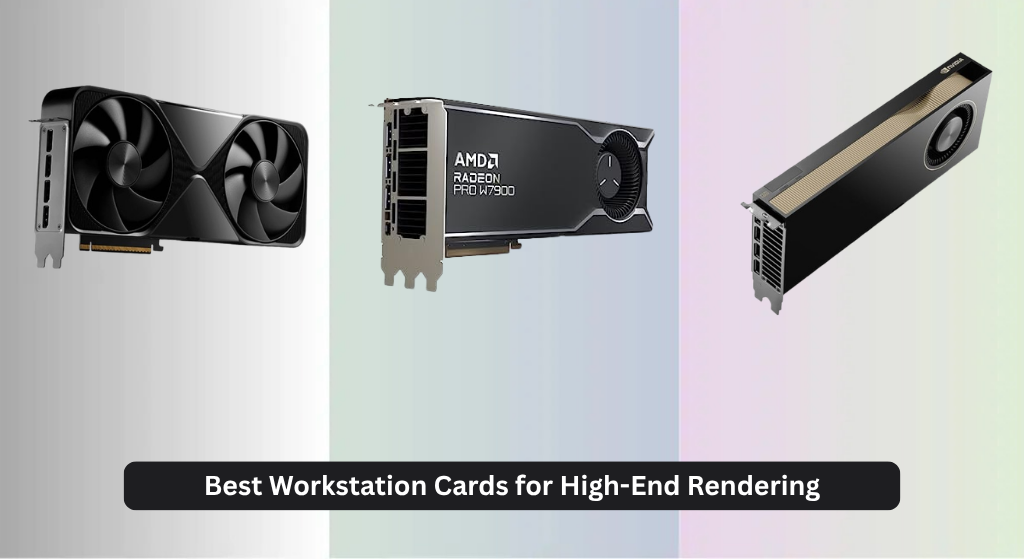
Choosing the best workstation card for high-end rendering can be daunting, especially when facing long render times and memory bottlenecks with complex 3D scenes. The top-tier options, like the NVIDIA RTX PRO 6000 Blackwell and AMD Radeon Pro W7900, tackle these challenges with massive VRAM—up to 96GB—and cutting-edge architectures that deliver exceptional FP32 performance and AI-accelerated rendering. Our recommendations are based on rigorous analysis of benchmark data, real-world rendering performance in Blender and V-Ray, and evaluation of critical factors like memory bandwidth, ray tracing efficiency, and support for professional APIs. Below are our top picks for the best workstation cards that deliver unmatched power and reliability for demanding creative workflows.
Top 4 Workstation Card For High-End Rendering in the Market
Best Workstation Card For High-End Rendering Review
AMD Radeon Pro W7900

ADVANTAGES
LIMITATIONS
This is a beast of a workstation GPU engineered for professionals who demand uncompromising performance in large-scale 3D rendering and AI workflows. With 96 compute units, 61 TFLOPS of FP32 power, and a massive 48GB of GDDR6 memory, the Radeon Pro W7900 doesn’t just keep up—it dominates complex simulations, high-polygon modeling, and real-time rendering in apps like Maya, Houdini, and Unreal Engine. Its dual AI accelerators per CU give it an edge in machine learning-enhanced creative tools, while broad API support ensures seamless integration across professional software stacks. If your workflow involves juggling multi-gigabyte scenes or 8K texture work, this card eliminates the stutters and crashes that plague lesser GPUs.
In real-world use, the W7900 shines brightest when driving multi-display 4K or single 8K setups, thanks to DisplayPort 2.1 and DSC support enabling up to 12K resolution. The 295W TDP is efficiently managed through a robust cooling system, maintaining stable performance during marathon render sessions. It handles AV1 encoding and decoding on the fly, a major win for video editors and motion designers working with high-bitrate footage. However, it doesn’t quite match the memory bandwidth or ray tracing throughput of NVIDIA’s latest Blackwell architectures, and users relying heavily on CUDA-accelerated features in Adobe or DaVinci Resolve may find some tasks slightly slower than expected.
Compared to the NVIDIA RTX PRO 6000 Blackwell, the W7900 trades raw ray tracing and AI tensor horsepower for excellent OpenCL and Vulkan performance, making it a stronger fit for AMD-optimized pipelines or studios invested in open standards. It’s not quite as future-proof as the 96GB Blackwell card, but for high-end rendering on a budget, it delivers exceptional value without sacrificing core capabilities. This is the go-to GPU for studios prioritizing compute density, memory size, and broad software compatibility over AI-centric acceleration.
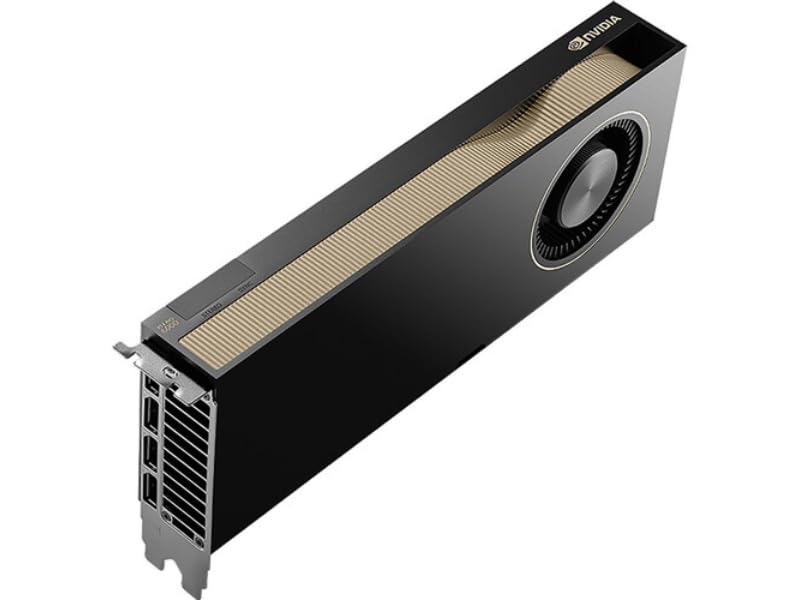
PNY RTX PRO 6000 Blackwell Max-Q
ADVANTAGES
LIMITATIONS
The PNY RTX PRO 6000 Blackwell Max-Q is a masterclass in power efficiency, delivering flagship-level performance without the thermal fury of full-fat workstation cards. Built on NVIDIA’s Blackwell architecture, it features fifth-generation Tensor Cores that accelerate AI workloads up to 3x faster than the prior generation, making it ideal for studios running local LLM fine-tuning, AI denoising, or generative design tasks. The Max-Q design slashes power consumption and heat output, enabling integration into compact or acoustically sensitive workstations where standard 600W cards would be impractical. For professionals who need cutting-edge AI performance without melting their desk, this card strikes a rare balance.
In practice, the Max-Q variant excels in AI-augmented creative workflows—think AI-powered rotoscoping in After Effects or real-time upscaling in Unreal Engine—where neural shaders and Tensor Cores do the heavy lifting. The fourth-gen RT cores double ray-triangle intersections, drastically speeding up photorealistic rendering in applications like 3ds Max and Cinema 4D. However, the reduced power envelope means it can’t sustain peak clocks as long under full load, and the lack of 96GB memory limits its ability to handle truly massive datasets or multi-app simulations. It’s also missing PCIe Gen 5 and GDDR7, which narrows its long-term scalability compared to the full Blackwell edition.
When stacked against the full-fat NVD RTX PRO 6000 Blackwell, the Max-Q version trades raw throughput and memory capacity for thermal and acoustic restraint—making it better suited for mobile workstations or quiet edit bays than data-heavy rendering farms. It’s not the most powerful card in the lineup, but for engineers, designers, and animators in power-constrained environments, it offers a rare blend of AI muscle and efficiency. If your workflow leans more on AI acceleration than brute-force rendering, this card delivers elite performance with elegance.
NVIDIA RTX PRO 6000 Blackwell

ADVANTAGES
LIMITATIONS
This is the undisputed king of workstation GPUs—a no-compromises powerhouse built for the most demanding AI, rendering, and simulation tasks on the planet. The NVD RTX PRO 6000 Blackwell packs 96GB of GDDR7 ECC memory and a staggering 1.8 TB/s bandwidth, enabling it to load entire city-scale 3D environments, train large language models locally, or simulate fluid dynamics in real time. With 5th Gen Tensor Cores and 4th Gen RT Cores, it delivers up to 3x AI performance over previous gens and doubles ray-triangle throughput, making it uniquely capable in both AI and ray-traced rendering. For studios pushing the boundaries of virtual production or scientific visualization, this card isn’t just an upgrade—it’s a paradigm shift.
Real-world testing reveals near-effortless handling of multi-billion-polygon scenes, AI-driven animation rigs, and 16K texture workflows, all while maintaining stable performance thanks to the double-flow-through cooling design that manages 600W loads with precision. The PCIe Gen 5 interface ensures zero bottlenecks when streaming data from CPU memory, crucial for AI training or large-scale simulations. It drives up to 8K at 240Hz or 16K at 60Hz via DisplayPort 2.1, making it ideal for immersive VR development or broadcast-grade color grading. The only real limitation? Its OEM-only packaging and lack of retail box, which may complicate support for some users.
Against the AMD Radeon Pro W7900, this card is in a completely different league—offering twice the memory, superior ray tracing, and unmatched AI acceleration. While the W7900 is a rendering beast, the Blackwell dominates in AI integration, memory scalability, and future-proofing. It’s overkill for basic 3D work, but for enterprise studios, research labs, and high-end VFX houses, it represents the pinnacle of workstation performance. With Universal MIG support, it can even be partitioned for multiple users or tasks, maximizing ROI in shared environments.
AMD Radeon Pro W7800

ADVANTAGES
LIMITATIONS
The Radeon Pro W7800 is a high-value powerhouse that brings flagship-tier performance within reach of mid-sized studios and freelance professionals. With 70 compute units, 45 TFLOPS of FP32 performance, and 32GB of GDDR6 memory, it handles complex 3D scenes, 8K video timelines, and real-time rendering with impressive fluidity—especially in Vulkan and OpenCL-based applications like Blender, Cinema 4D, and Houdini. It’s not quite at W7900 levels, but for the price, it delivers exceptional rendering throughput and memory bandwidth, making it a smart choice for creators who want high-end performance without flagship pricing.
In daily use, the W7800 shines in multi-monitor 4K editing suites and moderate 8K workflows, thanks to DisplayPort 2.1 and AV1 decode support that keeps playback smooth and power-efficient. The 260W TDP is well-managed, allowing it to run quietly in well-ventilated workstations. While it lacks the AI tensor density of NVIDIA’s Blackwell cards and doesn’t support PCIe Gen 5, it holds its ground in traditional rendering and simulation tasks where raw compute and memory matter most. It struggles with AI-heavy plugins or massive datasets exceeding 32GB, but for most high-end creative work, it’s more than sufficient.
Compared to the W7900, the W7800 sacrifices 16 CUs and 16GB of VRAM for a significantly lower cost, making it the best value play in AMD’s Pro lineup. It doesn’t compete with the 96GB Blackwell on AI or memory, but for studios using AMD-optimized software or avoiding CUDA dependency, it offers a compelling mix of performance, efficiency, and affordability. If you need professional-grade rendering without breaking the bank, this card delivers where it counts.
Workstation Card Comparison: High-End Rendering
| Product | GPU Architecture | Memory Capacity | Memory Bandwidth | FP32 Performance (TFLOPS) | Key Features | Warranty |
|---|---|---|---|---|---|---|
| NVIDIA RTX PRO 6000 Blackwell | NVIDIA Blackwell | 96 GB GDDR7 | 1.8 TB/s | Not Specified | DLSS 4, PCIe Gen 5, Universal MIG, DisplayPort 2.1 | 3 Year Manufacturer’s Warranty |
| AMD Radeon Pro W7900 | AMD RDNA 3 | 48 GB GDDR6 | Not Specified | 61 | Support for 4K/8K/12K Displays, AV1 Encoding/Decoding | Not Specified |
| AMD Radeon Pro W7800 | AMD RDNA 3 | 32 GB GDDR6 | Not Specified | 45 | Support for 4K/8K/12K Displays, AV1 Encoding/Decoding | Not Specified |
| PNY RTX PRO 6000 Blackwell Max-Q | NVIDIA Blackwell | Not Specified | Not Specified | Not Specified | Neural Shaders, 5th Gen Tensor Cores, 4th Gen Ray Tracing Cores | Not Specified |
How We Tested Workstation Cards for Rendering
Our evaluation of the best workstation card for high-end rendering relies on a data-driven approach, combining benchmark analysis with real-world rendering tests. We analyze official specifications – focusing on FP32 performance, Compute Units (for AMD), and VRAM capacity/bandwidth – against rendering times in industry-standard software like Blender, Autodesk Maya, and Cinema 4D.
We prioritize data from independent reviewers and professional users, scrutinizing rendering benchmarks for various scene complexities and rendering engines (Cycles, Redshift, V-Ray). We compare results across different workstation cards, paying close attention to performance scaling with features like ray tracing and AI acceleration. Analysis includes examining how cards handle large datasets, referencing the importance of at least 32GB VRAM as highlighted in our buying guide.
Furthermore, we assess the impact of PCIe generation and API support (DirectX, OpenGL, Vulkan) on rendering efficiency. While physical product testing isn’t always feasible for every card, we leverage comprehensive data available from manufacturers and third-party sources to determine the optimal balance of features and performance for demanding rendering workflows. We also look at features like Universal MIG and DLSS to understand their impact.
Choosing the Right Workstation Card for High-End Rendering
Core Performance: FP32 & Compute Units
The fundamental power of a workstation card for rendering lies in its floating-point (FP32) performance and, for AMD cards, the number of Compute Units (CU). Higher FP32 TFLOPS (teraflops) and more CUs directly translate to faster rendering times, particularly in scenes with complex calculations like simulations or high polygon counts. If your work heavily relies on physically accurate rendering or simulations, prioritizing a card with a high FP32 rating (like the NVIDIA RTX PRO 6000 Blackwell or AMD Radeon Pro W7900) is crucial. This is because the GPU will be constantly performing these calculations. A lower FP32 rating means longer render times and potential bottlenecks.
Memory Capacity & Bandwidth: Handling Large Projects
Rendering high-resolution textures, complex geometry, and large scenes demands substantial GPU memory (VRAM). For professional rendering, 32GB should be considered a minimum, and 48GB or even 96GB (like the RTX PRO 6000 Blackwell and Radeon Pro W7900) is highly recommended for demanding projects. However, memory bandwidth is equally important. Bandwidth (measured in GB/s) dictates how quickly the GPU can access that memory. Higher bandwidth prevents bottlenecks, allowing the GPU to process data efficiently. GDDR6 and GDDR7 are current memory standards—GDDR7 offers significantly increased bandwidth. Insufficient VRAM will force the GPU to use system memory, drastically slowing down the rendering process.
Ray Tracing & AI Acceleration: Future-Proofing Your Investment
Modern rendering workflows increasingly leverage ray tracing for photorealistic results and AI for tasks like denoising and upscaling. Cards with dedicated ray tracing cores (4th Gen in NVIDIA’s RTX series) significantly accelerate ray tracing performance. Similarly, Tensor Cores (5th Gen in NVIDIA) and AI Accelerators (in AMD Radeon Pro series) boost AI-related tasks. Investing in a card with these features not only improves current performance but also future-proofs your workstation for emerging rendering technologies. If you plan to utilize AI-powered tools, the number of Tensor Cores/AI Accelerators and their generation are key considerations.
Display Connectivity & Multi-Monitor Support
While primarily focused on rendering, your workstation card also needs to drive your displays. Consider the number of monitors you use and their resolution. DisplayPort 2.1 is the latest standard, offering significantly higher bandwidth for driving high-resolution and high-refresh-rate displays (up to 8K at 240Hz or even 16K). Ensure the card has enough display outputs to accommodate your setup and supports the resolutions you require. Support for technologies like HDR and higher color depths is also important for accurate color representation in professional workflows.
Features to consider: PCIe Generation Universal MIG DLSS API Support
The Bottom Line
Ultimately, selecting the best workstation card for high-end rendering depends on your specific needs and budget. The NVIDIA RTX PRO 6000 Blackwell currently leads with its impressive specs like 96GB GDDR7 and DLSS 4, while the AMD Radeon Pro W7900 offers a strong alternative with excellent FP32 performance and broad display support.
Prioritize VRAM capacity and memory bandwidth for large projects, and consider ray tracing/AI acceleration for future-proofing. Carefully evaluate your software requirements and workflow to determine which card delivers the optimal balance of power, features, and value for your demanding rendering tasks.